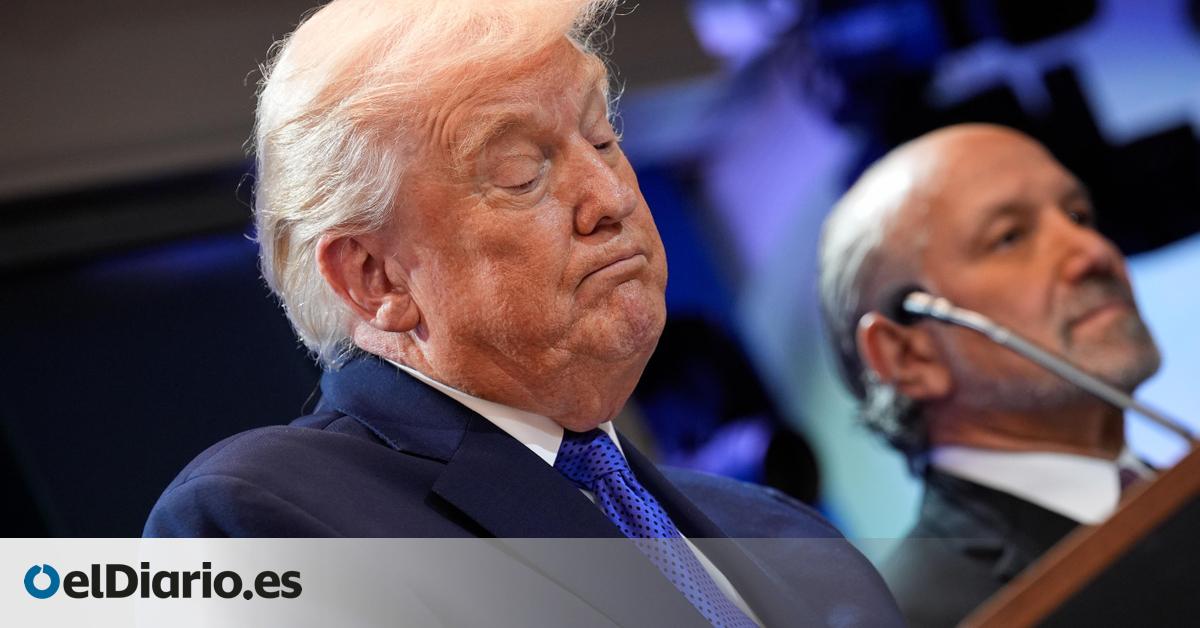
Donald Trump redoubles his push for the Supreme Court. And this Saturday he stated that he was raising the global tariff announced after the court’s setback from 10% to 15%. This is what he said in a post on Truth Social.
“Based on a thorough, detailed and complete review of the ridiculous, poorly worded and extraordinarily un-American tariff decision issued yesterday, after many months of deliberation, by the Supreme Court, I hereby declare that I, as President of the United States of America, will raise, effective immediately, the 10% global tariff on countries, many of which have been ‘ripping off’ the US for decades, without retaliation (until I came along!), to the level of 15%, totally allowed and legally proven,” stated the US president.
“Over the coming months, the Trump Administration will determine and publish new legally permissible tariffs, which will continue our extraordinarily successful process of making America great again,” Trump wrote.
The Supreme Court said this Friday what many people in the US have been saying for months: that the president cannot impose tariffs by invoking the International Emergency Economic Powers Act (IEEPA). Because that law, from 1977, is not designed to impose tariffs, and because there are multiple other mechanisms in the US legal system to tax foreign products and countries.
Of course, the Court has not ruled on the more than $133 billion collected by the Treasury thanks to the import duties that the US president imposed under the emergency powers law, federal data from December show. Many companies, including department store chain Costco, have already gone to court to demand refunds.
Trump has called the ruling “deeply disappointing.” And he has said: “I am ashamed of certain members of the court, I am absolutely ashamed for not having had the courage to do what is right for our country.”
The US president, in response, has announced: “We can use other laws, other tariff authorities, that have been confirmed and are fully authorized. Therefore, effective immediately, all national security tariffs under Section 232 and existing tariffs under Section 301 remain in effect. Today I will sign an order to impose a global tariff under Section 122, in addition to our normal tariffs that already apply. And also “We are launching several investigations under Section 301 and others to protect our country from unfair trade practices by other countries and companies.”
The US president can temporarily apply import taxes of up to 15% for a maximum of 150 days, under section 122 of the Trade Act of 1974.
The tariffs that the Supreme Court declared illegal this Friday are those that Trump imposed invoking the International Emergency Economic Powers Act (IEEPA).
Lower courts had already deemed these tariffs illegal, but they were allowed to remain in place on a precautionary basis while the Trump Administration appealed to the Supreme Court.
The levies included a minimum reference tariff of 10%, with some exceptions; unilateral tariffs, which ranged between 10% and 41%, on products from countries that had not reached trade agreements with the United States; and additional levies on some imports from Mexico, China and Canada that Trump said were justified by the fentanyl crisis in the United States.
The Supreme Court case does not address tariffs imposed on certain categories of products using different legal bases.
For example, the Trump Administration has imposed levies on steel, aluminum, automobiles, copper products, and lumber by taking advantage of Section 232 of the Trade Expansion Act of 1962.
Those tariffs depend on investigations by the Commerce Department, which concluded that imports of such products pose a risk to national security.
What options do Trump have left?
Article 232 of the Trade Expansion Act, 1962 (national security tariffs). Allows “sectoral” tariffs (e.g., steel, aluminum) following a Commerce Department investigation. They are limited to imports considered a threat to national security. They require investigations that can take months.
Article 301, of the Trade Law, 1974 (unfair trade practices). Allows tariffs against countries that the USTR (Office of the US Trade Representative) determines engage in unfair trade practices. Of course, each tariff is limited to a specific country. It requires investigations and consultations with foreign governments, which can take months.
Article 122 (balance of payments) of the 1974 law. Allows tariffs to address balance of payments deficits, including trade deficits. They can only last up to 150 days and are limited to a 15% ad valorem tariff. This is what the US president announced this Friday.
Article 338 of the Tariff Law of 1930 (trade discrimination). Allows tariffs when the president determines that a foreign country discriminates or harms American trade. Generally limited to 50% of the value of the assets. There is a 30-day delay after the presidential proclamation before it comes into effect.
Article 201 of the 1974 law (industrial safeguards). Allows tariffs to address damage to US domestic industries. They can last up to 8 years (4 initial + optional renewal of 4). Limited to 50% ad valorem. After 1 year they should be gradually reduced. They require investigation by the ITC (International Trade Commission).
Reclassify as “license fees.” If they are the same or substantially similar to IEEPA tariffs, you could face further legal challenges.
Congress makes the tariffs law. Congress could sign some or all of Trump’s tariffs into law, but it is not clear that there is a majority in both chambers to do so.
Bilateral trade agreements. Trump could reach agreements with other countries that set certain tariff levels. But agreements could take months or years and the tariffs could still face legal challenges.
Source: www.eldiario.es