The national government experienced moments of concern about the quorum. Not only in case the exchange of suitcases went well, but because the aviation strike threatened the arrival of some parliamentarians. The UTA strike was in the news after a long time of harassment by Roberto Fernández. The trains also stopped, this time it was not a threat. Plaza Constitución was almost empty, with the Dota group buses looking for a passenger to board. In Córdoba there had not been a strike like this for years. The entire Paraná range had the ports closed, the oil mills in silence, the beaches with trucks loaded with pigeons. In the steel and metallurgical plants there were no lines working because thousands of workers wanted a measure for a while that the Secretariat had not called for. The LN+ counter was showing “how much money was lost due to unemployment,” that is, how much wealth the working class had not generated in each passing hour. The Ministry of Security reported that in some distilleries some sheep had not been able to enter, “convinced” in different ways by those who stopped. In Tierra del Fuego people lived with strength, despite the constraints of the “owners of the Island” who forced them to go produce even though they spent their time crying “crisis”.
Millions of workers, who are looking for an alternative to defend their wages and rights, used the tool they had at hand, despite the fact that they detest their lukewarm or outright traitor leaders.
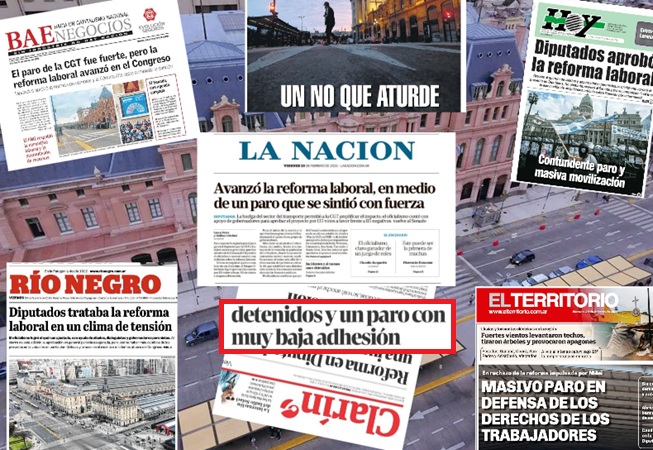
Those empty streets, roads and runways appeared in all the local and national media. Nobody could deny them. Except for a Clarín cover.
“Reform in Deputies: a failed move by the PJ, detainees and a strike with very low support.” He adds a box: “A strike that was little felt.” The argument? That there was commercial activity in different cities. We could lend an argument to Adorni’s scribes, sorry Clarín: more cars were seen than other times.
It has an explanation, in addition to libertarian militancy to show a certain mobility: there are professional sectors, there are monotributist or self-employed sectors, which due to these forms of contracting or because they do not make ends meet can never stop working. Small businesses, platforms, online commerce delivery, SMEs. The problem with this sector is that it cannot stop working, not even when it wants to rest. Clarín traffics it as a political stance or “union” weakness.
An active strike, as the left demanded and did to its extent, could have defeated that narrative. Because it would have guaranteed a morning of total paralysis, with pickets in each company and on the highways, and a forceful mobilization that could shake the law.
The CGT did not want to. His action was in response to the unrest and as an attempt to mitigate the betrayal, not as an action that hits the “reformers” and displays the potential of the reformed.
The problem was not unemployment, as Clarín lies. The problem is the CGT.
The only way to deny these covers is to continue the fight against the war that Milei and the employers declared against us, imposing new strikes on the unions and recovering them for workers’ and popular interests.
Source: www.laizquierdadiario.com