Live broadcast of press conference was interrupted after a question about the war in Gaza. Organization cites “technical problems”, and jurors avoid taking a position on the topic.
Known as one of the most political film festivals, the Berlinale is no stranger to controversy, but the first one this year took place even before the official opening of the event, on Thursday night (12/02).
Still in the morning, during the press conference that introduced the event’s international jury, and which was broadcast live, the signal was interrupted when a journalist asked what the jurors thought of the Berlinale and the German government’s position in relation to Gaza.
Present at the press conference were the festival director, Tricia Tuttle, and the seven people who will select this year’s winners of the Golden and Silver Bears: the president of the jury, Wim Wenders, acclaimed director of Wings of Desire and Perfect Days; Nepali director Min Bahadur; South Korean actor Bae Doona; Indian director Shivendra Singh Dungarpur; American director, screenwriter and producer Reinaldo Marcus Green; Japanese writer-director and producer Hikari; and Polish producer Ewa Puszczynska.
The question about Gaza came from journalist and podcaster Tilo Jung. He cited one of the judges’ previous comments about how cinema has the power to change the world, and highlighted that the festival does not happen in a vacuum.
“The Berlinale, as an institution, has demonstrated solidarity with the people of Iran and Ukraine, but never with Palestine, even today,” Jung noted. “In light of the German government’s support for the genocide in Gaza and its role as the main financier of the Berlinale, you, as members of the jury…”
The live broadcast was interrupted before he could finish questioning: “Do you, as members of the jury, support this selective treatment of human rights?”
Festival denies censorship and talks about “technical problems”
The interruption sparked speculation about whether the festival had tried to censor the theme, which the organizers denied.
“We had technical problems with the internet transmission of the press conference with the international jury this morning,” the Berlinale press office said in a statement, in which it also apologized.
Subsequently, the complete recording of the press conference was made available on the festival website.
Cameras from other stations recorded the responses of some of the jury members | John Macdougall/AFP
“Complicated issue”
“I find it hard to believe that it was just a coincidence,” Jung tells DW. According to him, Berlinale director Tricia Tuttle, who was leading the press conference, initially tried to avoid the topic before some members of the jury reacted tensely, avoiding directly answering the question.
“Asking us about this is a little unfair,” first said Ewa Puszczynska, producer of the film Zone of Interest, which deals with the Holocaust. Acknowledging that she has previously spoken about how cinema “changes the world”, she added: “Of course we try to talk to each viewer, to make them think, but we cannot be responsible for the decision they make – the decision to support Israel or the decision to support Palestine,” Puszczynska pointed out.
“But there are a lot of wars with genocides, and we don’t talk about that,” she continued. “So this is a very complicated issue and I think it’s a little unfair to ask what we think, how we support or don’t support, whether we talk to our governments or not,” he concluded.
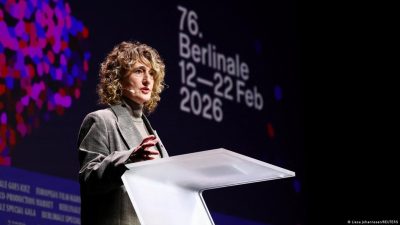 It’s Tricia Tuttle’s second year as director of the Berlinale | Liesa Johannssen/ Reuters
Wim Wenders: “We have to stay out of politics”
Wim Wenders concluded the discussion on the topic. “We have to stay out of politics, because if we make films that are dedicatedly political, we enter the field of politics; but we are the counterweight to politics”, declared the German director.
“Cinema has an incredible power to be supportive and empathetic,” he said. “News is not empathetic. Politics is not empathetic, but movies are. And that is our duty.”
The broadcast was completely off the air during Puszczynska and Wenders’ responses, but other broadcasters recorded the discussion.
In addition to the interruption in transmission, Jung considered the jury’s responses “questionable”. “A big film festival shouldn’t have started like this,” he told DW.
In 2024, Wenders told the dpa news agency on the red carpet that he liked the fact that the Berlinale always takes a stance and that the festival would “continue to do this in the future.” At the time, the filmmaker was reacting to the Berlinale’s decision to cancel the invitation to five politicians from the ultra-right Alternative for Germany (AfD) party to the opening ceremony.
Indian writer withdraws from participating: “shocked and disgusted”
Wim Wenders’ refusal to comment on the war in Gaza generated negative repercussions within the Berlinale.
This Friday (13/02), Indian author Suzanna Arundhati Roy announced that she was leaving the festival because of the German director’s statements. “Hearing these people say that art should not be political leaves anyone speechless,” declared the writer in a statement sent to the press.
“It’s a way to end a conversation about a crime against humanity, even as it unfolds before us in real time – when artists, writers and filmmakers should be doing everything in their power to stop it,” Roy added.
The writer would participate in the festival’s classic exhibition with the film In Which Annie Gives It Those Ones, originally released in 1989.
The author classified what has been happening in Gaza as “genocide of the Palestinian people by the State of Israel”, which is, according to her, “supported and financed by the governments of the United States and Germany” and by other European countries, whom she called “accomplices”.
“If the greatest filmmakers and artists of our time are not able to stand up and say this, they need to know that history will judge them. I am shocked and disgusted,” Roy said. “With deep regret, I must say that I will not be participating in the Berlinale.”
Accusations of anti-Semitism
Over the past two years, several filmmakers have made political statements about the conflict in Gaza, and the Berlin Film Festival has faced criticism from different sides over its handling of the issue.
On the one hand, the Berlinale is seen as reluctant to express solidarity with the Palestinians; on the other, anti-Semitism for opening space for dissenting voices.
Criticism of Israel’s policies by an Israeli filmmaker were among the incidents at the 2024 edition that led to the festival being accused of anti-Semitism.
Yuval Abraham, the Israeli co-director of the documentary No Other Land, which portrays the occupation in the West Bank, began receiving death threats in his home country after his appeal, at the festival’s awards ceremony, for an end to “this apartheid, this inequality”.
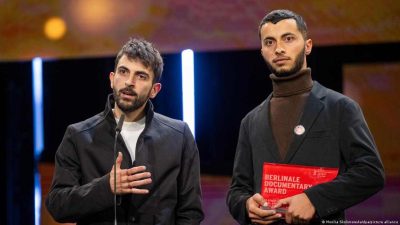 Filmmakers Yuval Abraham and Basel Adra were accused of anti-Semitism for their acceptance speech for the best documentary award at the Berlin Film Festival | Monika Skolimowska/dpa/picture alliance
Ahead of the 2025 edition – Tricia Tuttle’s first year running the event – the festival clarified its position on freedom of expression, including solidarity with Palestinians: “All guests have the right to freedom of expression within the limits of the law. We also defend the right of our filmmakers to speak about the impulses behind their work and their experiences of the world. The Berlinale welcomes different points of view, even if this creates tension or controversy.”
Originally published by DW on 02/13/2026
By Elizabeth Grenier
Collaboration: Fábio Corrêa
Source: https://www.ocafezinho.com/2026/02/14/guerra-em-gaza-gera-constrangimento-na-berlinale/