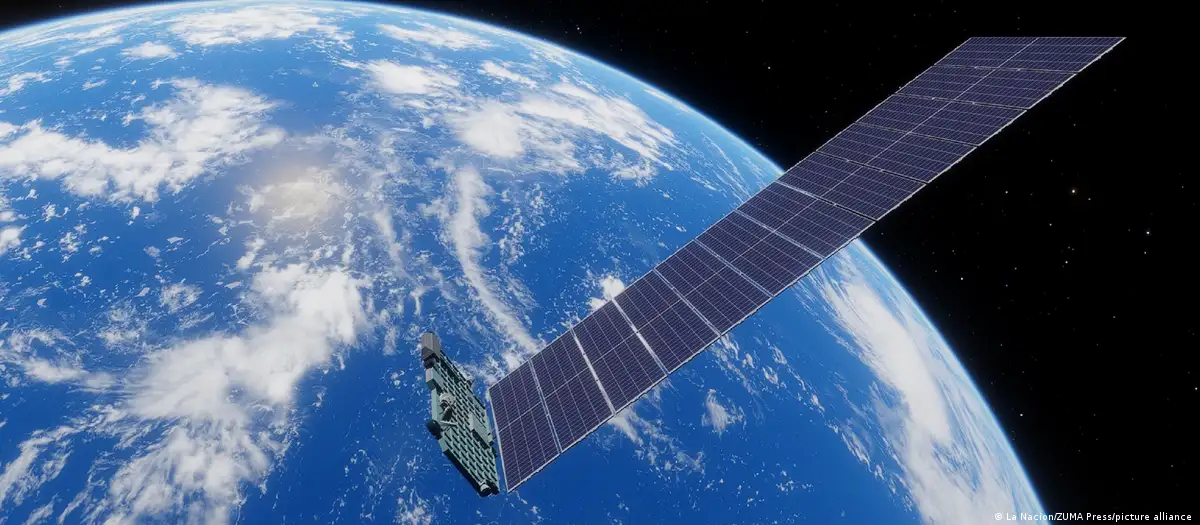
Created to provide internet access even in remote regions, the South African billionaire’s network has become a vital communication tool in war zones and crisis areas. But there are also risks to this.
Whether in the inhospitable deserts of the Sahara or the dense Amazon Rainforest, the immensity of the Pacific Ocean or the Arctic ice sheet, in many parts of the world there is no internet access.
Originally, South African technology billionaire Elon Musk promoted the development of Starlink to solve precisely this problem, bringing high-speed internet to regions of the world where cables or fiber optics cannot reach; or where it is so expensive that it simply isn’t worth it.
Meanwhile, Starlink’s range of applications has expanded considerably. The system began to be used for communication in disaster areas and also by armies or protest movements – for example, in areas where the original internet was destroyed by enemy fire or blocked by dictatorial regimes.
How does Starlink work?
Essentially, it is a satellite internet system with almost 10,000 small satellites orbiting the Earth. They relay data packets between each other via laser beams and do not require a constant, direct line of sight with a ground station that connects the satellite system to the conventional internet.
Unlike other internet satellites, which orbit at an altitude of approximately 36,000 kilometers, Starlink satellites are located only about 550 kilometers above the Earth’s surface. This allows internet signals to be transmitted much faster. Latency is kept so low that it allows even applications that require large amounts of data to operate.
Users only need a small receiving terminal with an electronically controlled antenna that automatically aligns itself with passing satellites. These terminals then forward the received signal to a nearby router, which provides the internet connection within the local network.
Musk promoted the development of Starlink to provide internet to remote areas | Julia Demaree Nikhinson/AP Photo/dpa/picture alliance
Where has Starlink been used?
Ukraine: Since the start of Russia’s war of aggression in February 2022, Starlink has become one of the most important communication tools in the war zone. The military uses Starlink to coordinate units, operate drones and control unmanned ground systems. In the civil sector, the system is used by hospitals, emergency services, energy suppliers and the Ukrainian railway, among others.
It is also alleged that the Russian Army is accessing Starlink using terminals illegally smuggled into the country through intermediary countries. Ukraine’s Ministry of Defense said it works closely with the operator, SpaceX, to restrict this use as much as possible.
Sudan: In the Sudanese civil war, Starlink is mainly used by the Rapid Support Forces (RSF), a paramilitary group that fights against the state army. Hundreds of devices were smuggled into the country through the United Arab Emirates, and a veritable black market for Starlink terminals was established. The RSF uses these devices for communication and coordination among its militias, while the Sudanese Armed Forces (SAF) attempts to block their importation and use.
Iran: Earlier this year, nationwide protests broke out against the regime in Tehran, which responded by, among other things, shutting down the internet. However, reports indicate that thousands of terminals were smuggled into the country and resold on the illegal market. This allowed protesters to use Starlink to coordinate their actions against the regime, despite state censorship of the internet.
Venezuela: Starlink has also been used in the past to bypass information restrictions and guarantee free internet access. For a long time, the service was only available unofficially, through the purchase of kits in local stores. After the US intervention and the capture of Nicolás Maduro, Elon Musk temporarily offered free internet access to the country’s citizens.
 The user only needs a receiving terminal with an antenna, which forwards the signal to a nearby router | Middle East Images/picture alliance
Gaza Strip: Since July 2024, Starlink has been used for humanitarian purposes in a largely destroyed Gaza Strip. Humanitarian aid organizations and a field hospital can use it to provide telemedicine assistance and logistics coordination. However, widespread access for civilians remains limited, in part due to security concerns on Israel’s part.
What are the criticisms of Starlink?
Starlink is often the only internet connection in conflict zones. This gives Elon Musk enormous influence. In some cases, the communication of entire armed forces or humanitarian organizations depends on your company, SpaceX. For example, Musk previously refused to activate service for Ukraine during an attack near Crimea. US President Donald Trump also threatened Ukraine with satellite shutdowns to force Kiev to make concessions in negotiations.
There are also criticisms from an ecological point of view. Starlink satellites are mass-produced and have a lifespan of only about five years. On average, one or two of Musk’s satellites disintegrate in the Earth’s atmosphere every day; The aluminum oxide released in this process can affect the ozone layer and contribute to global warming. Additionally, the numerous satellites reflect sunlight, making the night sky brighter, which can also have an impact on wildlife.
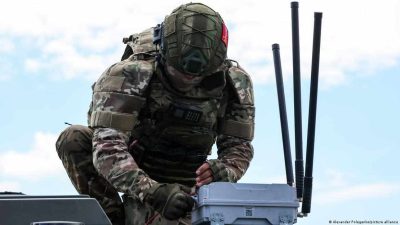 Vital tool in conflicts: Ukrainian soldier with Starlink receiver | Alexander Polegenko/ picture alliance
Who is working on alternatives?
Despite all the concerns, alternatives are already being developed, mainly in Europe, to break Starlink’s monopoly.
SpaceX’s biggest private competitor is currently Eutelsat. However, its satellite service, OneWeb, with a fleet of over 600 satellites, is significantly smaller. Additionally, the service focuses on corporate customers and marine applications. Eutelsat is also involved in the development of IRIS², an ambitious European Union high-security satellite network. This network aims to make Europe less dependent on Starlink. However, it will not be operational before 2029.
Elon Musk also faces competition in the US, particularly from fellow billionaire Jeff Bezos. Bezos’ company, Amazon, is working hard on its Amazon Leo service: building a network of more than 3,000 new satellites in low Earth orbit. Amazon plans to debut its service commercially later this year – including in Brazil, thanks to a partnership with Sky.
The skies are about to get more congested, especially as China is developing two satellite communications systems of its own. The state-owned Guowang project is aimed mainly at national and military use and envisages the inclusion of up to 13,000 satellites, while the Qianfan project, with approximately 12,000 satellites, has a more commercial orientation and is intended to serve emerging and developing countries. The first mass releases for both projects are also scheduled for this year.
Originally published by DW
By Thomas Latschan
Source: https://www.ocafezinho.com/2026/02/16/starlink-como-empresa-de-musk-influencia-geopolitica-global/