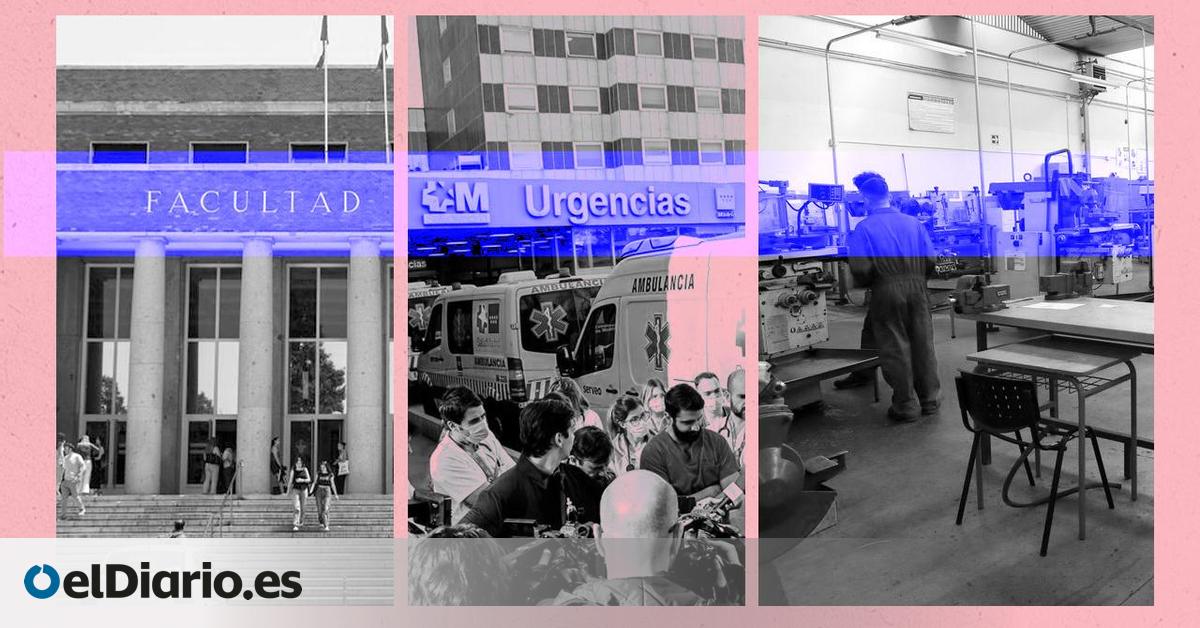
First was university. This week it was Health’s turn. In two months it will be the turn of Vocational Training (FP). After seven years in Moncloa, the Government of Pedro Sánchez has embarked on an offensive against the growing privatization of the basic pillars of the welfare state, a measure that the left had been demanding for some time, always with an eye on the Community of Madrid. In all three cases, Moncloa has encountered resistance from the PP, which fights every measure in favor of the public on all fronts, from the political to the judicial.
These measures are part of the ideological battle against the ultraliberal right that Sánchez began months ago and that Isabel Díaz Ayuso fundamentally represents in the Community of Madrid. To each suit of the regional government to rights or public services, the Council of Ministers has tried to respond with measures. For example, it occurred when the Madrid PP succumbed to a Vox proposal to torpedo the right to abortion by forcing municipal services to report a false post-abortion syndrome. The Executive counterattacked with measures to protect abortion in the Constitution and to force communities to comply with the law by sending the registry of conscientious objectors.
In Moncloa they are convinced that the message will end up reaching the citizens, although in the last two electoral tests, in Aragón and Extremadura, the strategy has not worked and the right has soared while the socialists have collapsed. The Government’s intention is, in any case, to continue fighting ideologically, despite the complexity of some initiatives ending up seeing the light given the parliamentary minority of the coalition. One of the problems is that two right-wing forces have to fit into the arithmetic, such as PNV and Junts, which has also broken with Sánchez until a series of demands are met. The other is that the PP has already made it clear that it will be a dam in defense of privatization, through parliamentary initiatives and appeals in the courts.
What they maintain in the Government is that the extreme right is stopped, in addition to not being whitewashed, with policies. “This is what the Government is doing: more politics in the face of the attempt to advance anti-politics,” said the spokesperson, Elma Saiz, at the press conference of the last Council of Ministers, where measures were approved such as the fight against health privatization, fines for ‘telephone spam’ by energy companies or the prohibition of exaggerated price increases in cases of emergency.
Beyond the words, the importance that the Government gives to these initiatives can be gauged in the fact that, in the case of those that concern the ministries led by the PSOE, it has been the president himself who has come out to present them instead of the respective ministers, a move that Moncloa makes when it wants an announcement to have more effect. Everything the president does is featured prominently in the media; If the announcement is made by Diana Morant or Milagros Tolón, it will probably not occupy the covers or summaries of the news.
“They present privatization as the only way out”
In one of those events, almost a year ago, Pedro Sánchez explained how the method works that – mainly the different governments of the PP, the national one at the time and the regional ones now – have put in place to undermine the public and promote the private: “First they cut resources to undermine its operation and, later, its service and quality are questioned, precisely affected by the resources that are withdrawn. Finally, when the deterioration is evident, they present privatization as the only way out,” Sánchez reasoned then.
The step has been welcomed by the educational community (only the PP and some private centers have opposed the tightening of the requirements to create new universities), although many think that they do not go far enough. “They are necessary measures, but insufficient,” says Enrique Díez, professor at the Faculty of Education at the University of León. This expert explains that in recent years public universities have been “led to a process of permanent competition through rankingssearch for financing, student recruitment… A model that leads to the commercialization of higher education,” he maintains.
In Díez’s opinion, “we must move towards the successive suppression of the private in common goods, in social rights. There cannot be benefit, profit motive and usury, as happens in the case of Quirón. In that case it is very obvious because it is health, but exactly the same thing happens with education,” he maintains.
Díez concedes that the framework has been shifting so much that just raising this sounds radical, but he is convinced that it is a matter of “political will.” “Shortly after the Inquisition, two people decided that they were going to confiscate all the assets of the church,” he recalls in reference to the confiscations of Mendizábal and Madoz in the 19th century. “It was said that it was impossible, but at a time when the Church had immense power, it was done. It is political will,” he insists. “But, of course, after the motion of censure, the first thing that the groups that supported Sánchez signed in parliament was to repeal the gag law, some [como Sumar] They asked to repeal the agreements with the Vatican. But nothing was done”, exposes that, in his opinion, lack of ambition.
Same argument, word for word.
In education, privatization is progressing well. The stagnation of public offerings in both vocational training and universities, together with the increase in demand for training in the face of an ultra-competitive labor market, have led to the arrival of all types of actors, with investment funds at the forefront, to occupy the space that the public sector has left free. Universities are bought and sold with a 100% profit, companies register profits that are around 10%, figures that are difficult to achieve in other sectors, and the customers seems guaranteed and, in some cases, growing: Spain is the gateway to Europe for all of Latin America.
The Government’s resistance began with the university last October, when Congress approved the reform of royal decree 640/2021, for the creation, recognition and authorization of universities and university centers. Diana Morant’s Ministry of Universities tightened the conditions for opening new centers after verifying, based on experience, that the previous modification, made by former minister Manuel Castells, had not had the desired effect: by leaving the decision to approve or not a project completely in the hands of the autonomous communities, they could give the go-ahead even if it did not meet the requirements. And so they did: in recent years at least three universities have been approved with unfavorable reports from the Ministry.
“A university cannot be a vending machine (…) a factory of degrees without guarantees,” argued the president when he presented the second update of the Royal Decree. That day he talked about “chiringuitos”. “We have to choose between a universal, quality higher education model that gives opportunities to those who need them and that unites the territory, or a model that discriminates between those who can pay and those who cannot,” he explained.
Since last October, to open private universities it is necessary for an independent quality agency (national or regional) to approve the project, beyond the fact that it must meet a series of requirements to obtain a university license.
The (attempt) to strengthen the public educational system now wants to be complemented with FP, another sector in which privatization has skyrocketed in recent years. In some popular cycles, such as biomedical or computer science, more people are enrolling in private centers than in public ones, basically because these do not exist.
The president announced two weeks ago that he wants to continue the path started with the university and that he is going to “put limits on the opening of private centers that do not offer guarantees” and that, he stated, “have become beach bars that only give diplomas” without quality training. Almost word for word with the argument used for the university a year ago. In this case, however, Sánchez did not anticipate where the reform of a process is going to go that, at this moment, barely asks the private initiative to adjust to certain requirements for facilities and teaching staff. As is the case with the university, the powers to authorize centers are held exclusively by the autonomous communities.
“The speculative claws” of Health
The Health plan follows the same line. It is not about reversing what has already been privatized, but rather about at least establishing some limits and control mechanisms to a model established 30 years ago by the Government of José María Aznar and which has resulted in large private healthcare groups doing business at the expense of insufficient public resources.
That law, from 1997, established that the autonomous communities could rely on the private sector in two aspects: outsourcing the management of public hospital centers in exchange for an annual fee and subcontracting services and treatments from public to private healthcare. The result, three decades later, is a public network increasingly in private hands, and companies that make cash with the budgets of regional administrations.
A couple of months ago, the Ministry of Health laid the foundations to justify the measure they have now taken. They presented a devastating report in which they pointed out that between 2011 and 2023, public spending on private healthcare had skyrocketed by 84%, as a result of the fact that currently one in three hospitals in the public network is managed by a company.
Health is like education, it always has customers. But in the case of Healthcare there are many costs that can reduce profits, so companies have been finding ways to boost their profitability. For example, as the report points out, rejecting the most expensive clinical procedures, which end up being assumed by the public system. But there are more extreme cases: the Torrejón Hospital demonstrated that practices to improve the bottom line went to the extreme of rejecting patients based on their severity, orders were given to reuse single-use material, some treatments were dispensed with, or waiting lists were shortened by changing the triage of patients.
The draft Law on Public Management and Integrity of the National Health System (SNS), approved last Tuesday and which has a long way to go until it is debated in Congress, does not go into reversing these privatizations. But it does raise requirements for the new ones, such as justifications for outsourcing hospital management, audits of accounts or the obligation to prioritize non-profit entities over companies. “We are going to protect the National Health System from the clutches of profiteering and privatization,” summarized the Minister of Health, Mónica García.
Of course, for this to end up happening, the text has to be approved in an enormously fragmented Congress, and with a majority that involves adding some parties that, far from having problems with health privatization, have promoted it in their territories.
Source: www.eldiario.es