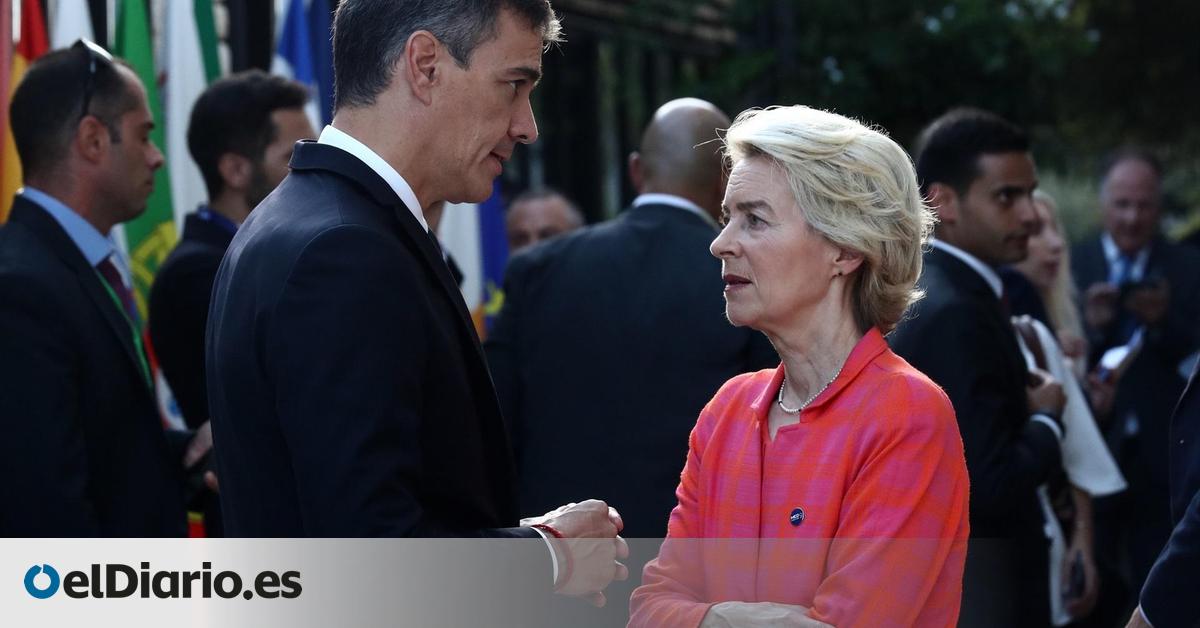
Spain is the country among the major economies that has grown the most in 2025. If our country increased its GDP by 2.8% last year, Germany stagnated at 0.2%, France climbed to 0.7% and Italy remained at 0.5%. With this starting point, this Thursday, the European leaders of the 27 EU member states meet at Alden Biesen Castle to discuss the path to increasing European competitiveness in a new scenario full of challenges in the face of Donald Trump’s belligerent trade policy with his former allies and China’s unfair competitive strategy. The President of the Government, Pedro Sánchez, will defend at this summit relevant aspects such as promoting Europe at two speeds, given the need to carry out short-term reforms, and the ‘European preference’, with the aim of making it easier for European companies to access subsidies and public tenders than companies from other economic blocs.
Sources from Moncloa have highlighted that the Government of Spain is going to support “Europe at two speeds”, since it points out that the integration of markets is “key in the current context”. “A few weeks ago the president raised the need to advance European integration in the field of security and defense, even if it is not with the unanimous agreement of the 27 member states; at different speeds,” explain government sources.
“Real progress in market integration”
The new geopolitical horizon leads the European Union to accelerate its integration at any cost. The EU is going to take steps to advance at two speeds in the face of global challenges. In fact, the president of the European Commission, Ursula Von der Leyen, already sent a letter to the member states in which she asked to advance in the integration of the EU and approve economic measures without the unanimity of the bloc of the 27 member countries.
It is a position that Von der Leyen wants to bring to fruition within a year. In a speech this Wednesday in the European Parliament he stressed: “Let’s do it this year. Plan A is to move forward with the 27 Member States. But if this is not possible, the Treaty allows for enhanced cooperation. We have to move forward and break down the barriers that prevent us from being a true global giant.” Enhanced cooperation is a mechanism approved in the Treaty of Lisbon that allows the EU to overcome country vetoes on matters related to European integration.
The president of the European Commission has emphasized achieving “real progress in the integration” of financial markets in a savings and investment Union; implement a true Energy Union and greater integration of the electricity market to lower prices and ensure non-polluting energy supply. Von der Leyen also wants to develop the single legal framework, known as Regime 28, which will allow companies to operate under the same rules throughout the Union, being able to register online in just 48 hours.
Spain already positioned itself with the group of the largest EU countries (Germany, France, Italy, the Netherlands and Poland) last week in a meeting to “generate political momentum to reinforce the competitiveness and strategic autonomy of the European Union in the face of a changing geopolitical landscape.” These countries identified as a priority “advancing the Savings and Investment Union, strengthening the international role of the euro, improving the efficiency of defense spending, deepening the integration of the single market and strengthening the resilience of the supply chains of critical minerals.” De facto they were creating the group of countries that wants to advance faster in EU integration, although there are always national markets that some large countries intend to defend.
‘European preference’
Regarding ‘made in Europe’, Moncloa emphasizes that Spain defends “the idea of ’European preference’ and that of ‘lead markets’, the creation of driving markets that boost the industrial capacity of the EU, including low-carbon steel that is made in Spain.” In this sense, sources from Pedro Sánchez’s Executive add that they will also support “the establishment of conditions for productive foreign investment in key sectors to guarantee quality employment, integration into local value chains and transfer of knowledge and technology.”
The Vice President and European Commissioner for the Internal Market, Stéphane Séjourné, is in charge of bringing to fruition the Industrial Acceleration Law, where the ‘European preference’ would be developed. Séjourné argues that “every time European public money is used, it must contribute to European production and employment. Whether it is a public contract, state aid or any other form of financial support, the beneficiary company must produce a substantial part of its production on European soil.”
It is a debate that does not convince everyone in the EU: a group of nine countries (Czechia, Slovakia, Estonia, Finland, Ireland, Latvia, Malta, Portugal and Sweden) have doubts about its efficiency and demand that “the ‘European preference’ criterion should only be used when other instruments have been carefully analyzed and proven to be insufficient.” These smaller states are afraid that this regulation will benefit large European corporations from the four largest economies in the EU over their smaller companies, which need to buy cheaper Chinese or Korean components in order to compete. To overcome obstacles, Von der Leyen intends for the ‘European preference’ to only apply to a restricted group of products, as Germany defends.
Eurobond Issuance
Like France, Spain will support the proposal regarding the issuance of joint European debt to invest in strategic sectors. Sánchez has defended on several occasions the issuance of Eurobonds “as a tool that drives public investment towards strategic objectives of the EU and also that enhances a great European asset such as the euro.” Although the topic will come up at the summit, it is not on the agenda of discussion topics. Furthermore, it finds Germany as a clear opponent of the Eurobond proposal.
The Chancellor of Germany, Friedrich Merz, and the Prime Minister of Italy, Georgia Meloni, have formed a tandem this time, breaking the traditional couple of economic interests between France and Germany. In this case, Merz and Meloni rule out joint European debt and prefer the creation of a pan-European stock exchange in addition to increasing financing via venture capital.
Germany and Italy are also going to position themselves jointly in favor of deregulation and simplification of regulations that affect companies and economic sectors. Although regarding this proposal, Spain will insist on “the social dimension of the internal market”, so that it can “guarantee that the EU is competitive” but with the reinforcement of “social policies in training, recycling of human capital as well as continuing to work to attract foreign talent in a context of reduction or aging of our population.” Moncloa adds that “the recent EU agreement with India to facilitate the arrival of professionals and researchers is an example of how to move forward.” Spain will use as an example the Talent Partnerships that it promotes bilaterally and “defends that they be scaled up at the community level.”
This Wednesday, Italy and Germany coordinated a meeting prior to the summit on Thursday to agree on common positions on competitiveness, in which fifteen leaders of European countries, including France, will participate, although their position diverges in some aspects from the organizers of this previous meeting. Spain will not participate in the meeting organized by both countries. Moncloa sources have not explained the reasons for Pedro Sánchez’s absence from the meeting organized by Italy and Germany.
Source: www.eldiario.es