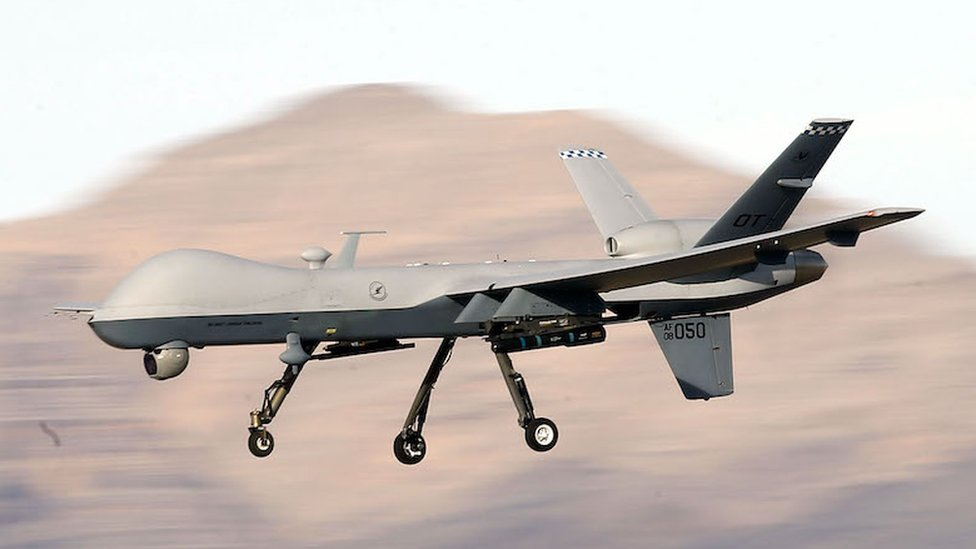
Brussels reacts to the war and changes drone policy
Imagine a drone flying over a nuclear power plant. Or silently crossing the airspace of a European capital. Now imagine that your navigation system carries a tampered chip, programmed to fail at the exact moment a cyber attack hits critical infrastructure. This scenario does not belong in a fiction film. It represents the nightmare that Brussels is trying to avoid with a bold new strategy. Next week, the European Union is expected to unveil a plan that puts “reliable semiconductors” at the heart of civil and military air security. The proposal goes far beyond technology: it is about regaining autonomy in a world where each integrated circuit can hide a geopolitical trap.
The pressure for this change came abruptly. Last September, NATO fighter jets shot down 19 Russian drones that invaded Polish airspace. It was a historic milestone. For the first time since 2022, an alliance country had to use lethal force against aerial threats on its own territory. This episode raised a red alert in Brussels. However, the problem is not limited to eastern borders. European authorities realized that dependence on poorly auditable electronic components creates a systemic vulnerability. Therefore, the answer cannot just be military. It needs to be industrial, regulatory and deeply human.
When technology becomes a weapon of hybrid warfare
Drones have become versatile tools of modern warfare. They deliver medical supplies to remote areas, monitor agricultural crops and inspect transmission lines. However, these same machines can transport explosives or disable electrical networks with coordinated attacks. The line between peaceful and military use has become blurred. Therefore, the EU understands that security starts at the source: in the chips that control each movement of these devices.
The new strategy requires semiconductors designed to resist both physical tampering and digital intrusions. This means creating technical barriers against anyone trying to insert secret doors into the circuits. Furthermore, the measure seeks to break with the neoliberal logic that handed over the production of critical components to a few countries. Europe wants to recover its own manufacturing capacity. Thus, each European drone will carry not just technology, but sovereignty.
Many citizens are unaware that their cell phones, cars and even refrigerators depend on chips produced in distant regions. This dependence is not neutral. It represents a silent transfer of decision-making power. When an economic bloc does not control its own technological base, it loses autonomy to protect its citizens. The new European policy clearly recognizes this.
Therefore, investing in secure chips is directly linked to the protection of hospitals, schools and drinking water networks. Imagine an attack that simultaneously disables control systems in several cities. Without auditable components, the response would be slow and chaotic. However, with rigorous safety standards from the manufacturing stage, collective resilience increases significantly. Regulation, in this case, is not bureaucracy. She is a social shield.
The European strategy intelligently combines national security and social justice. By stimulating local production of advanced semiconductors, the bloc creates opportunities for qualified engineers, technicians and workers. These jobs don’t just strengthen the economy. They weave a network of knowledge that makes Europe less vulnerable to external blackmail.
Furthermore, the initiative dialogues with the ecological transition. Modern chip factories can operate on renewable energy and strict environmental standards. In this way, technological sovereignty goes hand in hand with sustainability. This is not about technological isolationism. It is about building balanced partnerships, where Europe comes to the negotiating table with its own production capacity.
Cooperation with Kiev emerges as a central element of the plan. Last year, the European Commission proposed the creation of a “anti-drone barrier”but faced internal resistance. Still, the bloc demonstrated practical solidarity by bringing forward €6 billion of a G7 loan to support Ukraine’s defense. Now, the new strategy transforms intentions into concrete actions.
By the European summer, Brussels will convene an industrial forum to expand joint production of drones. In parallel, an anti-drone research center will begin operating in 2027. This partnership does not only benefit Ukraine. It allows European engineers to learn from those who face aerial threats every day. The exchange of knowledge strengthens both sides. Therefore, international solidarity also reveals itself as a strategy of collective intelligence.
The EU plans to create rapid response teams by autumn. These units will act in an integrated manner between member countries, reducing reaction time to incidents. Additionally, annual exercises will test civil and military air defense protocols. The logic is simple: transnational threats require collective responses.
However, success depends on human coordination. Therefore, each country will appoint national drone safety coordinators. These professionals will ensure that local policies are in line with the common strategy. The United Kingdom and Norway will also be able to participate, expanding the regional protection network. In this scenario, cooperation replaces individualism as the guiding principle.
The European bet on reliable chips represents more than a technical measure. It signals a return to the idea that technology should serve people, not obscure interests. When ordinary citizens trust that the systems that protect their cities are transparent and auditable, democracy gains material substance.
Of course, the road will be long. Asia currently dominates the production of advanced semiconductors. Breaking this dependency will require massive investments and strategic patience. However, the alternative is worse: remaining vulnerable to blackmail and silent attacks. Europe therefore chose to build its own future. And in that future, every chip will carry not just binary code, but a commitment to security that protects real lives, not just abstract geopolitical interests.
With information from Bloomberg and Investing*
Source: https://www.ocafezinho.com/2026/02/07/europa-busca-a-soberania-dos-ceus/