Madrid has a unique health system. In it, publicly managed hospitals coexist with five privately managed hospitals (four in the hands of Quirón and one, from Ribera Salud). In addition, they compete among themselves for patients, since Esperanza Aguirre approved a law that allowed free choice, so that each patient can decide which center they are treated at, whether or not it is their turn by area. These patients are the most profitable for companies, which implement strategies to attract them. Precisely, the Ministry of Health has just announced this Tuesday a law to put a stop to health privatization, which has increased exponentially in Madrid, especially since Isabel Díaz Ayuso governs.
The uniqueness of Madrid has a cumbersome consequence from an economic and financial point of view in the so-called ‘inter-centre balances’. It is the final balance of free-choice patients who left their hospital to go to another and those who arrived. Publicly managed and privately managed hospitals have to account in a computer system for the patients they take in from outside their area and the cost of their treatments to bill the hospital of origin. For example, if a woman who is responsible for giving birth in La Paz (public) prefers to go to the Jiménez Díaz Foundation (concerted by Quirón), the public system will have to pay Quirón for that birth. The same thing happens in reverse. On a monthly and annual basis, all these cases are entered into the system and the costs are accounted for.
The balance adds and subtracts cases and shows a final balance in favor of the public or in favor of the concessionaire companies (which is what always happens, since they are the ones that absorb the majority of patients from the public). From 2018 to 2023, the Community of Madrid disbursed an extra 1,268 million for that final balance, money that has gone to the two companies that manage the five privately managed public hospitals in the Community, four of them from Quirón (Rey Juan Carlos de Móstoles, Villalba, Jiménez Díaz and Infanta Elena de Valdemoro) plus that of Torrejón, from Ribera Salud. This money is an extra outlay for the free-choice patients they serve, which is added to the fixed fee they charge annually for each inhabitant of their area.
The privatized hospitals of Quirón and Ribera, the most benefited by the system in 2024
Net balance between incoming and outgoing appointments of the free choice system of the Community of Madrid in each hospital in 2024. In yellow, highlighted privately run hospitals by Quirón and Ribera Salud
Source: Community of Madrid
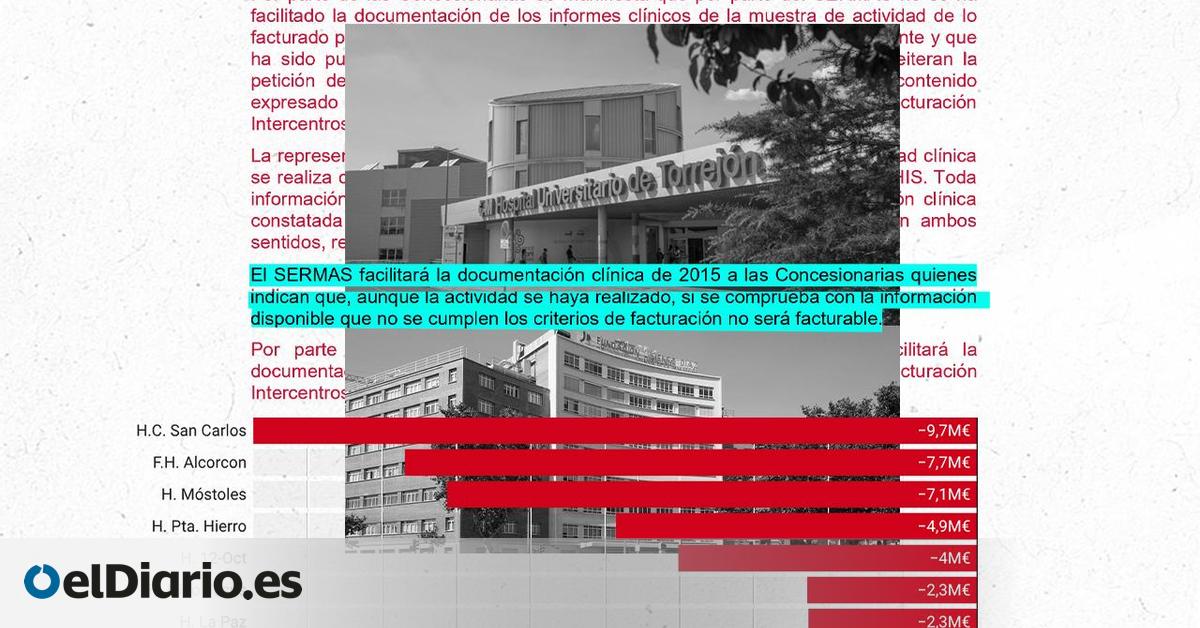
But the success in collecting payments from these foreign patients is not the same in both directions. An internal document from the Ayuso Government to which elDiario.es has had access puts figures on the “economic impact” that not having charged Quirón and Ribera Salud for hundreds of treatments has had on Madrid’s public health system. Between 2017 and 2023, a total of 71,653,032 euros in costs for treatment of patients who arrived at public hospitals from one of the five contracted hospitals were no longer recorded in the balance system. The reason: “Not finding documentation of clinical activity,” says the internal report. That is, the system does not find sufficient data on the patient or their treatment to be able to bill according to the regulations. This “economic impact” was more than 11 million euros in 2023 alone, the latest data available in this document prepared within the Ministry of Health.
Asked about this loss, sources from the Ministry consider it not adjusted – despite the fact that it is verified by its own economic control service – but do not give an alternative figure: “It does not take into account that the information that justifies the activity carried out can be obtained by different procedures.”
How is it possible that the public system cannot find patient documentation? The answer is in the Intercenter Billing Manual, which is the standard shared by the Madrid Health Service and companies to register services and then be able to calculate a final balance for free-choice patients.
In that manual, to which elDiario.es has had access, the Ayuso Health Department orders with which programs and information systems the information must be collected for the note to be valid. That same document warns that in public hospital centers there are their own “information subsystems” and “codes (…) pending standardization,” which “has prevented the automatic capture of certain lines of activity.” That is, not all public hospitals manage data in a standard and centralized manner, which would explain that there are treatments that cannot be billed to Quirón and Ribera Salud because there is no precise data required by that manual. According to the data managed by the Ministry of Health, those 71 million euros have been lost in treatments for patients who changed from the concerted to the public treatment.
When the ‘intercenter balance sheets’ are made, on a monthly and annual basis, private groups are very attentive to the amounts that public health wants to endorse on them. If there are errors (serious or simply formal) or missing data, they do not give approval. “In the private sector, the financial departments do not miss a bill, because their survival depends on it and they invest in personnel and computer programs,” says one manager. “The managers designed a bad system and have no interest in this improving. In the case of Madrid, it is not even the hospital that receives the money for treating a patient from Quirón or Ribera, but rather the central services of Sermas (the Madrid Health Service), so the incentives are lower,” agrees José Manuel Freire, emeritus professor at the National School of Health and former Health Minister of the Basque Country.
In the regular meetings between the Madrid Health Service and the concessionaires – periodic commissions in which conflicts are resolved whose content stopped being posted online in 2021 – it is also observed how the private companies fight with Health over the invoices. In the one from July 2019 you can read: “The concessionaires indicate that, although the activity has been carried out, if it is verified with the available information that the billing criteria are not met, it will not be billable,” notes the secretary of that year’s meeting. That is, if Health does not meet the billing criteria, they will not pay you.
A 2018 audit of the Villalba Hospital (managed by Quirón) posted on the web also shows how the economic control of the free-choice system works and how public collection is hindered. On the one hand, the Community of Madrid reviews the expenses for treatments presented to it by private groups, but not all, but with a sample. In the opposite direction, the private company reviews whether the treatments presented to it by the Community for patients assigned to Villalba, but who went to the public company, fully fit, including whether the data is accurate or missing. In the case of Villalba, what was billed by public health to this hospital does not have complete approval from Quirón. The reason: “The lack of reports that meet the criteria of the Intercenter Billing Manual, since the existence of the corresponding record in the patient’s medical history as detailed in said manual is an essential condition.” That is, if data is missing or not obtained as that manual indicates, the invoice is discarded and public health does not charge for the treatment that has been performed.
The Community of Madrid insists that Sermas carries out audits “not observing inefficiency” and remembers that the ‘inter-center balance’ is adjusted 100% in favor of directly managed hospitals and 90% in favor of indirectly managed ones and according to the current price order. They have not responded specifically to how much money has been left uncollected due to failures in the data collection system evidenced by their team in this document to which elDiario.es has had access or the collection problems that are also reflected in the minutes.
The Torrejón hospital (from Ribera Salud) and the Quirón hospital group have not responded to elDiario.es’ questions.
You can send us documentation or confidential data to the editorial office by email: [email protected]
Source: www.eldiario.es