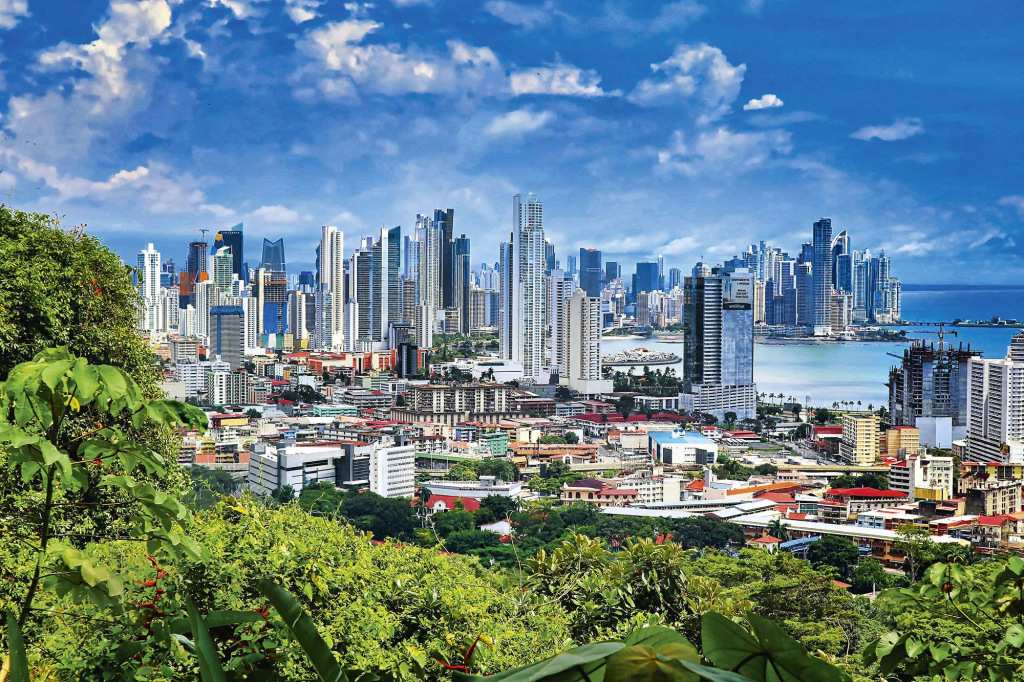
Dispute between the United States and China puts the Panama Canal in the spotlight again
The Panama Canal has once again occupied the center of international attention. A controversial court decision turned two port terminals into the scene of an open dispute between Washington and Beijing. The Panamanian Supreme Court’s verdict annulled the license of a company linked to Hong Kong and paved the way for the United States to celebrate a strategic victory on its own doorstep.
Panama’s top court has revoked CK Hutchison subsidiary’s concession to operate two crucial terminals on the waterway. Around 40% of the containers that the United States receives or sends pass through there every year. The White House considers the canal a strategic chokepoint and has long pushed to reduce Chinese presence in the region.
The sentence fell like a bombshell in Beijing. The Hong Kong and Macau Affairs Office of the Chinese State Council spared no criticism. He classified the decision as “logically flawed” and “completely ridiculous”. He then warned that Panama “will inevitably pay a high price, both politically and economically”, if it maintains its current course.
China reacts with harsh warnings
Beijing did not stop at rhetoric. On Thursday, Chinese authorities ordered state-owned companies to suspend negotiations on new projects in the Central American country. In addition, they asked maritime carriers to evaluate redirecting cargo to other ports. Reports indicate that Chinese customs plans to intensify inspections of Panamanian products, especially bananas and coffee.
However, analysts believe that these measures are still more symbolic than decisive. Jack Lee of China Macro Group explains that the Chinese response will likely be calculated. The goal, he said, is to signal disapproval without forcing an immediate reversal of Panamanian policy.
Panamanian president defends sovereignty
José Raúl Mulino was not intimidated. The Panamanian president rejected Chinese threats and reaffirmed that the country is a “country of law” that respects the decisions of its superior court. He wrote on social media that judicial decisions are independent of the central government and that Panama firmly rejects any external interference.
CK Hutchison, in turn, did not sit idly by. The company reported that it resorted to international arbitration and that it “strongly disagrees with the decision [do tribunal]The case is expected to drag on for years in different jurisdictions.
Analysts predict long battle
Scott Kennedy, senior advisor at the Center for Strategic and International Studies, sums up the picture clearly. For him, it is “a simple dispute for hegemony in Latin America”. Kennedy foresees “a protracted court battle across multiple jurisdictions, along with substantial political and economic pressure imposed by both Beijing and Washington.”
Context of deterioration in bilateral relations
Relations between the two superpowers were already fragile. Last year, Donald Trump imposed heavy tariffs on Chinese products. Beijing responded by tightening controls on rare earth exports. Tensions in Taiwan, Chinese support for Russia in Ukraine and American military actions elsewhere on the planet have only worsened the situation.
In March of the previous year, CK Hutchison had reached a US$23 billion deal to sell port assets outside of China. Beijing harshly criticized the operation and tried to rewrite it, including suggesting the entry of state-owned Cosco into the purchasing consortium. The episode exposed China’s difficulty in protecting economic interests when Washington decides to act with force.
China expands maritime influence in Latin America
Meanwhile, Beijing continues to invest heavily in the region. The Port of Chancay, in Peru, majority-controlled by Cosco, promises to cut maritime transport time between Asia and South America in half. Analysts at the Foundation for the Defense of Democracies, in Washington, warn that China controls more than 100 overseas ports on all continents (except Antarctica), manufactures 95% of maritime containers and 70% of port cranes, in addition to dominating almost two-thirds of global construction orders naval to 2025.
Any further advances in this maritime domain, according to the think tank, could create the same dependence for the United States and its allies that they face today in relation to critical minerals and rare earths.
UN Secretary General defends multipolarity
Faced with this confrontational scenario, António Guterres’ voice sounded different. The Secretary-General of the United Nations openly criticized the logic of two rival poles. At a press conference on January 29, he declared:
“We see — and many see in relation to the future — the idea that there are two poles, one centered on the US and the other centered on China. If we want a stable world, if we want a world in which peace can be sustained, in which development can be widespread and in which, in the end, our values prevail, we need to support multipolarity.”
Guterres recalled that global problems cannot be resolved when a single power dictates the rules. His message resonates with many countries in the Global South who prefer not to choose sides in a new Cold War.
The Panama Canal, therefore, is not just a trade route. He has become a symbol of a world that resists the idea that the future will be defined only by Washington or Beijing. While judges, diplomats and executives prepare for long battles, the planet is witnessing another chapter in a dispute that, unfortunately, seems far from over.
With information from CNBC*
Source: https://www.ocafezinho.com/2026/02/08/uma-decisao-no-panama-reacende-a-disputa-entre-eua-e-china/