With record levels of job insecurity and informality, low salaries, attacks on union organization, Jujuy shows a preview of what Milei’s slave labor reform aims to deepen with the complicity of governors like Sadir that, in fact, they apply the reform in the State and support that companies like Ledesma or Industrias Zapla do the same.
In this article we will try to graph, based on the study of the data of the 2022 Census, which allows us to estimate the life and work situation of women in the province. Particularly, we will focus on elements of the current situation and an approach to the consequences of the labor reform project for the education and health sectorshighly feminized activities.
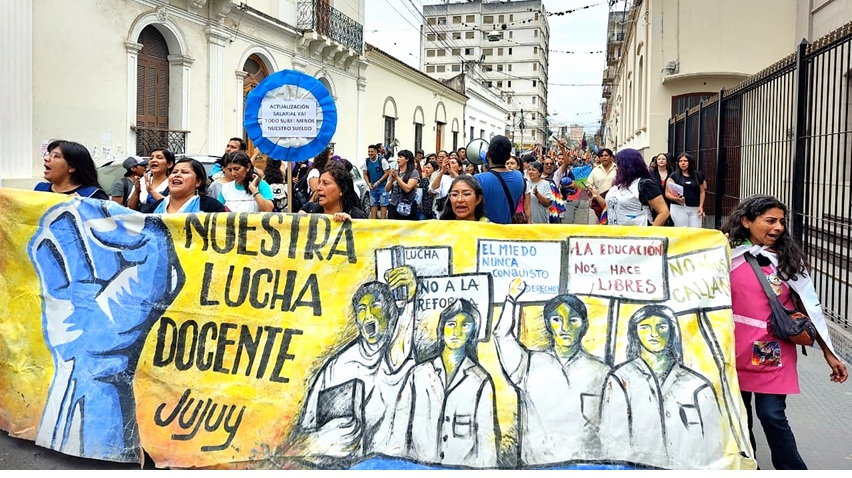
Faced with this situation, we highlight the combative chalk workers who, unlike the bureaucratic leadership of the Centrals and the majority of the unions, no vacations were taken: They took the lead from the recovered Cedems and the Hormiguero of the fight against the slave labor reform.
Where do we start from? Women’s work in Jujuy
Women represent 46.95% of the province’s workforce, concentrating on activities associated with service, care and social reproduction tasks. 18.17% work in commerce, 12.25% in domestic service, 10% in teaching, 5.66% in public administration and 5.44% in health. Tasks where physical and psychological overload aboundsthe effects of adjustment with low wages and moonlighting with its consequences for women’s health/mental health.
The gender gap is crudely expressed in the possibilities of access to paid work. Being Unemployment in women (9.67%) is 3.28 points higher than unemployment in men (6.39%)and representing women make up 57.13% of the unemployed population. At the same time, the inactive population (of working age that is not looking for work) amounts to 29.7% among women and 22.4% among men. These are women who do not enter the labor market, but far from being “inactive” they are the ones who guarantee the tasks of care and social reproduction that, increasingly, fall into the private family sphere.
Returning to the salaried workplace. The Jujeña workers are concentrated in sectors that are the axis of the adjustment policies and the precariousness that the labor reform aims to make the norm. In it domestic service, women represent 93.16% of the sector and 83.47% of them are in the informal sector; while in commerce, where women represent 52.9%, 57.8% of them are self-employed.
In education and health, women represent 72.12% and 72.41%, respectively. Below we will focus on the current situation of workers in these activities and the impact that the labor reform – if approved – will have on these two highly feminized sectors.
The health of those they care for in the crosshairs of labor reform
On March 20, 2025, teacher Adriana Silvia Armella suffered a decompensation during a parents’ meeting at the Normal School in the capital of Jujuy, where she died as a result of a cerebrovascular accident (CVA). Her colleagues published an open letter to the community where they expressed that “being a teacher is a complex profession because they require us to be improvised psychologists, family mediators, and perfect bureaucrats in a system that prioritizes roles over people. Every day, we work in overcrowded classrooms and receive children who arrive with social wounds that no educational plan contemplates (…)”, and they denounced that “the death of our colleague is not an isolated drama. It is the symptom of a disease that eats away at public education“The normalization of teacher burnout as if it were a mandatory sacrifice.”
They were right, less than a month after Adriana’s death – and after a huge mobilization of teachers, students and the community that protested against the working conditions that cost her life – on April 18 she died. the teacher Wara Puca, also the product of a stroke, while moving from School 237 in Caspaláto your location of residence.
You may wonder, what does this have to do with labor reform? All. Because, as the teachers denounce, These are not isolated dramas. They are the most brutal consequence of the attacks that are already being applied, and will be deepened with the reform, in a double sense. Let’s see…
On the one hand, the adjustment policies, growth of unemployment and poverty that hit the working class, degrade living conditions and they are a breeding ground for new and more acute psycho-social problems that do not stay outside the school doors and fall on the shoulders of the teachers. On the other hand, the socio-labor problems inherent to work in education: overcrowded classrooms, overload of administrative tasks, lack of resources, receiving the lowest salaries in the country that force multiple jobs. Not only do they work two or more shifts in schools, but they often work in businesses that sell food, crafts, and others to make ends meet, plus domestic and care work in their homes.
Combative teaching It is also the target of an attack on its union organization rights. in ADEP, where after having won the union elections by a wide margin, Sadir and Milei stole their union, as denounced by the Hormiguero – Lista Naranja teachers who continue fighting to recover their union.
For the health workersthe situation is no less pressing. They also carry the excess demand on their shoulders. of, increasingly, users who turn to the public system in the context of growing job insecurity, unemployment and cuts to PAMI benefits, disability, sexual and non-reproductive health programs, etc. The provincial government, far from investing in resources and expanding professionals, although it failed in its privatization attempt with SeProSa, continues with its strategic plan to empty the public subsystem and demands greater “productivity” from its workers with low salaries and no resources.
In hospitals and health centers, Many workers see conditions that already prevail in the province reflected in the labor reform project.. And since the pandemic, the hourly compensation module has been in force for personnel who depend on the Ministry of Health: overtime hours worked are not paid as such but are compensated at another time (when the employer approves it). In fact, it is the “hour bank” that Milei proposes. Also, in the case of vacation leave, it is the employer that approves – or not – when and how many days a worker can take based on the demand for care.
Also in the health sector, in fact the lack of knowledge of the right to receive equal pay for equal work governs. Through the implementation of contracting by location of services for replacements, they receive a lower salary for the same task and workload, or from the roaming of professionals whose Income is tied to “productivity” (number of care provided).
Conditions that degrade the health/mental health of workers in these sectors that, because they are highly feminized, they also carry the mandate to fulfill the “vocation” of care. Because they are declared essential, the occupational medicine system of the Ministry of Health imposes obstacles to access sick leavedelaying the number of days or, directly, denying the licenses.
The labor reform promoted by the national government and endorsed by governors like Sadir, if approved, will deepen these conditions in two senses. On the one hand, via measures that make working conditions more flexible, attack collective agreements and the right to strike via the declaration of essentiality of both sectors. Also the cut employer contributions to social works and the Solidarity Redistribution Fundfrom 9 to 8%, will impact the definancing of sensitive areas of the health system. On the other hand, via the leap in the care crisis that will fall on workers within the framework of more underfunded systems.
Against the slave reform, all together hand in hand with the master!
The combative chalk workers, as they proudly call themselves, who in 2023 were the spearhead of the fight against Morales’ constitutional reform, once again lead the way to confront the labor reform and all the attacks.
Extremely opposed to the attitude of the union bureaucracy, teacher activism did not rest a day and took advantage of the summer to develop a militant campaign against labor reform with talks, leaflets and meetings throughout the province. Even more, aware that to defeat the slave labor reform and all the war plan against the working class, organization from below and democratic coordination of all sectors that want to fight against these attacks are necessary, from the recovered Cedems they promoted an important Meeting on January 31 in which workers who are in struggle such as those fired from Ledesma, union, social, human rights and political organizations such as the FITU parties participated.
These sectors that had already mobilized as an independent pole on December 18, decided in this meeting to form themselves as a Permanent Assembly against the Reform, from where They demand from the CGT and CTAs a national strike and a fight plan at the height of the attack, while they promoted a common action plan in recent weeks. And for this February 11, within the framework of the Senate’s treatment of the labor reform project, they call for a half road cut in the South Access of the capital of Jujuy during the morning; mobilization and a festival in the afternoon
That is why we say that we face the labor reform “all together, hand in hand with the teacher”, as we face the constitutional reform in 2023. But This time, we have the challenge to win.
Source: www.laizquierdadiario.com