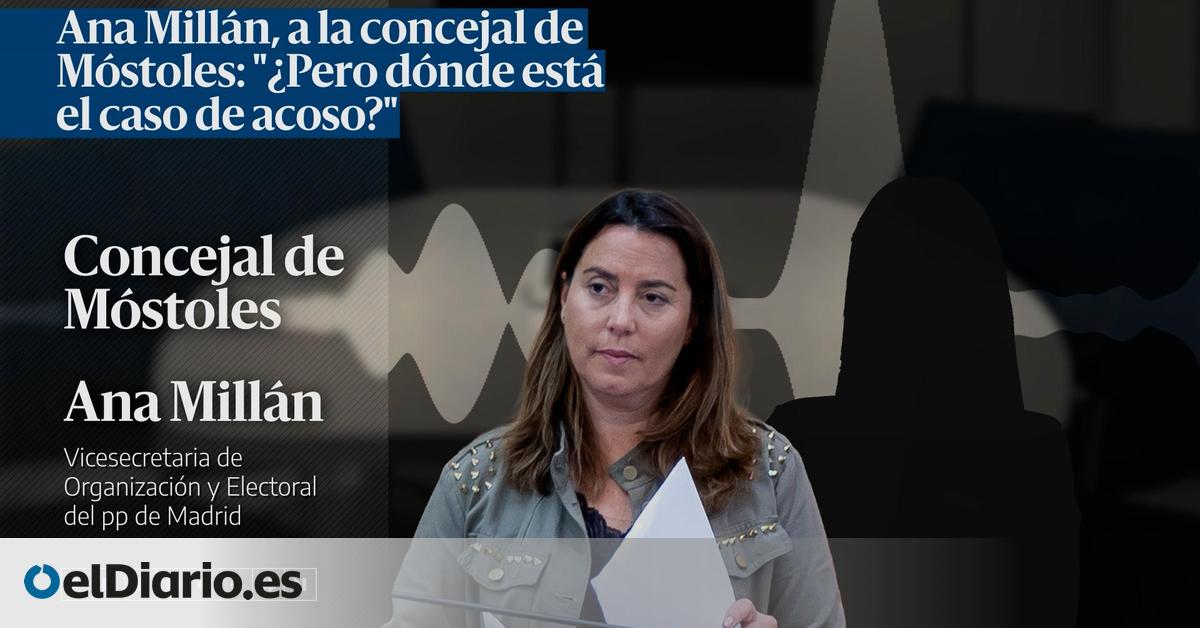
The former councilor of the Popular Party in Móstoles who internally reported the town’s mayor for sexual harassment addressed the party several times, in person and in writing, to explain her situation. The recording of one of those meetings with Ana Millán, a senior PP official in Madrid and one of Isabel Díaz Ayuso’s closest collaborators, reveals that her response was to question the alleged harassment for not having gone to the Rights and Guarantees Committee, refuse to meet with her in the presence of her lawyer, and even announce that she was being investigated under the accusation of leaking information about this case to the PSOE. “The party has a complaint against you with evidence that you have been passing information to the PSOE about this whole issue for some time,” Millán said before the end of the meeting. A day later he left his record and was removed from the party.
The case was revealed this week exclusively by the newspaper El País. A councilor from the Madrid town of Móstoles, which with more than 214,000 inhabitants is one of the most populated municipalities in the country, reported that she had been harassed by Mayor Manuel Bautista. This councilor, as reported by the PRISA group newspaper, met with senior officials from Isabel Díaz Ayuso’s party between March and October 2024, including her two closest collaborators: Alfonso Serrano and Ana Millán.
A recording to which elDiario.es has had access shows that the last meeting, held in October of that year at the party’s headquarters on Génova Street, ended tensely. The councilor went to meet with Ana Millán, deputy secretary of Organization of Ayuso’s PP, after having written directly to the regional president to explain what was happening, sending up to six emails and holding two previous meetings. She came accompanied by her lawyer, Antonio Suárez-Valdés, a specialist in military jurisdiction and harassment, who was once defense lawyer for Commander Zaida Cantera.
“We were not going to receive you with a lawyer,” Millán stated while reproaching him for having addressed Isabel Díaz Ayuso and not the Committee of Rights and Guarantees. “Once again you have just confirmed to me that you continue to mix up the institution,” he stated at the end of the meeting before moving on to attack the complainant. “I tell you, in all honesty, this party does have a complaint filed against you with evidence that you have been passing information to the PSOE on this issue for some time.”
Millán explains to the then councilor in Móstoles that she will face an internal investigation for those alleged leaks that she denies. “They will call you about the party’s internal procedure established by our statutes, they will call you about Rights and Guarantees.” The same committee before which he calls to report the mayor’s alleged harassment. “Let them call me because I don’t have any problem,” answers the complainant. The case was not known until a year and a half later and she was not finally called to testify about this alleged leak.
The information revealed by El País reveals that senior officials of Ayuso’s PP came to recognize that what he was denouncing was “a textbook case of harassment” and that it was studied and archived by the party at the national level. In this recording, Millán questions whether this harassment exists for not having gone to the Committee and having addressed them: “Where is the case of harassment? If you have evidence you will have the tools established by the statutes. From the first moment you have said that you did not want to report.” The councilor replies: “The one you told me to take a step back…” she says before ending the meeting. Shortly afterward he resigned from his record. “I am not going to allow any more victimization, until now.”
“I don’t have to meet with anyone with a lawyer”
Ayuso’s number three began the meeting by imposing “the premises” under which it was going to take place and questioning the presence of a lawyer when “there is no record of any judicial procedure.” “With all due respect, I don’t have to meet with anyone with a lawyer,” he told her, and then clarified that he was only attending to her “like any party member who asks to speak.” Millán insists that the Móstoles councilor’s harassment complaint “is a strictly municipal issue” of which they have “no formal knowledge” despite the two previous meetings and email exchanges in which she spoke of the “very serious discrimination” she suffered.
“As an organization, don’t you have any protocol?” the complainant asks at one point while Millán insists that they serve her “with all the love in the world” as they serve “anyone,” but the way is the Committee of Rights and Guarantees, which has not been activated. “I have come here and I have told you some facts, as the person in charge of the party you will have to transfer it where it corresponds,” she says, something that Millán denies, because the party “has its procedures.” He also reproaches him for having communicated by email with the cabinet of the president of the Community of Madrid instead of addressing the party.
The councilor later wrote to report her case to this body of the national PP, without success. Feijóo’s team confirmed to elDiario.es that “an information procedure was opened” but they did not want to respond to what the process was like or who was called. El País revealed this Friday that the PP filed the file without summoning or hearing in person the alleged victim or the witnesses she mentioned in her writing.
The councilor who reported harassment reproaches Millán for, at one point, trying to address the case “at the level of a colleague” with a conversation with the mayor without “activating anything.” “I am neither judge nor party,” Millán answers.
The allusions to the Rights and Guarantees Committee are constant from Ayuso’s number 3. “If you had a labor problem (…) we told you that the party as a political organization is one thing, we have tried to give you the protection you asked for because you did not want your powers to be taken away.” At that time, Millán boasted of having forced the mayor of Móstoles to keep the complainant in office even after the complaint. “See if we have tried to keep you as I think you deserve and continue with the same skills.”
The mayor of Móstoles defended himself yesterday against the accusations of harassment, stating that the controversy responded to a professional confrontation with the complainant, who wanted to be deputy mayor and was not granted it. Some audios revealed this Friday by El País point in the opposite direction: “Indeed, you have not asked me for anything… not to be deputy mayor or anything.”
Source: www.eldiario.es