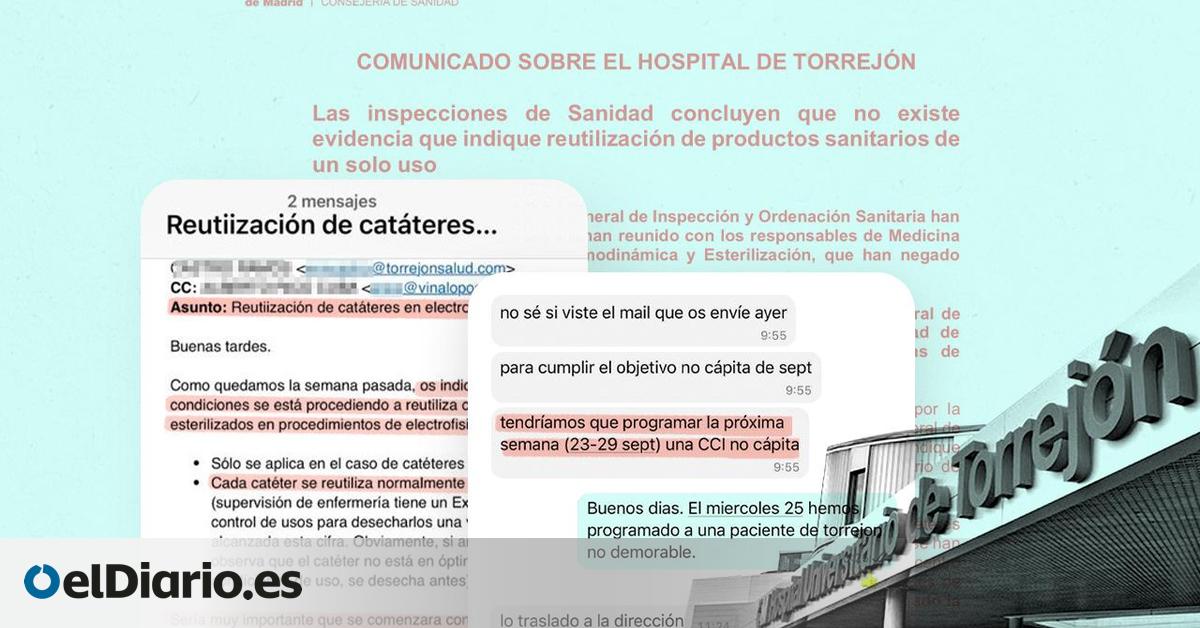
On September 25 of last year, the general director (CEO) of Ribera Salud, Pablo Gallart, called an online meeting with 20 executives of the group and the Torrejón Hospital, a privately managed public center that serves a population of 150,000 inhabitants in the Community of Madrid.
In that speech he gave the order to make more profitable processes to fit the costs of health care with the money provided by the Community of Madrid. Currently, the Ayuso Government pays a fee of 581 euros per inhabitant assigned to that area – whether the hospital center is treated or not. According to the CEO, if this process meant increasing the waiting lists, it would have to be done, information revealed by The Countrywhich published the audios of the meeting, triggering a scandal that led the Ministry of Health to carry out two audits in December that have not found any problems.
However, this normality that the Ayuso government found with its inspectors contrasts with the reality described a month after the meeting with Gallart by four directors of the group itself assigned to Torrejón. Both the manager and three other senior officials reported in an internal complaints channel that the talk the CEO gave them had led to a “contingency plan” that included, in their opinion, measures that represented a “violation of patients’ rights, poor care practices and a breach of the commitments made with the Ministry of Health,” according to a document that was advanced. The Country after the audios and to which elDiario.es has had access. The measures, according to these managers, were shared on October 8 by the financial team, “indicating that the CEO insisted on implementing it” and that they were planned in the 2026 budget.
Ribera Salud has confirmed the directors’ meeting on September 25, but has not answered the specific question about whether this “contingency plan” was activated or put into operation. These official sources refer to the fact that “all the audits, more than 40 in the last year, have been favorable.”
Illegally reused catheters
These managers – who sent the complaints a month after the talk and were immediately fired – reveal in their letter that on October 2, two Ribera bosses ordered the Management Committee of the Torrejón hospital, among other things, to “re-sterilize single-use material”, an illegal and dangerous practice.
This fact was demonstrated with documentation by elDiario.es a week ago, when it published that the head of Ribera Salud’s audit urged Torrejón in an email dated October 6 to reuse cardiac catheters up to “ten times” “as soon as possible” and as was already being done in the contracted hospital that Ribera has in Elche (the Vinalopó hospital). This practice is prohibited due to the risk of infection. The objective pursued, according to the board’s own email, was to save money: “The average number of catheters per procedure in Torrejón is 2.02 vs 0.59 in Vinalopó (potentially avoidable savings of more than 160,000 euros),” says this employee of a group that had a turnover of 808 million in 2023, the latest commercial data published.
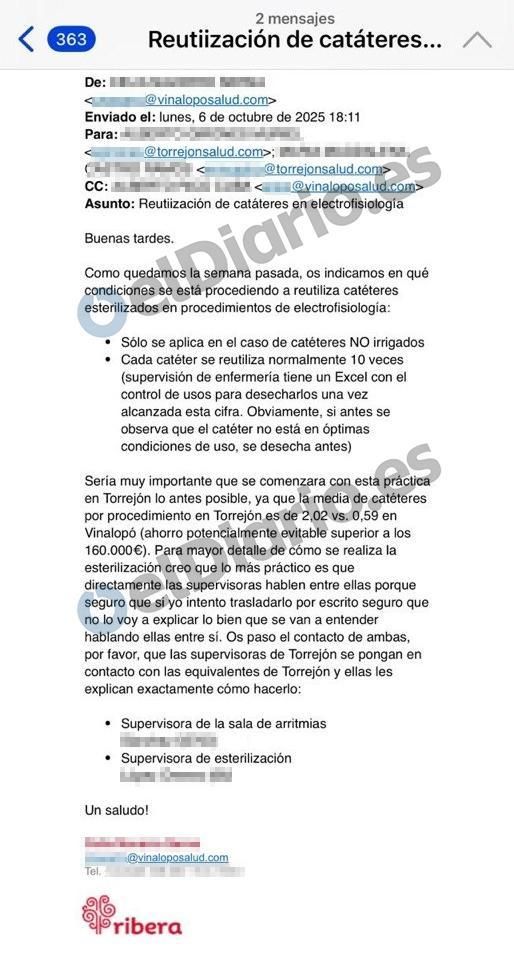
The email sent with orders to reuse single-use catheters.
Transfer mid-income
Another measure to increase profitability that the managers reveal is that Ribera ordered that, two days after admission, patients be transferred to their hospital of origin with the aim of “billing the DRG and reducing stays,” the complaint states. The GRD is the Diagnostic Related Group with which the Ministry of Health is billed for the treatments of patients who come from other hospitals (normally public). For example, in the case of a cesarean section delivery woman who had La Paz, but had chosen Torrejón, Ribera Salud would bill as a birth with that complication. But Ribera wanted her to be transferred to La Paz two days later so that her recovery could finish there. In this way, the entire healthcare process would be charged, but admission costs would be saved, to the detriment of public coffers and publicly managed hospitals that would have had to attend to that case halfway through recovery. That is, the plan was to accept the free-choice patient due to its high profitability but without giving him the full benefit.
Quick List for Profitable Patients
According to the complaint in Ribera’s internal mailbox, it was not the only practice that was intended to be implemented regarding free choice. For example, it is revealed that that same October 2, the Torrejón Hospital was given the instruction to “increase non-capita surgery [los pacientes de libre elección que llegan de otras áreas, que son los más rentables] displacing patients capita [los que pertenecen a Torrejón] of surgical scheduling.” elDiario.es already confirmed this illegal procedure in December and showed that Torrejón managed, at least since March 2025 and until December of that same year, a waiting list that was always shorter if the patient was from outside. The economic profitability comes from the fact that, in addition to the fixed fee, Ribera invoices the Community of Madrid separately for each outpatient operation that is not from its area, using rates that are approved each year according to the health treatment.
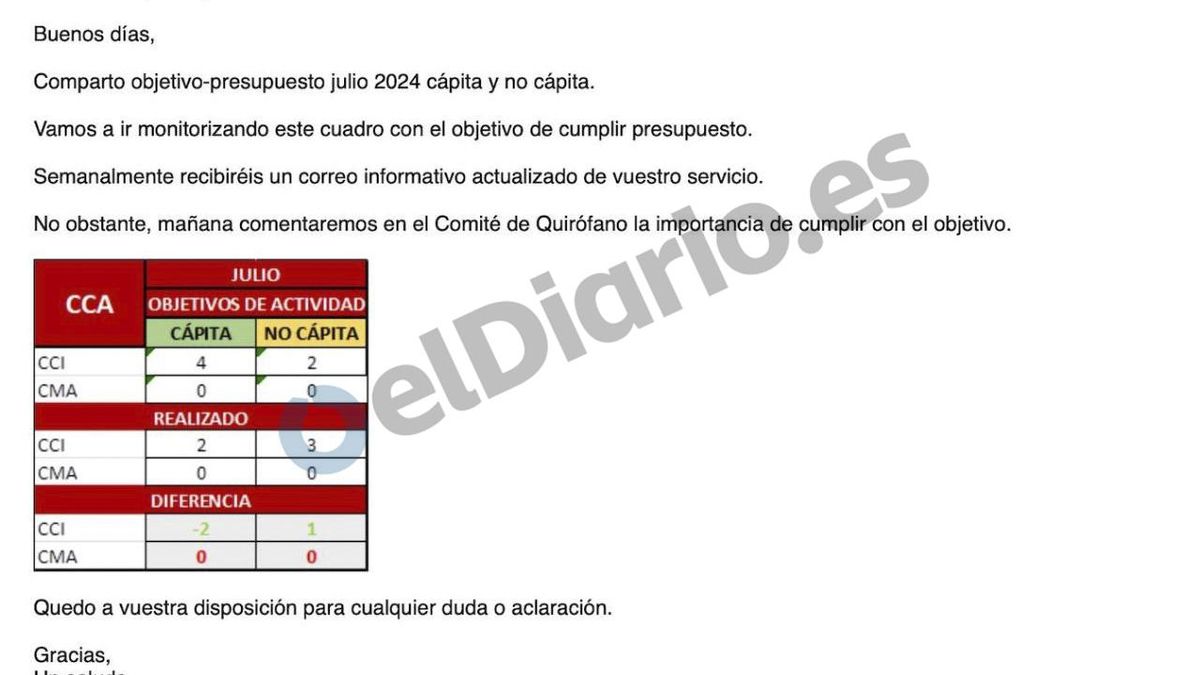
In addition, these managers complained that they were ordered (including the director who signed the catheters email) to “attend consultations to capitated patients, but not perform their surgeries,” which is the order that can be sensed in the audios published by The Country. The reason is that opening the operating rooms costs money due to the structure and salaries and Ribera Salud considered that reducing the waiting list too much by operating a lot was not profitable because the cost was very high. The waiting list had to be long enough to not incur low profitability and short enough to attract patients from publicly managed hospitals, which are the majority (in Madrid there are five privately managed ones: four managed by Quirón and the one in Torrejón, in the hands of Ribera Salud).

Messages from the admission department of the Torrejón Hospital in which they ask the center’s cardiac surgery service to schedule an intervention to meet the quota of “non-capita” patients.
Stop peritoneal dialysis
According to this internal complaint, the Torrejón Hospital was also given instructions to “suspend peritoneal dialysis care” for patients from outside the Torrejón area, so patients were referred to other centers even though they had chosen Torrejón, “violating the Free Choice Law of the Community of Madrid.” This law, promoted in 2009 by Esperanza Aguirre and which put private and public hospitals in competition (since the more patients Ribera and Quirón recruit for the five public hospitals they manage, the more they earn), aims to protect precisely the patient’s right to choose where to receive treatment. According to the directors, it was not fulfilled in the case of this treatment, which is used at home in patients with kidney failure and is characterized by being an expensive service.
Always according to the version of the complainants, the indignation over this plan led a group of 15 heads of service (responsible for the different specialties of the hospital) and three nursing supervisors to visit the mayor of Torrejón (from the PP) on October 17 to explain what they intended to do in the reference hospital of their municipality, in addition to writing letters to Ribera Salud and the owner of the group, the Frenchwoman Vivalto Santé. According to sources familiar with the meeting, the mayor confirmed these reported events with the then manager of the hospital (who was fired after the internal complaint) and assured that he would transfer them to the deputy minister of Health. The Torrejón City Council has not responded to elDiario.es about the meeting or the call to the Ministry. For its part, Health has not responded to the specific question of whether or not this call occurred and, therefore, whether in October the department was aware of these practices. These same official sources stick to the fact that “Sermas does not need to have other sources, the audit is constant.”
A month after this complaint, and with the four managers already fired, the company responded to their demands in the internal mailbox that it had found no “evidence” of the reported events, despite the fact that, in part, they are recorded in the audios of its own CEO at the meeting on September 25.
Regarding the dismissal of managers, Ribera Salud frames it in the “loss of confidence in their management” although it does not give the details for reasons of “confidentiality”, but it separates them from the complaints in the internal channel. Regarding the question of whether Pablo Gallart, who stepped away from the management of Torrejón after the audio scandal, has returned to take charge of this concerted center, the health group assures that he remains disengaged and adds that the company “has been the subject of a strong smear campaign.” Ribera says he is “fully aware of the origin and objective” and adds that he is taking legal measures to “defend his honor and reputation.”
If you have information about this case or know of other similar ones, you can write to our confidential email at [email protected]
Source: www.eldiario.es