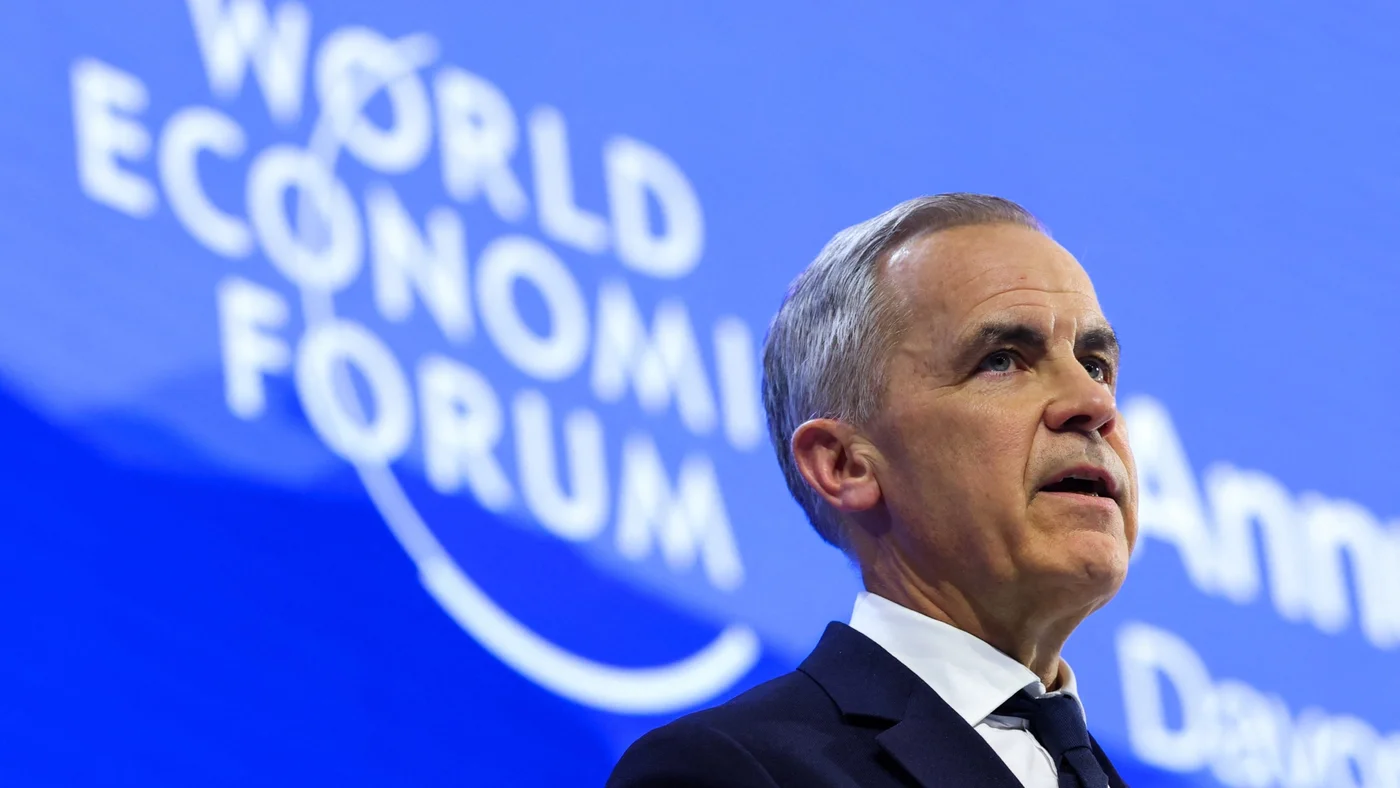
‘We’re on the menu’: Mark Carney, Prime Minister of Canada sought to dismantle the relevance of today’s “liberal rules-based order” in the world
It was probably the most impactful speech given by a Canadian prime minister on a global stage in decades.
Canadian Prime Minister Mark Carney, a former banker who had never run for political office until April last year, declared emphatically in Davos that the liberalism long embraced by the West is no longer viable in an environment where US President Donald Trump is making decisions unilaterally.
“It’s rare that I get a link to a world leader’s speech from diplomats around the world asking me if I’ve seen it. So I think it’s absolutely accurate to characterize it as somewhat surprising,” Maya Ungar, an analyst at the International Crisis Group, told Middle East Eye.
At the World Economic Forum in Davos, Switzerland, Carney said Canada, along with other “middle powers” like it, must chart a new path.
“For decades, countries like Canada have thrived under what we called the rules-based international order,” he told an audience of the highest echelons of government and finance.
“We knew that the story of the rules-based international order was partly false, that the strongest would exempt themselves when it suited them, that trade rules were applied asymmetrically, and that international law applied with varying rigor depending on the identity of the accused or the victim,” he continued.
“So we put the sign in the window. We participated in the rituals and, for the most part, avoided pointing out the discrepancies between the rhetoric and reality.”
“This agreement is no longer valid.”
The admission was surprising, but many saw the irony of a G7 country now lamenting the loss of its privileges after decades of benefit provided by a system that kept the Global South at arm’s length from the economic and social security of the rules-based liberal order.
Why now?
Canada shares the world’s longest international border with its superpower neighbor to the south, and the two countries are deeply linked through trade, business, tourism and family ties. More than $2.5 billion in goods and services are exchanged between the two countries daily, according to the US State Department.
The United States and Canada are also G7 partners and NATO allies.
Over the past year, Trump has imposed a 35% tariff on Canadian imports that fall outside the scope of the Canada-United States-Mexico Agreement and has also threatened to make Canada “the 51st state.”
He also openly and repeatedly undermined institutions that Canada helped build and support, such as the United Nations and the International Criminal Court.
In his speech, Carney, former governor of the Bank of Canada and the Bank of England, declared that a series of crises in finance, health, energy and geopolitics over the past two decades have exposed the risks of “extreme global integration,” where tariffs and financial infrastructure are instrumentalized and exploited.
“You cannot live in the lie of mutual benefit when integration becomes the source of your subordination,” he added. “When the rules stop protecting you, you have to protect yourself.”
“To put it bluntly, we are in the midst of a rupture, not a transition.”
But this rupture may not be so new to many of Carney’s compatriots, Steve Staples, a Canadian defense and foreign policy analyst, told MEE.
“Many people in Canada recognize the disparities of the old system and oppose it, and others may be saying, ‘Wait a minute, didn’t we benefit from this rules-based system? We did, and we don’t want to give it up so easily.'”
Canada now finds itself in the crosshairs of Trump’s reshaping of the traditional liberal order in his own image – a point Trump was keen to convey to Carney in Davos.
‘Canada lives thanks to the USA’
In his own speech at Wednesday’s summit, Trump took direct aim at Carney.
He said that the “Golden Dome” he is building – similar to Israel’s Iron Dome, which is also funded by the US – “will be defending Canada” and that “Canada gets a lot of things for free from us.”
“They should be grateful, but they’re not,” Trump said. “I saw your prime minister yesterday. He wasn’t grateful at all. But they should be grateful to us.”
“Canada exists thanks to the United States. Remember that, Mark, the next time you make your statements.”
Before arriving in Davos, Carney was in Qatar for the country’s first visit by a Canadian prime minister and, before that, in China for the first visit by a Canadian prime minister in eight years.
The relationship between Canada and China, in particular, was tense due to the arrests of high-ranking citizens on both sides, with Washington’s shadow looming over the entire situation.
The prime minister spent four days in China and spoke of a “new world order”. He left there with a deal that stipulates that Beijing reduces tariffs on Canadian canola oil exports to 15% while Canada imports 49,000 Chinese electric vehicles.
In Qatar, the results included major investments in Canadian “nation-building” projects, as well as Canada’s finalization of the Foreign Investment Promotion and Protection Agreement with Qatar, which was on hold until the summer, and Ottawa’s creation of a defense attaché post in Doha.
It was clear that Carney could no longer depend as much on its southern neighbor as Canada always had.
“We are engaging broadly and strategically, with our eyes wide open. We actively face the world as it is, without waiting for a world we want to be,” he said.
But Carney didn’t present a plan for what exactly the world should be doing instead.
“I have doubts about the idea that you could build a liberal order based on a coalition of middle powers, which seems to be the foundation, the kind of theoretical framework, that was at play,” Peter Rough, senior researcher and director of the Center for Europe and Eurasia at the Hudson Institute in Washington, told MEE.
“Secondly, I don’t think the idea of middle powers as a bloc is viable, because there’s very little that unites them. I mean, what unites someone’s worldview in Brasilia, in Ankara or in Tokyo is very different. Even the Europeans, who theoretically are the best candidates to form some kind of bloc, can’t even complete the Mercosur deal,” he said.
Ungar told MEE that while Carney did not propose a new coordination mechanism or international institution, he did make “an appeal to middle powers in general.”
“I think the speech was a call for middle powers to say, ‘Canada believes we need to cooperate more. We’re open to them joining us in this effort,'” she said.
Many, if not most, of these “middle powers” are part of the Global South, which has had to effectively face American gunpoint in ways that Washington’s Western partners have not previously faced.
“The Global South has long felt and understood the power dynamics of the system, which often makes it more difficult for them to develop and assume leadership roles and capabilities,” Ungar said.
“I think Carney is echoing what many world leaders have been saying for a long time, but because it’s coming from someone with the face of someone who is normally in power structures, it’s resonating more than it would otherwise,” she explained.
This repercussion was profound among Canadians, who praised their prime minister’s bold statements on social media.
“Canadians take the prime minister at his word; he’s still very new in office. All of this happened in months, not years,” Staples told MEE.
“I think they appreciate the consideration and trying to find a way forward,” he added. “The prime minister needs to tread a delicate path between moving in a new direction and not risking a new fight with the Americans, because Canada is very vulnerable because of the system.”
Staples described the state of relations between Canada and the US as “dire.”
“I mean, it’s not just about the trade issues and the border issues that individual Canadians are facing. [Há] massive boycotts of American products and travel to the United States. The Canadian public is very dissatisfied, and not only that: we have a privileged place to follow Trump’s domestic policies in the United States,” he said.
“We need to find new partnerships. Otherwise, we will change the menu.”
Originally published by Middle East Eye on 1/22/2026
By Yasmine El-Sabawi – Washington
Source: https://www.ocafezinho.com/2026/01/22/primeiro-ministro-canadense-subverteu-a-ordem-mundial-liderada-pelos-eua/