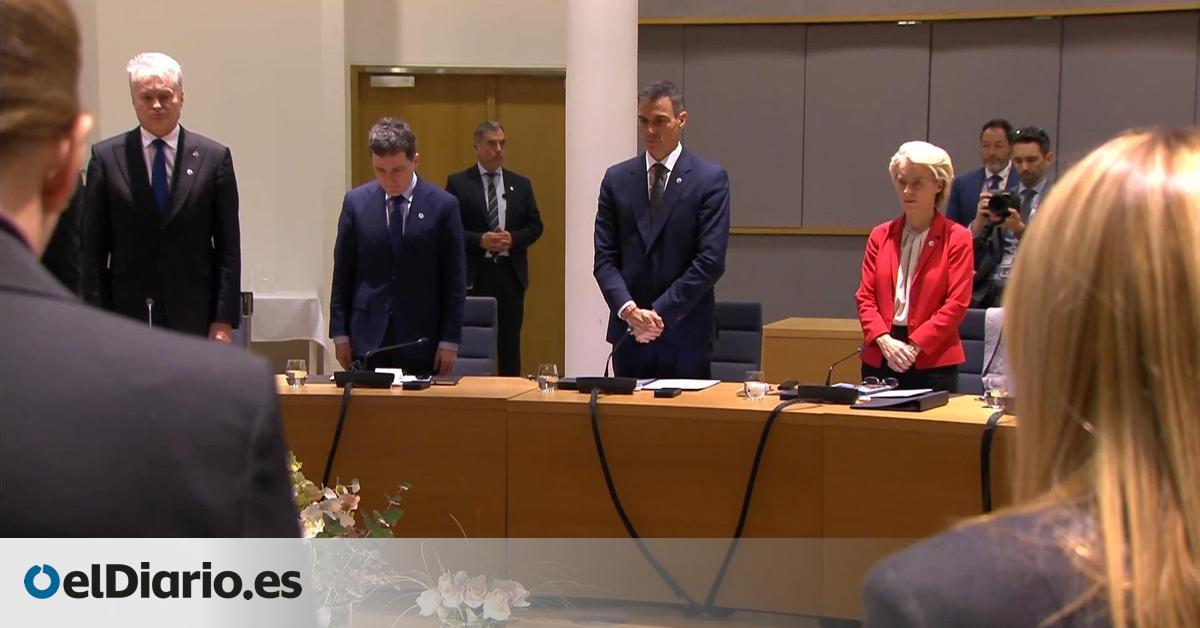
With the apparent tranquility of US President Donald Trump’s abandonment of military and tariff threats to take over Greenland, European leaders closed an extraordinary summit this Thursday in Brussels in which it became clear that they can stop Trump and, therefore, they remain waiting. The United States will remain an ally, relations have deteriorated, and the European Union is prepared to respond if threats are repeated. However, no specific measure has been approved. At the beginning of the meeting, European leaders observed a minute of silence for the victims of the Adamuz train accident.
The EU prefers not to take any further steps, despite the fact that the details of the supposed agreement between NATO and the US on Greenland that Donald Trump announced are still unknown, ensuring that “if it is carried out, it will be very beneficial for the United States of America and for all the countries” of the Atlantic Alliance. The abandonment of the military option and the elimination of tariffs against the eight countries that sent troops to the Danish island managed to de-escalate what seemed like the beginning of a trade war in the making. So the EU maintains the position, that is, it does nothing further. It neither uses the anti-coercion instrument nor implements tariffs worth 93 billion euros on US products.
After finishing the summit that lasted about five hours, the President of the European Council, António Costa, once again highlighted that the EU is based on the principles of “international law, territorial integrity and national sovereignty, which are essential for Europe and for the international community as a whole.”
“Yesterday’s announcement that there will be no new US tariffs on Europe is positive. The imposition of additional tariffs would have been incompatible with the trade agreement between the EU and the United States. Our focus must now be on advancing the implementation of that agreement. The objective remains the effective stabilization of trade relations between the European Union and the United States,” Costa stressed.
For her part, the President of the European Commission, Ursula Von der Leyen, stressed: “We are well prepared with trade countermeasures and non-tariff instruments in case tariffs have been applied. We maintain four key principles: firmness, scope, preparation and unity. It was effective.”
According to The Wall Street Journal, the negotiations to reduce Trump’s threats and return relations between the EU and the US to a tense calm had been based on the renewal of the defense agreement between Denmark and the US, which would mean expanding the North American bases in Greenland, an option that the Danes had already offered; greater participation of European countries in Arctic security, which the president of the European Commission had already announced; and, what really interests Trump, that the US has preference in the exploitation of critical minerals and rare earths in Greenland.
The President of the Government, Pedro Sánchez, pointed out at the end of the summit that “hopefully we can trust that an agreement can be reached that takes into account the territorial integrity and sovereignty of Greenland. This is what the entire EU is working on.” Sánchez recalled the role of NATO by pointing out that “if there is a legitimate demand for security in the Arctic, there are institutions to articulate missions that respond to that legitimate concern.”
Once Trump backed down, was this extraordinary summit necessary? Doubts ran through the corridors of the European institution. As a curious fact, neither the President of France, Emmanuele Macron, nor the German Chancellor, Friedrich Merz, nor the Italian President, Giorgia Meloni, or the Prime Minister of Denmark, Mette Frederiksen, gave a press conference when the meeting ended.
These European leaders had already made their position clear at the beginning of the meeting. When the Prime Minister of Denmark, Mette Frederiksen, was asked if the US Government could still be trusted, Frederiksen could not help but hesitate for a few seconds before finally answering: “We have been working together for many years, but it has to be respectful and without threats. Of course, I hope to find a political solution within the framework of democracy.”
Transatlantic relations have “taken a big hit”
The EU foreign policy chief, Kaja Kallas, emphasized the need to be alert to Trump’s continuous changes in position. After admitting that transatlantic relations have “taken a big hit in the last week” and that they are “no longer the same as they used to be.” Kallas warned that “although everyone is relieved with the recent announcements [de Trump]we have also seen in one year that we must be ready for unpredictability. You have to design plans for different scenarios, because one day it is one way, the next another, and everything could change.”
Macron stressed that “when Europe is united, strong and reacts quickly, things return to normal and calm.” Now, the French president asked that Europe remain “vigilant” and united, since “if it is threatened it must command respect.” Along the same lines, the German chancellor highlighted that the “unity and determination” of the European side has proven to make the difference against Trump’s aspirations for Greenland.
But perhaps the one who made the best reading of the moment was the Polish Prime Minister, Donald Tusk: “We always accept the leadership of the United States as something absolutely natural, but… it is important for everyone, also for our partners on the other side of the Atlantic, to understand the difference between domination and leadership.”
Source: www.eldiario.es