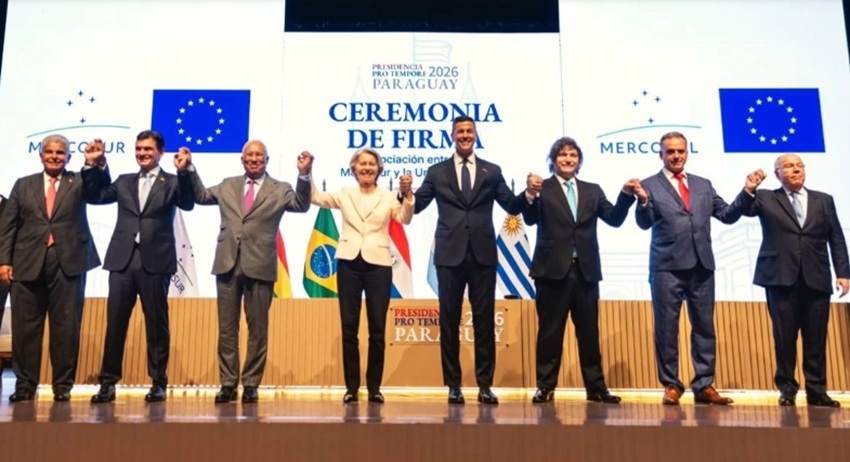
In a very tight vote, this Wednesday the 21st European Union (EU) legislators voted in Strasbourg in favor of refer to the Court of Justice (CJEU) the decision to determine whether the agreement between the EU and Mercosur is compatible with its legislation.
So, by 334 votes in favor and 324 againstpractically The ratification process of the trade agreement was frozen. This decision comes just 4 days after signing last Saturday, January 17 in Asunción, Paraguay. The Court of Justice of the European Union considers that this type of opinions They usually take between 18 and 24 months.
However, until the verdict is in the European Commission could continue with its application provisional of the commercial part if at least one Mercosur country completes its adoption process.
This is so because Two types of agreements were signed. A more agile one (although not easy), since its ratification only requires the European Parliament, which refers exclusively to commercial aspects (interim trade agreement, or ACI). This is supported by the fact that legally trade policy is an exclusive competence of the European Union. This agreement is the one that was sent to Justice, precisely by said Parliament.
Another is the association agreement (EMPA), of a comprehensive nature (cooperation, political and commercial). In this case, its ratification is more complex, since it includes political provisions that require its approval by the national parliaments of the countries. twenty-seven member states. It will only come into full force once all EU Member States and Mercosur countries have completed their respective ratification processes, at which point it will replace the interim trade agreement.
What were the points most questioned by MEPs?
The greatest pressure to “postpone” the agreement and send it to the Court of Justice came from MEPs from France, Romania, Poland and Greecewhich together with votes from different political wings, ended up winning in a very close vote. “For our farmers, the environment and public health,” said many European deputies who celebrated the result of the vote.
For their part, leading the “no” front to the postponement, defeated in the Chamber, were the MEPs of Italy, Germany and Spain, where the majority of national delegations opposed the postponement of the agreement. Those who defended the agreement revealed the background of tensions between Europe and the United States, and Trump’s tariff pressures. They propose that the agreement with Mercosur “would provide a boost to European GDP that would double the value of the negative impact of the tariffs announced by Trump against the bloc” and that “the agreement with Mercosur must be the response to the actions of the United States”, highlighting the need to “open spaces of understanding with other regions of the world that share the multilateralist vision” of the European Union.
One of the aspects that the Luxembourg Court will be asked to clarify is the “rebalancing mechanism”which allows Mercosur countries to challenge European legislation that they consider harmful to their exports. This, those who oppose it, could contradict the regulatory autonomy and the EU Treaties.
They also question the powers that the European Commission had to divide the agreement into two parts – a political and cooperation one, and a commercial one -, since they consider that this strategy facilitated the signing, given that the commercial part only requires European ratification to enter into force provisionally.
From the Mercosur side there are also clauses in the opposite direction, although logically they are not the ones that were of interest in the European discussion. For example, one clause in the agreement gives European countries the possibility of stopping the entry of Argentine grains. With the aim of preventing a massive landing of products from Mercosur, the agreement contemplates a series of safeguards that would be activated in two cases: if there was a much higher income of grains, or when their values were very competitive against European ones. There, the European bloc can freeze tariff benefits until the situation is resolved. This began to raise the cry of the standard-bearers of the agreement until now: the soybeans and livestock farmers of Mercosur.
Keys to the agreement
- The promoters of the agreement mention that it covers “a market of 720 million people“and an increase in interregional trade due to the reduction of tariffs. In other words, a “free trade zone would be opened, with an area of 31 countries, 720 million potential consumers, with a gross domestic product of 22 trillion dollars.”
- However, the agreement is beneficial for large companies on both sides of the ocean (multinationals and European industrialists, Mercosur agricultural employers), to the detriment of the working classes and the development of productive potential. It implies an increase in backwardness, economic dependence and social problems in the region, as well as greater pressure to increase local “competitiveness” by further lowering salaries, making work more flexible and increasing the degrees of job insecurity.
- Why did the negotiations take 26 years? Negotiations began in 1999, but were effectively suspended for about 14 years: mainly in the periods 2002–2010, 2012–2015 and 2020–2022. The pauses responded to structural differences between both parties, economic crises, political changes and, in the most recent stage, to alleged environmental concerns on the part of Europe (with a background of the interests of European farmers).
- He Saturday 17 The colony pact was signed in Paraguay by the foreign ministers of Paraguay, Rubén Ramírez Lezcano; from Argentina, Pablo Quirno; from Brazil, Mauro Vieira; and from Uruguay, Mario Lubetkin, and the European Commissioner for Trade and Economic Security, Maros Sefcovic. The highest European authorities were also present: Ursula von der Leyen (president of the European Commission) and António Costa (president of the European Council). Representation was not at the level of heads of state of individual member countries of the European Union, but through the heads of the institutions.
- In Argentinaafter the signing of the agreement, the Chief of Staff, Manuel Adorni, confirmed that it will be sent to Congress to be discussed in extraordinary next February 2.
- It is expected that EU exports to Mercosur increase by 39%while exports from Mercosur to the EU would increase by 17% (48.7 billion euros and 8.9 billion euros, respectively).
- In commercial matters, it is worth noting the enormous inequality between both blocks. While around 70% of Mercosur’s imports from the EU are high value-added manufactured products (such as vehicles, machinery and pharmaceuticals), around 60% of Mercosur’s exports to the EU are agricultural and food products. This suggests that the agreement could increase the trade deficit of countries such as Argentina and Brazil, mainly benefiting the EU.
- Las automotive multinationals and large agricultural employers would be the main beneficiaries of the agreement. European companies could reduce import and export costs, while the agropower sectors would welcome the opening of the European market, which is why France’s reluctance is expressed due to the unequal ability of its agricultural producers to compete.
- The two blocks together represent about the 25% of world GDP and 35% of global trade.
The treaty between the EU and Mercosur will only do reinforce dependency, strengthening the discipline of global capital and the ability of multinationals to gain positions in the economy and opening the door to more agreements with similar characteristics.
From the working class and the poor people we must warn about its consequences and reject this new colonial pact, building a social force that allows breaking the vicious circle of imperialist domination, starting by rejecting Trump’s interference in Latin America, European imperialism or China’s interference.
For this it is necessary transform the economy from the grassroots, based on long-delayed social needs and not capitalist profit. Integration must be the way to achieve true well-being, that is, socialist unitystarting with Latin America and with the perspective of a world truly without borders, neither for goods nor for people.
Source: www.laizquierdadiario.com