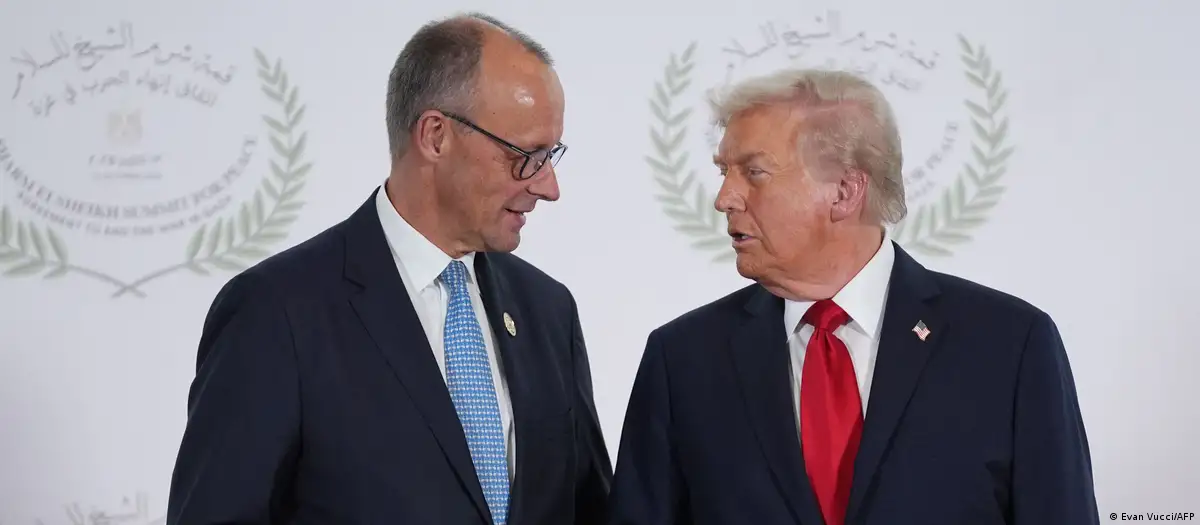
Threats in relation to Greenland mean that the second year of the American president’s new administration begins with a strong shock to the historic alliance between Berlin and Washington.
The dispute between NATO’s European partners and the US is intensifying every day. US President Donald Trump has escalated the conflict over Greenland by announcing special tariffs against eight European countries. Germany and other European nations had sent soldiers to Greenland as a sign – largely symbolic – of resistance to Trump’s demand to annex the semi-autonomous Danish island, if necessary by force. Now, the EU is considering launching retaliatory tariffs if Trump goes ahead with his proposal.
A few days ago, during a visit to Washington, German Foreign Minister Johann Wadephul was optimistic. “Our partnership is strong, we are capable of acting and we are determined to expand this partnership even further”, he declared. The US, he added, is “totally and completely on Europe’s side,” both politically and militarily.
Annexation would change everything
But there are growing doubts about the US alliance with European NATO countries. Doubts not only about whether Washington would really protect its partners in the event of a Russian attack. If the US violates the sovereignty of Denmark, its NATO partner, the alliance would be over, as Danish Prime Minister Mette Frederiksen stated.
“This is a moment of dramatic tension,” says Rachel Tausendfreund, an American expert at the Berlin-based think tank German Council on Foreign Relations (DGAP). “Germany is now asking itself whether it should prepare for an attack from its most important partner in NATO. In that sense, the relationship has never been more tense. On the other hand, from what we’ve heard, Trump and German Federal Chancellor Friedrich Merz have a fairly good working relationship.”
But this good relationship cannot be put to the test indefinitely. The German Chancellor was still cautious when commenting on the attack on Venezuela and the kidnapping of President Nicolás Maduro by American special forces, classifying the action as “complicated” from a legal point of view, although it was clearly a violation of international law. Such contention is now difficult to sustain.
Danish warship patrols off Greenland | Odd Andersen/AFP
Johannes Varwick, professor of international relations at the University of Halle in Germany, believes that an invasion of Greenland “would, in fact, be the last straw”.
“The relationship of trust with the US would probably be irremediably destroyed. It would be necessary to start over from scratch and assess on what basis future cooperation would be possible. But this will be very, very difficult, because, at the same time, we depend on the US on many issues. And this rupture would be expensive, risky, but probably inevitable”, he assesses.
Differences of interest
A staunch supporter of transatlantic cooperation, Merz is determined to avoid this rupture. Trump, who was sworn in for a second term as US president on January 20, 2025, has upended virtually every previous principle of the once-close partnership.
Merz was not yet federal chancellor when Trump humiliated Ukrainian President Volodymyr Zelensky in front of the world in February. At the time, Merz stated: “Since Trump’s statements, at the very least, it has become clear that this segment of the American population is largely indifferent to the fate of Europe.” His top priority now, he said, is to help Europe “achieve, step by step, independence from the US.”
But the problem is not that simple, warns Varwick. “The only thing that could really make an impact [em Trump]if anything, is a truly unified European position. Friedrich Merz is working on this, but the differences in interests between European states are still very significant.”
Merz em Washington
Relations continued to deteriorate throughout the year. American import tariffs on European products are hitting the German economy hard, which is heavily dependent on exports. On the Ukraine war, Trump has made it increasingly clear that he would make significant concessions to Russian President Vladimir Putin to achieve peace.
However, despite all the conflicts – or perhaps because of them – Merz went to Washington in early June. The meeting went better than expected, probably also because Merz was able to confirm that Germany now intends to spend considerably more on defense, as Trump had demanded. As for Trump, there were no concessions.
Return of imperialism
Since December, events have unfolded rapidly: in the new national security strategy, the American government warns Europe of “civilizational annihilation” through migration. The Western Hemisphere is declared a US sphere of influence. Then, after the intervention in Venezuela, came the threat from Greenland.
The German government appears perplexed about how, on the one hand, to maintain its partnership with Trump in seeking peace in Ukraine and as protector of Europe and, on the other, to remain true to its self-proclaimed values: adherence to international law and a rules-based international order.
Rachel Tausendfreund doesn’t believe the US will completely turn its back on Europe. “The United States wants to recalibrate its relationship with Europe; it wants to bear a much smaller burden on Ukraine’s security, but even the Trump administration still sees Europe as a partner, even though some members of the administration are very anti-EU.”
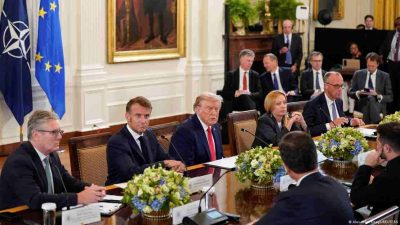 Trump’s meeting with Europeans on Ukraine in August: Europe fears losing American support against Russian threat | Alexander Drago/Reuters
Political scientist Johannes Varwick, however, predicts turbulent times for Germany, as imperialism and the “law of the jungle”, according to him, have returned with Trump. “This is obviously very, very bad news for Germany, because like almost no other country, Germany depends on a stable international environment, both in terms of security policy and economic policy. The German business model is on the brink of collapse and there is nothing better in sight.”
Low popularity among Germans
At the end of last year, the German Chancellor’s office announced that Trump had accepted Merz’s invitation to visit Germany. The invitation was made during his visit to Washington in June, when Merz also presented Trump with a birth certificate from his grandfather, who emigrated from Kallstadt, in the Palatinate region, Germany, to the USA.
Tausendfreund believes Trump likely felt flattered by the gift of his ancestors’ country. However, he warns against jumping to hasty conclusions. “This does not mean that he has any strong or lasting feelings of attachment to Germany.”
A survey released in early January by German public television ARD revealed the public sentiment that Trump would find in the country: only 15% of respondents consider the US a reliable partner, compared to 76% who think the country is no longer trustworthy – a radical reversal of the sentiment that prevailed under President Joe Biden’s government.
The invitation to Germany was made when relations were already quite tense, but long before the recent escalation of tensions in Greenland. Given these circumstances, a Trump visit to Germany seems inconceivable in the short term.
Originally published by DW on 01/19/2026
Por Christoph Hasselbach
Source: https://www.ocafezinho.com/2026/01/19/apos-um-ano-de-trump-relacao-com-alemanha-esta-por-um-fio/