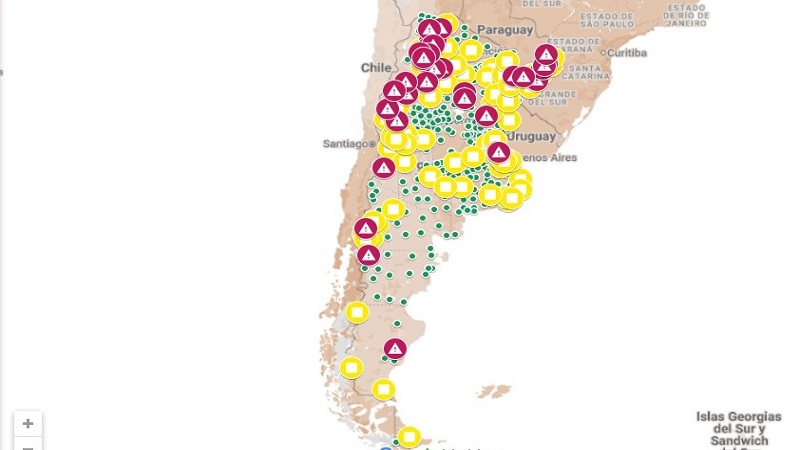
An interactive map from the CONICET and UBA Land Observatory revealed the real magnitude of the foreignization of land in Argentina. Based on official data from the National Registry of Rural Lands, the tool allows you to visualize by province and department what portion of the territory is in the hands of foreign capital, revealing information that until now remained fragmented or directly invisible.
Sizing: more than 13 million foreign hectares are equivalent to 5% of the national territoryan area similar to that of all of England. But the added data hides the most serious thing: 36 departments already exceed the legal limit established by the Land Law, and in some cases foreignization exceeds 50%, always in areas with water, minerals or logistical value.
The map confirms that the foreignization of land overlaps with the main foci of the extractivist model.
In Malargue (Mendoza), for example, foreign ownership is around 15% of the territorywhile in this department at least 18 mining projects at different stages of progress. There, the dispute over land is directly linked to the control of water and the expansion of mega-mining, in a context of growing water scarcity. Let us remember that in the north of the same province, the communities have just led the rejection of the San Jorge Project.
Foreignization, concentration and inheritance of the 90s
The map confirms that the foreignization of land is neither a recent nor accidental phenomenon. It is a structural process, deepened during the privatizations and economic opening of the 90s, which, far from being reversed, was consolidated in the following decades and today is accelerating again under a new cycle of adjustment and delivery.
Although no province formally exceeds the 15% limit established by the Land Law (26,737), the analysis by department reveals that 36 districts already exceed that legal limit. In four cases—Lácar (Neuquen), General Lamadrid (La Rioja) and Mills y Saint Charles (Salta)—foreignization is above 50%. Strategic natural assets are concentrated in all of them.

The logic is clear: not just any land is foreignized, but rather that which guarantees control over water, mining, biodiversity, tourism or logistics.
Extractivism and offensive against environmental laws
The publication of the map occurs in a precise political context. The government of Javier Milei is promoting a comprehensive offensive to make the Land Law, while adding a new leap in the definancing of the Fire Management Lawwith parties reduced to around 50% or less amid the Southern fires, the sustained attack on the Glacier Law and the promotion of a model that enables mining, oil and real estate expansion. Presidential spokesperson Manuel Adorni came to define these regulations as “ideological obstacles” to the entry of capital.
The result is a scenario of territories liberated for extractive businesses, where foreignization functions as a material condition of the model and liabilities are areas of sacrifice.
Patagonia in flames and appropriation of the territory
Patagonia appears as one of the most sensitive spaces. As forest fires multiply, investigations by the CONICET warn that fire cannot be analyzed as an isolated natural phenomenon, but in relation to processes of territorial reorganization, land concentration and speculation.
It is no small fact that large areas in the hands of foreign landowners, like those of Joe Lewis or the group Benettonare not affected by the fires, unlike Mapuche communities, small producers and local populations. The relationship between fire, dispossession and real estate or extractive businesses is once again at the center of the debate.
United States, territorial control and reissue of the Monroe Doctrine
The conclusions of the researchers who built the map show that USA tops the ranking of foreign owners, with approximately 2.7 million hectaresan area larger than entire provinces like Tucumán. It is followed by the capitals of Italy and the Spanish State.
This American predominance is part of a broader geopolitical strategy, which seeks to ensure control of water resources, critical minerals and strategic territories throughout America. from Greenland to the southernmost part of Latin America. Under new forms, Trump updates the principles of the Monroe Doctrine, whose most brutal face is the looting of oil in Venezuela, after the attack and kidnapping of its president, Nicolás Maduro.
Social conflict and criminalization of protest
This process does not proceed without resistance. In provinces such as Chubut – which prevented mining zoning in 2021 – and Mendoza for water, the struggles against mega-mining and in defense of water are marked by a growing criminalization of protest with arrests, open court cases and people who continue to be deprived of their liberty, as is the case today in Chubut with the arrests of Naum and Díaz.
Facing delivery from below
The foreignization of the land, the emptying of environmental laws and the labor reform—which seeks to discipline the working class—are part of the same offensive: guaranteeing optimal conditions for the business of capital, local and foreign. Faced with this, it is necessary to strengthen and coordinate territorial resistance, socio-environmental struggles and organizational experiences that question a model that offers the surrender of territorial sovereignty, job insecurity and repression.
In this framework, the map by researchers Julieta Caggiano and Matías Oberlin of the Agrarian History Research Program of the Faculty of Economic Sciences of the UBA and the Latin American Interdisciplinary Mirador of Agrarian Policies is a tool that does not only expose data: it highlights the relationship between foreignization of the land, extractivism, but also enables a reading of the resistance. Something necessary in Argentina and throughout the continent.
.
Source: www.laizquierdadiario.com