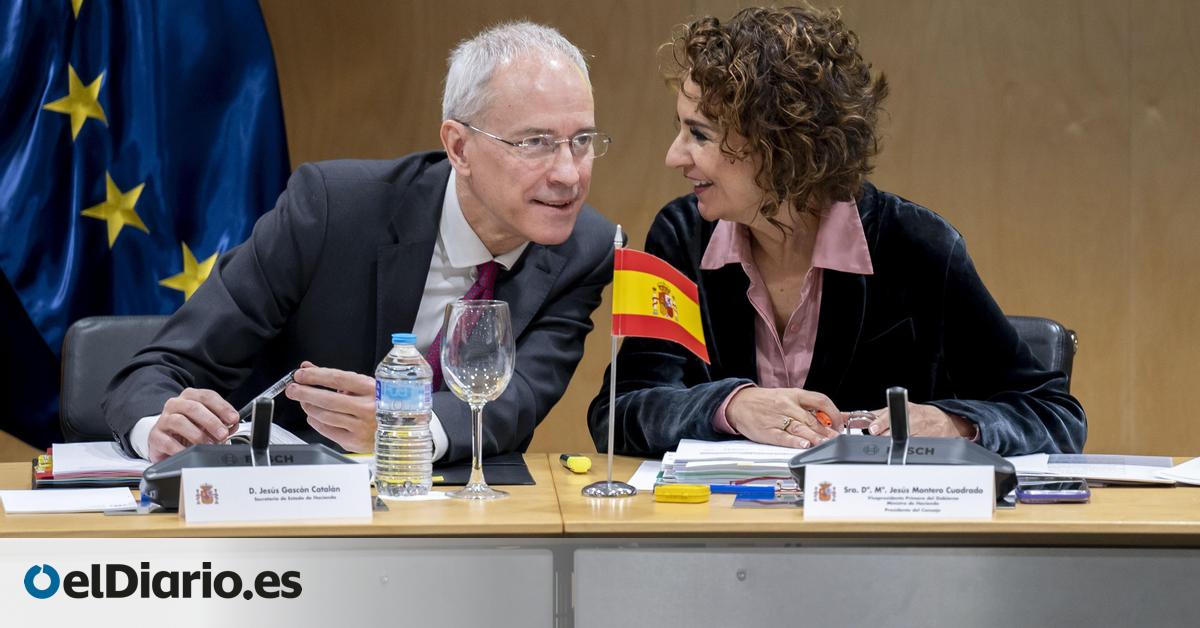
The Government has informed the autonomous communities that membership in the new financing system proposed by the Government will be voluntary, something that is already established in the 2009 Law, which will allow regions that wish to remain with the model that has expired since 2014.
Sources from the Ministry of Finance detail that the first vice president, María Jesús Montero, has opened the door for only those communities that consider it to subscribe to the new model, allowing them to continue with the one designed during the Zapatero Government.
It would not be the first time that some of the communities have abandoned the current model to continue with the previous one. It already happened between 1997 and 2001, when the communities led by the PSOE (Andalusia, Extremadura and Castilla-La Mancha) rejected the one designed by the Executive of José María Aznar and continued with the one that was in progress at that time. In fact, the Executive remembers that it is something that is already in force in the 2009 law.
The Government has presented to the Fiscal and Financial Policy Council (CPFF), the mutilateral body that brings together the Treasury with the regional officials in the sector, the proposal to reform the regional financing model that the Executive closed with ERC. The Montero approach represents almost 21,000 million euros more resources for the communities, through a greater transfer of the main taxes (IRPF and VAT) and additional transfers by the State, in addition to other mechanisms.
The meeting is merely informative, since the Government will not put the proposal to a vote until they have designed the law. The Executive will then convene a new Fiscal and Financial Policy Council, which some regional governments expect to be held at the end of February.
After this Wednesday’s meeting, in which the regional councilors of the PP (the majority) have charged against the proposal of the Ministry of Finance, the Executive will begin a series of bilateral meetings of a technical nature to delve into the details of the model.
“Champagne and caviar” for the independence movement
The counselor of the Junta de Andalucía, Carolina España (PP), said upon her arrival at the meeting that she came “with a lot of uncertainty and also with a lot of indignation” because the “Montero financing model” means “champagne and caviar” for the independence movement and “the menu of the day, but without dessert” for the rest of the communities. Andalusia is, precisely, one of the most benefited by the Montero project, since it would add 4.8 billion more than with the current system.
Criticism that has also been joined by the Government of Castilla-La Mancha, led by Emiliano García Page’s PSOE. The person in charge of Castilian-La Mancha, Juan Alfonso Ruiz Molina, has described the proposal agreed with ERC as “lack of respect”.
The new model designed by the Ministry of Finance foresees an injection of an additional 21,000 million euros, increasing the total financing available to the autonomous communities to 224,057 million in 2027, when it would come into force.
These amounts come from a greater transfer of the main taxes: personal income tax (from 50 to 55% of the collection) and VAT (from 50 to 56.5%), as well as an additional contribution from the State that the Treasury has estimated at 19,000 million for next year.
For the distribution of resources, the Government has designed a methodology that calculates the adjusted population. That is, the population residing in a territory, weighted by a series of variables (such as aging or university students from other communities, for example) that should bring this figure closer to the true needs of a region to cover its public services.
The Treasury has also projected a climate fund of 1,000 million euros, of which two thirds will go to Mediterranean communities; and another additional adjustment worth 400 million so that no autonomy obtains fewer resources than it would receive with the system currently in force. In addition, it opens the door for the territories that request it to receive a part of the VAT collection from SMEs that is generated in their territory.
With this system, according to the Executive’s calculations, the difference between the best and worst financed communities would be reduced from the currently adjusted 1,500 euros per inhabitant to around 700 euros, less than half.
The proposal outlined on Friday by the first vice president and Minister of Finance, María Jesús Montero, has received the endorsement of the rating agency Standard & Poor’s, which highlights the greater resources that the communities will receive. This would bring them closer to the objective pursued by the Treasury: that regional governments can finance themselves in the markets and submit to their discipline. But he doubts whether it will move forward, precisely because of the precariousness of the majority that supports the Government.
Source: www.eldiario.es