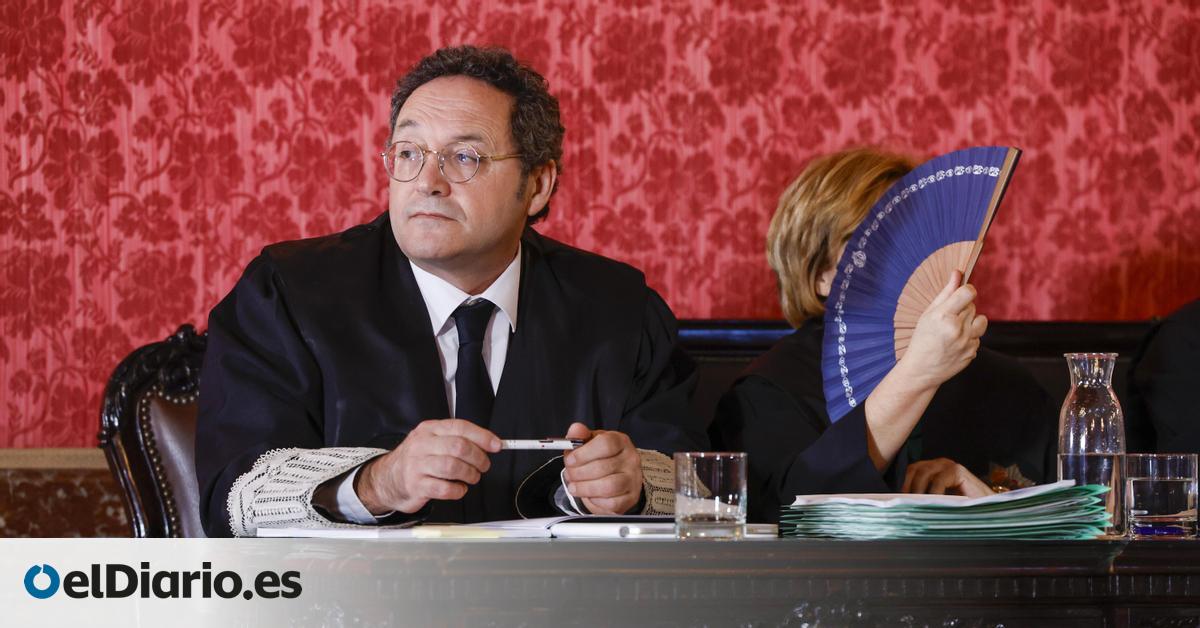
The former State Attorney General, Álvaro García Ortiz, will ask the Supreme Court to annul the sentence that condemns him to two years of disqualification for the leak of the confession of businessman Alberto González Amador, partner of Isabel Díaz Ayuso and prosecuted for two tax crimes. In addition to the annulment incident, the State Attorney’s Office, which exercises its defense, will register another document in which it will demand the suspension of the execution of the sentence, as confirmed by legal sources to elDiario.es. The deadline to challenge these writings is January 13.
With this second request, the State Attorney’s Office intends to postpone the application of the Supreme Court ruling until the annulment incident is resolved. In addition to the disqualification, the Court imposed a fine of 7,200 euros on García Ortiz and the obligation to compensate Ayuso’s partner with 10,000 euros. The presentation of an incident of nullity is a prior and obligatory procedure to file an appeal for protection before the Constitutional Court. The Supreme Court ruling is final and cannot be challenged, so you can only request its annulment and then be able to go to the guarantee court.
The State Attorney’s Office will defend in its brief that the sentence signed by judges Andrés Martínez Arrieta, Manuel Marchena, Juan Ramón Berdugo, Antonio del Moral and Carmen Lamela violates fundamental rights of the former top representative of the Public Ministry. Among them, the right to the presumption of innocence, to criminal legality and to effective judicial protection.
In addition, the State’s legal services were also considering alleging a loss of the appearance of impartiality on the part of the court that tried García Ortiz due to the participation of three of the magistrates as speakers in a paid course organized by the Madrid Bar Association (ICAM) that began one day after the oral hearing ended. These are Andrés Martínez Arrieta, president of the court that tried García Ortiz, and judges Juan Ramón Berdugo and Antonio del Moral. The decision whether to include this aspect in your writing will not be made until the last minute.
The ICAM filed the first complaint against the Prosecutor’s Office and brought the popular accusation against García Ortiz in the trial. This last magistrate, in addition, was for several years the director of the thesis of the lawyer representing Isabel Díaz Ayuso’s partner.
The sessions in which they gave presentations took place on November 17, 18 and 19, coinciding with the deliberations of the ruling. Training is mandatory to access the specific job shift, it has been carried out for years and has a remuneration for speakers of 90 euros per hour. In this edition, Martínez Arrieta taught two hours of class, which meant a remuneration of 180 euros; and Del Moral and Berdugo four hours each, for which they would receive 360 euros. Del Moral also received 270 euros for his work as course coordinator, which brings his total remuneration to 630 euros.
This factor relating to the independence of three of the magistrates who signed his sentence was not revealed as a preliminary issue or as a formal challenge. The Supreme Court itself, when rejecting a complaint against President Andrés Martínez Arrieta for revealing secrets of the deliberations during one of the ICAM courses, established that this would have been the way to question the appearance of impartiality of these judges.
Among other complaints that the State Attorney’s Office plans to raise are some that were already exposed during the trial: that the search of the Central Operational Unit (UCO) in the attorney general’s office violated their rights or that being accused and convicted by the press release, when the Supreme Court itself said that it was not criminal when it agreed to open the case, also violates the accusatory principle. There will also be allegations about the court’s assessment of the testimony of the journalists who, despite explaining that they knew González Amador’s email before the accused himself, were not taken into account in an exculpatory manner.
Suspending your sentence: from disqualification to fine
Incidents of annulment are not a resource but they are the only way to challenge a final ruling of the Supreme Court through ordinary means. The usual practice of the Criminal Court, unless there is some type of error that must be corrected, is to reject this type of allegations, although in this case there is the possibility that it will not be a unanimous rejection. The two judges who already voted against the conviction, Susana Polo and Ana Ferrer, will have the opportunity to once again show their disagreement in this procedure, as they already did with the case of the ERE of Andalusia.
The reasons for the annulment incident that the State Attorney’s Office will raise in the coming days are very similar to those already filed at the end of last year by the Prosecutor’s Office. And although they have little prospect of success – it would mean that the same judges who signed the sentence now deny it – it is a necessary step before being able to go before the Constitutional Court.
This incident of annulment will be accompanied by a second request for the Supreme Court: to provisionally suspend the execution of his sentence. Both the two-year disqualification from being able to serve as attorney general – a position in which García Ortiz was already replaced weeks ago by Teresa Peramato – and the financial part of his sentence, the payment of 10,000 euros to Ayuso’s partner and a fine of 7,200 euros.
The former attorney general’s request comes while his successor is pending the management of the consequences of García Ortiz’s criminal conviction: if, in addition to being disqualified as attorney general, he also loses his status as a member of the race, to which he has belonged since the 1990s. The internal regulations of the Prosecutor’s Office include the possibility of expelling a prosecutor convicted of an intentional crime, but also recognizes the power of the attorney general to change this punishment for a less burdensome one.
Source: www.eldiario.es