When force tries to trample the right
There are statements that do not go unnoticed because they say more about the world than about the fact itself. That’s what happened when Celso de Mello, former dean of the Federal Supreme Court, broke the protocol tone and called things by name: the capture of Nicolás Maduro by the United States would, according to him, be an armed kidnapping. Not a sophisticated legal operation, not a civilizing gesture, but an international crime with unpredictable consequences.
The speech, made to SBT News, fell like a stone into the already turbulent lake of Latin American geopolitics. Waves spread beyond Venezuela. After all, when a powerful country decides to act outside the rules, the message is not restricted to the immediate target. It echoes across the region — and the world.
Latin America is not a backyard
Celso de Mello did not spare words or historical memory. When commenting on the United States’ stance, the jurist evoked ghosts that many believed buried. Old doctrines, now recycled, return to the scene with a military veneer and authoritative discourse.
“The American intention to restore anachronistic doctrines, with militarized guise, constitutes blatant disrespect for the Latin American peoples. Latin America is not a protectorate, nor is it an area of national security for any power. The people of this region fought, paid in blood, to gain their independence and consolidate their own constitutional regimes, plural, socially sensitive and dedicated to peace. New forms of imperialism disguised as a “renewed” doctrine cannot be tolerated (Corollary Trump to the Monroe Doctrine), much less admitting that History goes back to the unfortunate times of the “big stick” policy, when the “club” (military power) spoke louder than International Law, and legal reason was replaced by geopolitical arbitrariness”.
The message is direct. Latin America no longer accepts being treated as an automatic zone of influence. Not after dictatorships, interventions, coups and decades of forced dependence. There is a limit. And it’s called sovereignty.
When force replaces law
Throughout his career at the STF, Celso de Mello built a reputation as a radical defender of constitutionalism and international law. It is not surprising, therefore, that he views the replacement of diplomacy by coercion with extreme concern.
For the former minister, the defense of sovereignty goes beyond nice speeches in international assemblies. It is about imposing real limits on the use of force. According to him, the foreign policy adopted by Donald Trump ignores the United Nations Charter and relies on intimidation as a method.
“No repressive convenience authorizes replacing international cooperation treaties and agreements with kidnapping, which constitutes an essentially criminal act.”
The sentence is harsh because it needs to be. There are legal mechanisms to deal with conflicts between States: extradition, legal cooperation, international courts. Ignoring these paths means establishing a dangerous logic, in which the law only applies when it suits the strongest.
Borders for the weak, rules for the few
In Mello’s view, this type of action creates a toxic precedent. If a powerful country can ignore borders and agreements, why wouldn’t others do the same? The result is a more unstable, less predictable and much more violent world.
Even recognizing that the United States Supreme Court has precedents that allow it to judge illegally captured people, the former dean makes a crucial reservation: the criminal jurisdiction cannot act as if nothing had happened. The initial crime — kidnapping — does not disappear for political convenience.
Here, the criticism takes on broader contours. This is not just about Venezuela or Maduro. This is the principle that international law cannot be a disposable ornament.
Read also: Latin America is not a backyard, says Celso de Mello about Trump
Imperial arrogance and contempt for the vulnerable
Celso de Mello also connects the dots. For him, the aggressive external stance goes hand in hand with an internal policy marked by hostility towards the most fragile. Immigrants, refugees and peripheral countries fall into the same basket of indifference.
He points to “imperial arrogance” as a central feature of Trumpism. A project that disregards humanitarian commitments, ridicules other people’s sovereignties and treats smaller nations as negotiable pieces. In place of a rules-based multipolar order, the logic of “who can do the most” emerges.
It’s not just an ideological criticism. It’s a warning.
The warning that cannot be ignored
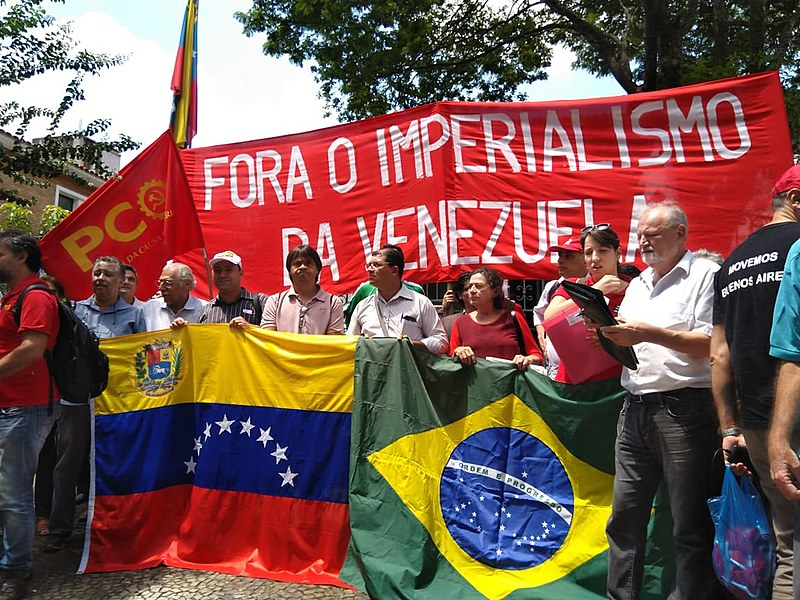
In a demonstration held this Sunday (4), Celso de Mello made it clear that the episode could be just the beginning. The ambition to interfere in other Western countries, according to him, threatens the basic right of each people to decide their own destiny.
The week’s chronicle, therefore, does not just talk about a possible international kidnapping. She talks about the return of a world where the club once again replaces dialogue. Where force tries to silence the right. And where Latin America, once again, needs to remember that its history does not authorize setbacks.
Ignoring this warning could be costly. Much more expensive than many seem willing to admit.
Source: https://www.ocafezinho.com/2026/01/09/sequestro-internacional-e-o-retorno-do-porrete/