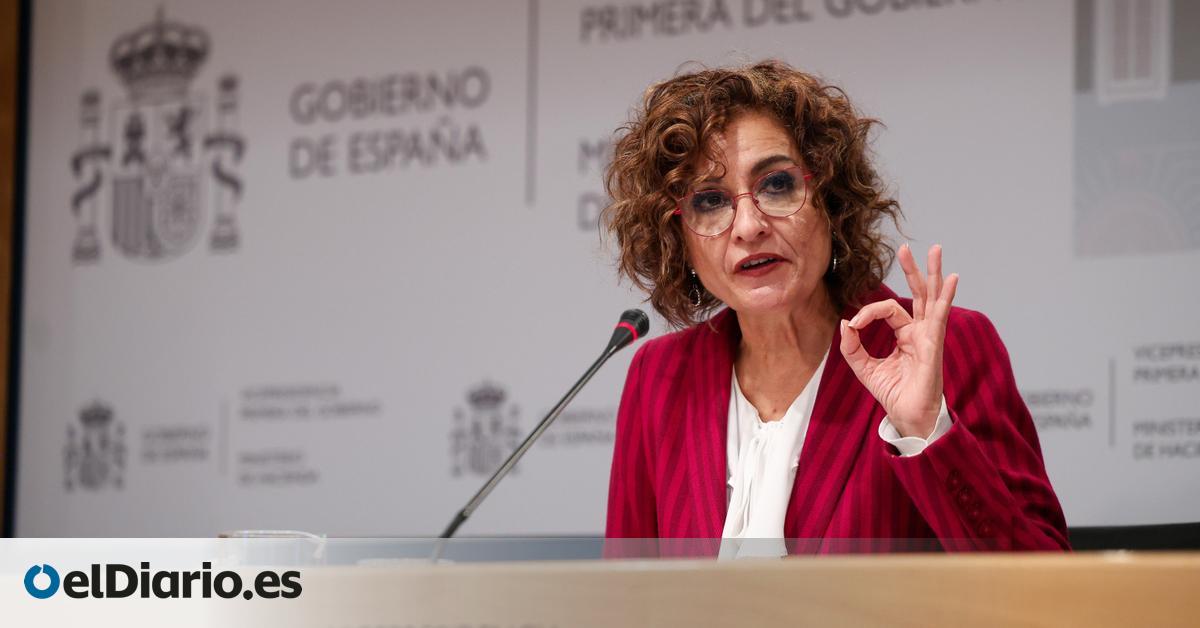
It is a debate that has been going on for more than a decade and in which positions transcend ideology to establish transversal alliances between PP and PSOE based on the particularities of the territories, but those of Alberto Núñez Feijóo anticipated their rejection of the new regional financing model even before the vice president and Minister of Finance, María Jesús Montero, presented it. Once the figures – albeit partial – are on the table (an increase in funds to 224,507 million euros in 2027, which translates into an additional 21,000 million euros for the autonomies), the PP has made it clear that it will make this proposal a new the events of war against Pedro Sánchez, including judicial means, and the first round of the battle will take place in the Fiscal and Financial Policy Council next Wednesday.
The popular ones have not entered into the fine print of a system that very few understand and that escapes the vast majority of the electorate. And there they find a new battering ram against the Government with very simple messages that everyone understands, whether they are true or not. “Sánchez kicked the unity of Spain and the equality of all Spaniards,” said the PP’s deputy secretary of Autonomous, Local Policy and Electoral Analysis, Elías Bendodo.
The PP’s argument basically involves attacking the regional financing model under the premise that it benefits Catalonia more. The Government left it in the hands of the ERC leader, Oriol Junqueras, to communicate the agreed proposal and the Republican emphasized the principle of ordinality, which means that communities receive financing based on their contribution to the common fund. The system reduces the disparities that have existed until now. The maximum distance between the one who receives the most and the least is reduced from more than 1,600 euros to less than 900 euros between the old and the new model, according to sources familiar with the system. What there was consensus on was that the current model, which had expired since 2014, was unfair for everyone.
Appeals to the Constitutional Court without seeing the fine print
However, the Ministry of Finance has not provided global data on the new regional financing system but rather the increase figures for each autonomous community. With their calculations, it is Andalusia (with an additional 4,846 million) that comes out best in absolute figures and is followed by Catalonia (an extra 4,686 million). Behind these two is the Valencian Community (3,669 million), which was one of the most underfinanced with the current model. Madrid follows, with 2,555 million euros. With a similar population figure, Madrid would gain half as much as Catalonia with the new model. If the population is taken into account, but without adjusting it to the singularities of each region, Murcia (with 743 euros per inhabitant) and Comunitat Valenciana (with 668 euros) are the regions that earn the most, according to elDiario.es calculation.
Precisely the executives of Andalusia and the Valencian Community have been the most cautious when it comes to speaking out on the proposal that the vice president has presented to journalists for more than two hours. The Government of Isabel Díaz Ayuso has been one of the most belligerent. “It is harming the people of Madrid because with the taxes of the people of Madrid we are going to have to provide more resources to finance this whole independence party and this whole new system that fundamentally benefits those who benefit the most,” said the Minister of Economy, Finance and Employment, Rocío Albert, who has revolted against the accusations of dumping Treasury prosecutor for the elimination of taxes in the region that represents unfair competition for other territories.
Although it is one of the territories that would receive the most additional money, the Community of Madrid has anticipated an appeal to the Constitutional Court if the model is approved. Extremadura, Castilla y León, Aragón and Murcia have also advanced it. In the case of Extremadura, the acting Treasury Minister, Elena Manzano, has denounced that the region will not receive “not one cent more”, although Montero has specified that both Extremadura and Cantabria will be compensated with the Compensation Fund and will receive 216 and 46 million more, respectively.
“Sánchez pays 4.7 billion euros to stay in power. It enshrines an unconstitutional principle, the principle of ordinality that territorializes income,” added the counselor in reference to the ranking of receiving income based on contributions, despite the fact that this principle will not be followed to the letter. The Minister of Finance has pointed out that the figure will not be homogeneous and has given two communities in the hands of the PP as an example: “The financing per adjusted inhabitant of Cantabria is higher than that of Madrid and, if it had a principle of ordinality, Madrid would have to be above it.”
Exploit the differences in the PP
The Government is going to exploit the internal disagreements of the PP. “If the Popular Party does not have a single position, it is not possible to agree on the model with the Popular Party, which is what has happened,” Montero said: “Mr. Feijóo does not have enough leadership to put a proposal on the table.” “They are going to say no out of pure partisan interest and political sectarianism,” criticized the vice president: “It seems difficult to me that the Popular Party can say no to this financing model.” Montero recalled that around 70% of the additional resources will go to communities governed by the right.
For the Executive, it is incomprehensible and inexplicable for citizens to reject a system that increases the funds of all communities for the maintenance of public services, and also increases the transfer of taxes such as personal income tax or VAT. The regional financing system is now entering the battle of the story in which the right is clear in its argument: as Catalonia gains more, singularities are recognized and concessions are made in tax matters, in addition to seeking to impose limits on tax exemptions to avoid dumping fiscal, “we are facing an ideological political financing system that responds to a principle of survival of Pedro Sánchez,” in the words of the PP spokesperson on the matter.
The other strategy of the Executive is to attack the PP for its desire to privatize public services that are underfinanced where they govern while companies take a profit. “I hope that this money will improve the lives of citizens and not the interests of a few, as seems to be happening in some communities now,” Montero expressed about the increase in funds for the communities: “In the end we are transferring more resources to the autonomous communities every day and, however, the citizens do not notice, on the contrary, they perceive a deterioration in the quality of these public services.” “It makes no sense that this happens due to the privatization interest of the Popular Party, which allocates the majority of these new resources to private healthcare or private universities and, therefore, not allowing the public system to be strengthened,” he concluded.
Junts wants the concert for Catalonia
The Government assumes that it will not have the support of the PP in Congress, but it is not the only difficulty encountered in carrying out this autonomous financing law that Montero wants to bring to Parliament around the summer and that requires a simple majority (more if it is what noes) to be approved.
Junts has reiterated its rejection of the proposal and demands to “transition” from the financing model agreed with the Government towards the economic agreement. “14 deputies in Madrid can make it possible,” the vice president of the party, Antoni Castellá, told ERC. According to Castellà, Junts will present an amendment to the entirety with alternative text to remove Catalonia from the common regime and bring it to a system like that of Navarra or the Basque Country, the EFE Agency reports. However, it is an approach that the Ministry of Finance flatly rejects. Government sources pointed out after the presentation of the financing system that “they should apologize” to those who claimed that Montero, also a candidate for the elections in Andalusia, would propose a Catalan ‘quota’.
Page revolts against the proposal and the PSOE avoids the clash
However, it was the president of Castilla-La Mancha, Emiliano García-Page, who was the most critical of the Treasury proposal. “Before an attack of this nature advances to what we are as a country, and the independentists decide how the wealth of Spain is distributed, – of that Spain that they want to break up –, before that, I prefer that the Spaniards speak,” he blurted out. “You cannot consider this country as an immense nursery in which you can impose a story, an argument and it comes to crowing about what are traps one after another,” he said in reference to the new model that he described as “the greatest attack on equality that has occurred in any democracy.”
According to Treasury figures, Castilla-La Mancha would be the fifth community that would increase its income the most, with an additional 1,248 million (for each inhabitant it would mean 583 more euros compared to 572 for each Catalan). What the Page Government argues is that the starting point was very low given that it was one of the four autonomies, along with Comunitat Valenciana, Murcia and Andalusia, that were underfinanced with the current model. “Catalonia today receives 3,015 euros per inhabitant (above the national average); Castilla-La Mancha receives 2,814 euros per inhabitant, below the average. Despite this “slight improvement per inhabitant” (which is also only 1 euro with the population as of July 1) the difference remains the same. Catalonia will be even more above the national average and Castilla-La Mancha will remain below it,” they argue from the PSOE. regional.
The La Mancha Executive is very angry with the partiality of the data that Montero has shown: “With the complete figures we are below average.” Furthermore, they do not share the criteria that are applied in the new system or the way in which that model has been arrived at. “Ordinality is unbearable,” say sources close to Page, who consider that “fiscal progressivity is burdened for the remains.” “He who has the most and he who gives the most has the right to receive more,” they argue. “Amancio Ortega would have the right to be treated in public health better than me because he contributes more,” exemplifies one leader. The argument that funds increase does not work for Page because he maintains that “there is more cake for the richest to eat more.”
In Moncloa and Ferraz they are accustomed to disagreements with Page, who has been the main critical voice internally against Sánchez throughout the legislature and, although they avoid entering into confrontation, the socialist leadership is upset that he is a thorn in the side in an already complicated mandate. “We are sure that Page knows that with this Government Castilla-La Mancha wins. And we are going to continue working until the end of the legislature for the benefit of all citizens,” they limit themselves to answering in the direction of the PSOE.
Source: www.eldiario.es