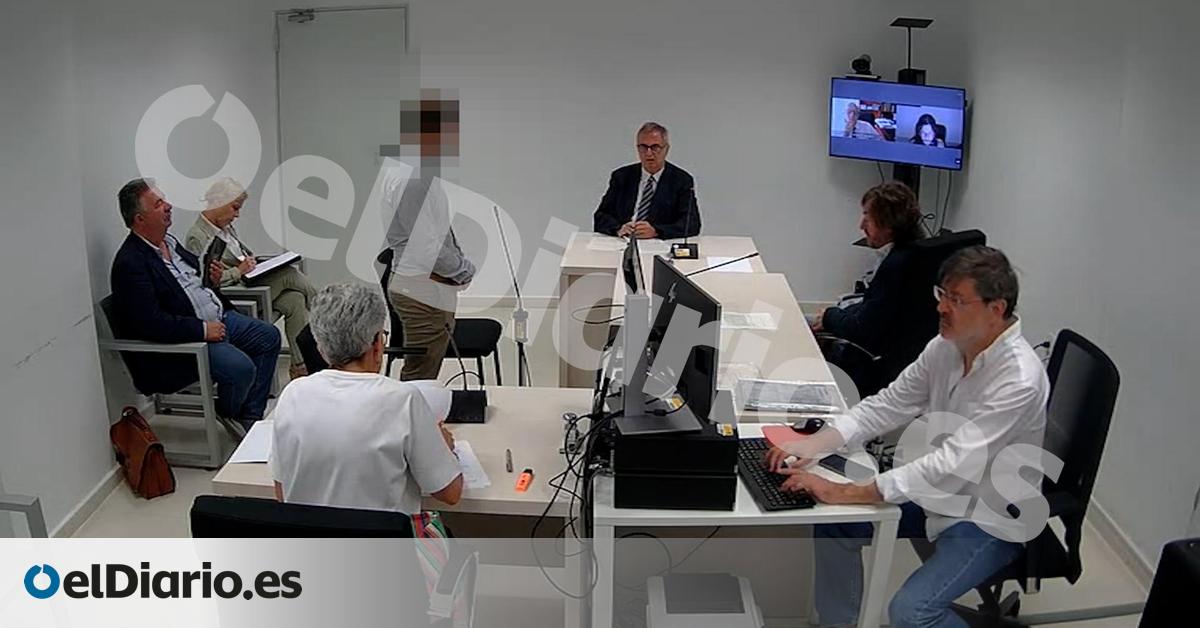
The scene took place on July 3 and has remained unpublished until now. In the National Court, a chief inspector of the Anti-Drug Police testifies because his code appears in a search for Pablo Iglesias in March 2016, in the full fury of the political brigade against Podemos to prevent him from reaching the Government. The command assures that it introduced the name of Iglesias because another founder of Podemos, Miguel Urbán, was being investigated in a drug trafficking case – a crude setup whose details were offered by elDiario.es – and that it “always” investigates “the closest environment” of the suspects. It is then that the prosecutor in the case, Vicente González Mota, asks him if the same action was taken in the Gürtel case. “Was Don Mariano Rajoy’s police file investigated?” “I don’t know,” the policeman answers.
The video of the statement, which elDiario.es plays today, condenses in just a few seconds the spirit of the police maneuvers against the opposition during Mariano Rajoy’s first term in office, whether they were Catalan independentists or members of Podemos. The police commanders try to frame them in the normality of their investigative work and deny any political slogans, but the facts contradict them. In the first half of 2016, between the elections of the previous December and those of June of that year, the majority of false journalistic information about Podemos was concentrated, which included police reports without a signature, seal or foundation.
One of these maneuvers was called Operation Cardinal. Based on the alleged testimony of a confidant, one of the members of the political brigade at the service of the Popular Party, Commissioner José Luis Olivera, convinced the Anti-Drug Prosecutor’s Office to open investigation proceedings into the sale of 40 kilos of cocaine by Miguel Urbán in a pub in Malasaña with the confessed intention of financing Podemos. The police leadership managed to involve the specialized Anti-Drug unit, Udyco. One of his inspectors sought information from Pablo Iglesias with the argument that the Podemos leader was “the closest entourage” of the “leader” of the drug trafficking organization, the then MEP Miguel Urbán.
The investigation of the dirty war against Podemos based on a complaint filed by the party revealed a long list of police inquiries about members of the party, most of them parliamentarians. The Internal Affairs Unit obtained that one of these searches occurred within the framework of Operation Cardenal, the fanciful story of the sale of cocaine by Urbán. On July 3, the then inspector who carried out the search for Pablo Iglesias went to testify as a defendant in the court led by Santiago Pedraz.
Prosecutor González Mota asked the police officer if there is “a protocol” that indicates that if the financing of a party through drug trafficking is investigated, the police bases must be consulted in search of the background of its leader. “No, I acted as I act with the rest of the actions, the closest environment is investigated to see if they are involved. But no one tells me ‘you have to look at this person’ or another,” responded the chief inspector.
The prosecutor wants to know what led him to think that, according to an alleged sale of cocaine by Miguel Urbán, it would be advisable to check if Pablo Iglesias had a criminal record. “I consult the data of Mr. Pablo Iglesias because when I see that it is Miguel Urbán who the investigation proceedings supposedly indicate as the leader or the one who carries out the transfer of 40 kilos of cocaine, as is done in the rest of the investigations, we look at the closest environment. As he is a co-founder of Podemos, there are Pablo Iglesias and other people. We act in the same way with other investigations and as I have acted for nine years,” the police officer answered.
The agent’s defense requested that the case against him be filed after the statement and Judge Pedraz agreed. But the private prosecution, exercised by Podemos, appealed the decision and the Criminal Chamber ordered the magistrate to re-indict the chief inspector of Udyco. In this way, the Anti-Drug police officer joined the Secretary of State for Security Francisco Martínez and other commanders who made up the PP political brigade.
One of the conversations that gave rise to the case in the National Court was intervened in the Kitchen case between Martínez and Commissioner Enrique García Castaño when the politician asked for background information on Podemos parliamentarians via WhatsApp and the police officer responded that the search had a negative result. “Did those from Podemos not have a record? Screw me,” Martínez wrote on WhatsApp. Another of those investigated in the databases based on the cocaine setup was Senator Josetxo Arrieta, convicted by the Franco regime in relation to his activity in ETA and benefited from the 1977 amnesty.
By ruling out the existence of a protocol that would justify the search on Iglesias, prosecutor González Mota is moving forward in another way: confirming whether it is a common practice to investigate party leaders when there is suspicion of a crime in any of the members of the party, in this case from a unit against drug trafficking and organized crime. That is why he asks the agent if he knew of the existence of the Gürtel case in 2016. This is when González Mota says: “Do you know if Mariano Rajoy’s police file was investigated?” “I don’t know,” responds the chief inspector.
In recent days, Judge Pedraz has ordered a battery of proceedings that promote the case of the dirty war against Podemos. On January 21, the victim of the cocaine conspiracy, Miguel Urbán, will testify at the National Court. A day later, two police officers, whom José Luis Olivera, the architect of the setup, pointed out during his testimony as a witness, will do so. Both were his subordinates at the Intelligence Center against Organized Crime and Terrorism (CITCO) in 2016.
Source: www.eldiario.es