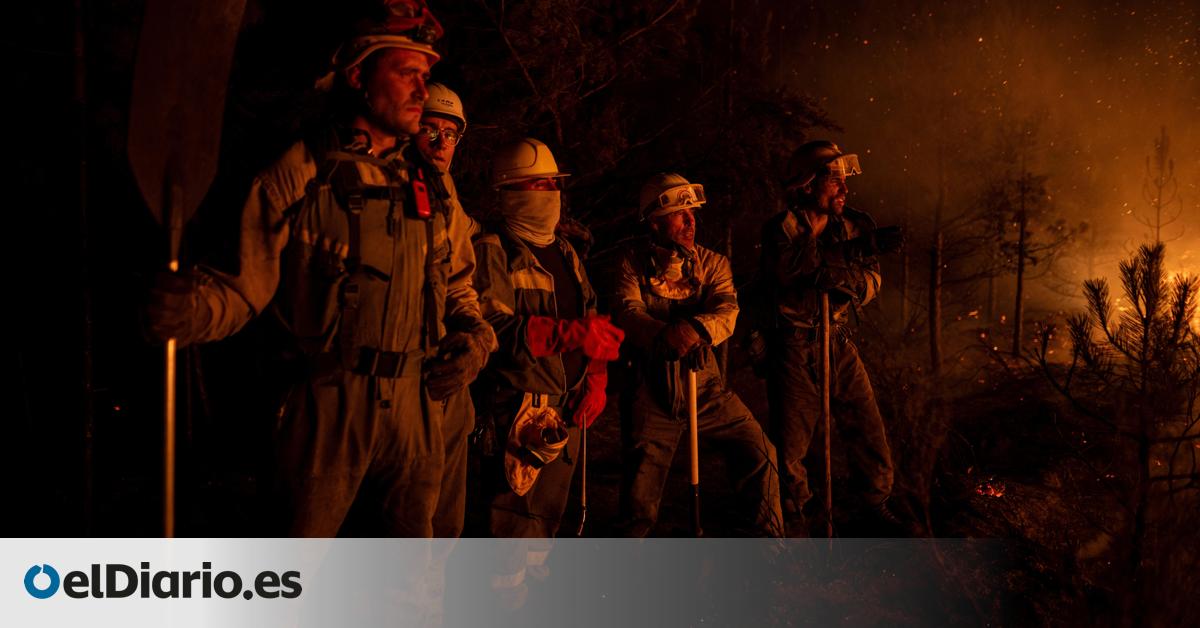
The 400,000 hectares of forest devastated in Spain by the forest fires last summer have been one of the worst global climate disasters of all of 2025, according to the annual review carried out by the Christian Aid organization: “One of its most devastating fire seasons.”
Spain has been appearing in the rankings of the most severe climate impacts carried out by Christian Aid for several years. In 2024 it was the damage that hit Valencia especially that was noted as one of the most costly disasters and in 2023 it was the drought.
Forest fires, drought and floods – the trident of the new climate normality that global warming has brought to Spain – demonstrate the high degree of vulnerability that the country has to the climate crisis, despite the slowdown in green policies generated by the neo-negationism of the right and the international and Spanish extreme right.
These disasters are not ‘natural. They are the predictable result of continued fossil fuel expansion and political lag.
Joanna Haigh.
— Professor Emeritus at Imperial College London
“These disasters are not natural“explains Joanna Haigh, emeritus professor at Imperial College London. “They are the predictable result of the continued expansion of fossil fuels and political delay,” says this lead author of the UN Panel of Experts on Climate Change (IPCC).
Among these violent events, the report indicates other fires, in this case the fires that devastated the Los Angeles area (USA) in January 2025, as the most costly in economic terms of the course: more than 60,000 million dollars and 31 people died directly plus another 400 indirectly.
Also highlighted are the cyclones that hit Southeast Asia in November with 25 billion in losses and more than 1,700 lives, the floods last summer in China, Hurricane Melissa that devastatingly crossed the Caribbean and the drought that hit Brazil.
No part of the world has been spared from receiving very severe impacts. Typhoons in the Philippines, Cyclone Alfred in Australia, Garance on Reunion Island have spread disasters across all continents. The climate crisis is a total crisis.
In this way, a calendar and a map are completed that, each course, reflects how climate change is not a mere projection of the future, but an already present reality. In fact, “the economic impact of disasters is measurable: 28 trillion dollars between 1990 and 2020,” this report recalls. But, “despite growing scientific evidence of the damage caused by continuing to rely on fossil fuels, the world continues on its path of consuming these fuels,” the work concludes.
A path that the main producers of oil, coal and gas want to take forward to increase their production (and sale) of these products. Fossil fuels to which we are still stuck, as the last Climate Summit in Brazil has shown.
The most precarious are the ones who suffer the most
“This year has shown us, once again, the stark reality of climate collapse,” stresses Christian Aid CEO Patrick Watt. “These disasters warn us of what awaits us if we do not accelerate the abandonment of fossil fuels,” he continues. And he concludes: “The suffering caused by this crisis is a political option directed by the decisions to continue burning fossil fuels that end up affecting the most precarious first and hardest.”
Burning these fossils increases the layer of greenhouse gases that warms the planet and collapses the climate as humanity has known it. The accumulation of CO₂ in the atmosphere continues to grow without brakes as measurements by the World Meteorological Organization have shown in 2025.
One caveat that Christian Aid includes in its 2025 outlook is that when it attributes economic damage, its vision is limited to areas where there is insurance that values the assets that are destroyed. “That is why some of the worst disasters that have happened in impoverished countries do not climb places on the economic list, but they were just as devastating and affected millions of people.” Furthermore, these countries are the ones that have contributed the least to climate change because their historical CO₂ emissions are very low.
As an example of these extreme episodes, the document recalls that Nigeria suffered a major flood last May and Congo another in April. “The drought in Iran and West Asia threatens ten million people with a possible mass evacuation due to lack of water,” they add.
This year, even “very unusual” episodes have been observed that have caused climate change due to the greenhouse effect of CO₂ accumulated in the atmosphere due to emissions. The work points out that in Scotland an unprecedented heat wave led to forest fires in the Highlands that burned 47,000 hectares. In Japan they had to face a year with unprecedented snow storms and record high temperatures.
Source: www.eldiario.es