Trump will continue to be a threat to the green agenda and EU technology regulation in 2026. It has been of little use that Brussels has eliminated the EU’s total ban on combustion engines by 2035 or that environmental requirements for companies have been reduced. The US president continues to approve measures against the EU, from tariffs to the prohibition of certain European citizens from entering the country, as a form of pressure to try to get European institutions to change their rules and favor American companies.
The United States Trade Representative, Jamieson Greer, has once again put the EU in his sights both for regulation on sustainability and for the rules that affect technology companies. “We have gigantic imbalances. It is not because Europe is really competitive. We know it is not. It is because they have many of these rules that prevent American goods and services from entering the continent,” he declared.
Greer has pointed out that dealing with regulatory conditions with Europe has represented a greater challenge than doing so with countries like India or China during 2025. The European Commission defends itself by remembering that “the EU is an open and rules-based single market, with the sovereign right to regulate economic activity in accordance with our democratic values and international commitments.”
Although European standards on the environment and sustainability for companies have been greatly lowered, the European directives on Corporate Sustainability Information and Sustainability Due Diligence are assumed on the other side of the Atlantic as a source of problems for American companies. In a vote where the conservatives and the extreme right converged, which could change the European political landscape, the EU exempts 80% of companies from environmental obligations, although they will continue to apply to large foreign companies that do business in Europe.
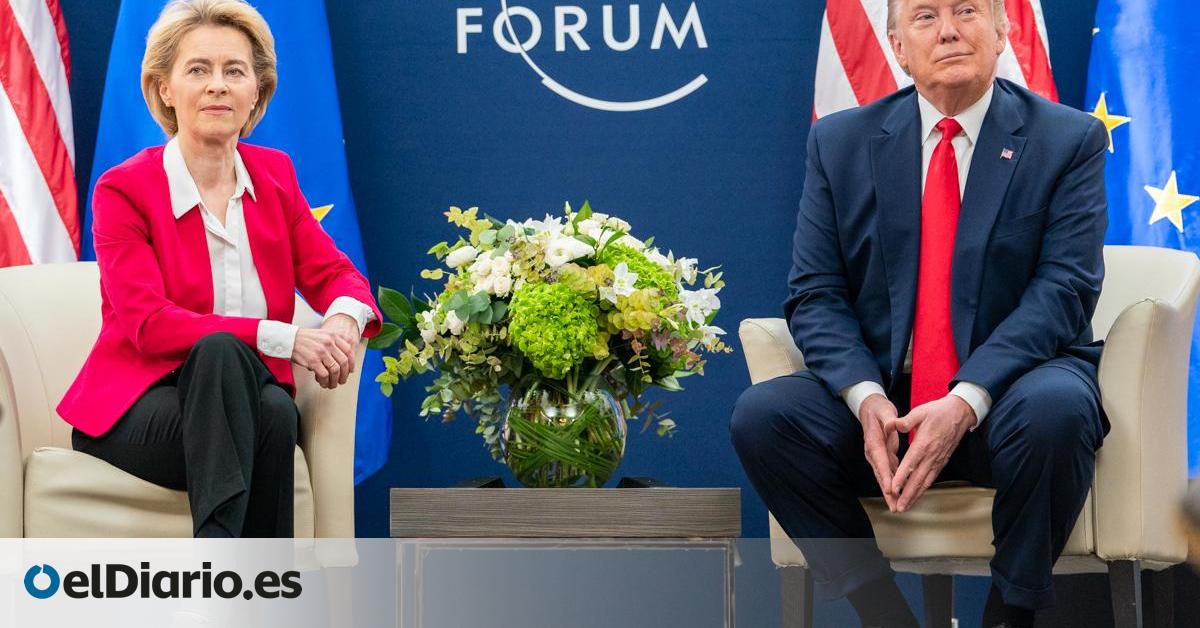
This is where the US has shown its fiercest opposition. Greer has described European regulations on sustainability as “inadequate” and recalled that the tariff agreement signed this year between Trump and the president of the European Commission, Ursula Von der Leyen, provides guarantees so that environmental legislation does not hinder the work of companies. The US Trade Representative has even suggested that the trade agreement could collapse if Europe does not make more concessions to US companies.
In response, Matthias Matthijs, senior fellow for Europe at the Council on Foreign Relations, and Nathalie Tocci, director of Istituto Affari Internazionali, argue in an article in Foreign Affairs magazine that “Green Deal politics is difficult, especially amid a cost-of-living crisis and slow growth. But the alternative, continued exposure to fossil fuels and geopolitical vulnerability, is much worse. The message should be clear: energy diversification is not just about “It is about climate change, but also about sovereignty. Furthermore, a credible green-industrial strategy would help create the high-tech jobs that nationalist parties say they want to defend. It would demonstrate that decarbonization and economic strength can reinforce each other in practice.”
The authors insist that Europe must “redouble efforts on the European Green Deal, which is currently being diluted through omnibus laws supported by the center-right and the far right.”
“Options such as repealing the directive entirely or limiting it only to EU-based companies were never viable, both to preserve a level playing field and to ensure a parliamentary majority,” Jorgen Warborn of the European People’s Party explained to Bloomberg. Warborn insists that although the scope of regulation has been lowered, “it is an extraterritorial instrument” in its scope of surveillance of companies’ value chains in areas such as violations of environmental aspects or human rights.
At the moment, according to Bloomberg, there is no perception of risk in the markets due to this legislation: funds domiciled in Europe that own US shares attracted 56 billion in investment until October. Now, the Trump Administration intends at all costs to further lower the regulations for its companies, advocating compliance with the tariff agreement of last July, where they were limited to 15% on EU exports and in return it was required that the laws not hinder trade. A spokesperson for the European Commission pointed out that these regulations allow all companies to operate on equal terms.
In the event of non-compliance with environmental and sustainability legislation, a company can face fines of up to 10 billion euros. Trump wants to end this rule, perhaps because he already foresees that large American companies are going to violate them.
Technological dependence and regulatory sovereignty
Giorgos Verdi, a researcher with the European Power program at the European Council on Foreign Relations, recalls that “three American giants provide 70% of Europe’s cloud computing infrastructure. American companies dominate phone operating systems in Europe, and OpenAI’s ChatGPT has become synonymous with the concept of AI. Starlink represents a near-monopoly in Europe’s satellite internet services, as does Nvidia in AI chips. The social media market—the digital marketplaces of European demos—is also dominated by American companies Meta and
Thus, Verdi adds that “Europe’s technological dependencies were a problem confined to the world of competition policy and innovation. But Trump’s second term in the White House has already transformed Europe’s excessive digital dependence into a geopolitical test. He has not hesitated to use the economic and technological dependencies of others in the pursuit of his own objectives.”
This has meant that the US Secretary of State for Commerce, Howard Lutnick, had no qualms about launching a kind of bribe so that the EU would lower the impact of its digital regulations with the large US technology companies in the midst of trade negotiations between the two blocs. “The idea is that if the EU drops this regulatory framework and makes it more attractive to our businesses, it can reap the benefit of hundreds of billions of dollars, possibly a trillion, of investment a year,” Lutnick noted.
The EU chose to give a piece of cake and a piece of sand. The most belligerent response came with a Spanish accent. EU Competition Vice-President Teresa Ribera responded by saying that “there may be those who prefer that we look the other way when big technology companies break our rules. We will not do it.”
They were not just words: Brussels sanctioned Apple and Meta with 500 and 200 million euros for violating digital laws, it also fined Google 2,950 million for abusive practices with digital advertising and has opened an investigation for manipulating media search results, and is also investigating Microsoft and Amazon for their market position in cloud services or has penalized X with 120 million for failing to comply with the obligations of transparency. All of this under the European Digital Services (DSA) and Digital Markets (DMA) laws, real headaches for the Trump Administration and US technology corporations, unaccustomed to having to deal with legislation that does not allow them to do whatever they want.
The sensitivity is so deep among US technology companies that even the compendium of recommendations to defend democracy that the European Commission has put in place has been assumed as intimidation by Elon Musk, the owner of the social network X.
In an attempt to try to reduce tensions with the US, the European Commission lowered the regulations on Artificial Intelligence (AI). High-risk AI practices, such as the creation of manipulated content, will have a 16-month moratorium so that companies can adapt to the new demands. NGOs describe the new regulation as “the biggest setback in fundamental digital rights in the history of the EU.”
“Counter unreasonable measures”
The movement, instead of calming the waters, has emboldened the Trump Administration, which has continued with its policy of threats. The Office of the US Trade Representative published a statement last week in which it noted that “if the EU and its Member States insist on continuing to restrict, limit and discourage the competitiveness of US service providers through discriminatory measures, the United States will have no choice but to begin using all the instruments at its disposal to counter unreasonable measures.”
According to the Trump Administration, complying with European legislation is “harassing” US providers of digital services with “discriminatory lawsuits, taxes, fines and directives”, so in the future “the United States will adopt a similar approach to other countries that follow a similar strategy to that of the EU in this area.”
Although the US does not have legislation to fine European technology companies, the Commerce Department’s statement directly mentions companies such as Capgemini, DHL, Publicis, SAP and Siemens. Faced with such a warning, the European Commission has assured that “the rules in the EU are applied equitably and fairly to all companies operating in the EU. We will continue to apply the regulations fairly and without discrimination.”
The conflict remains latent. Trump’s latest move has been the imposition of travel bans to the US on European citizens who have stood out for their position against hate speech on the internet. “For too long, European ideologues have led organized efforts to coerce American platforms and punish American opinions they oppose. The Trump administration will no longer tolerate these egregious acts of extraterritorial censorship,” argued US Secretary of State Marco Rubio.
Given the realistic dependence of the EU on certain American technologies, Verdi proposes that “Europeans must convert their political intentions into real capabilities. In this search, they will have to be selective and, above all, realistic. New and stronger capabilities at all levels cannot be built overnight. Decision-makers must start where the risks of militarization are greatest, the EU’s competitiveness is poor and defense security issues are a concern. Space, chips, cloud computing and AI are the “Success requires that the EU and its member states see the development of alternative capabilities in these technologies as an essential investment that will increase both their economic and military security. Ultimately, the question is not whether Europeans can afford to build their own technology, but whether they can afford not to.”
Source: www.eldiario.es