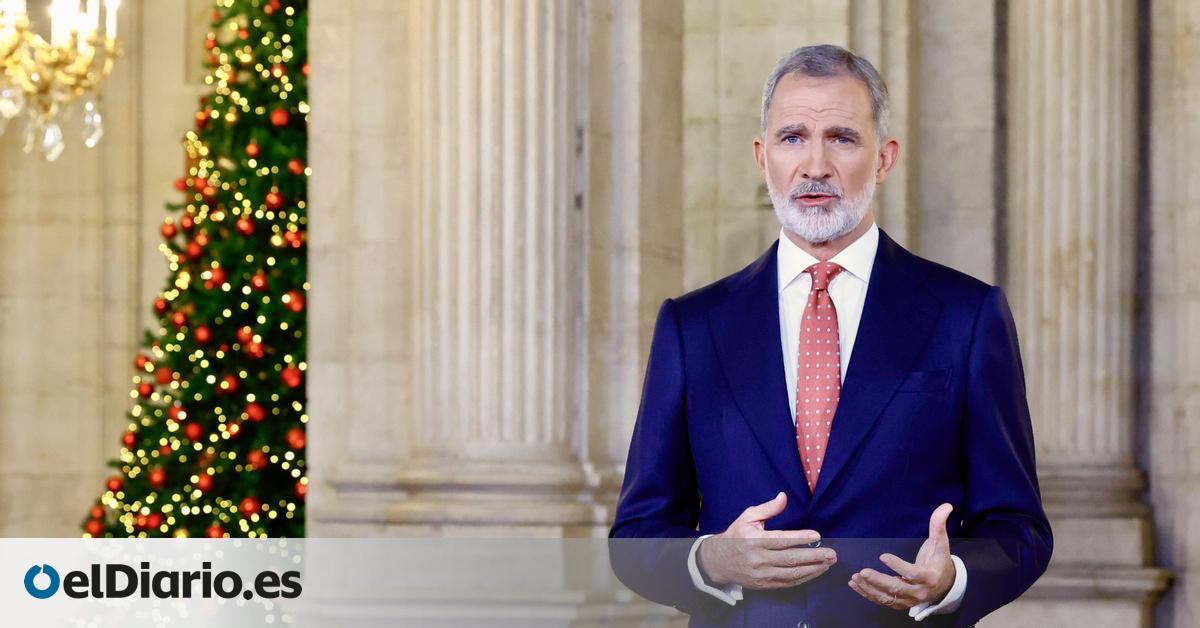
King Felipe VI has warned in his traditional Christmas message that “democratic societies are going through a disturbing crisis of confidence” that “seriously affects the spirit of citizens and the credibility of institutions.” From it, he said, “extremism, radicalism and populism” are “nourished”, which also feed “on misinformation, inequalities, disenchantment with the present and doubts about how to approach the future”. And he concluded: “It is up to all of us to preserve confidence in our democratic coexistence.”
This Christmas Eve, the head of state offered his twelfth Christmas message, the third from the Royal Palace and the second consecutive from the Hall of Columns, where 40 years ago Spain signed its accession to the European Communities, predecessors of the current EU. It was also where the premature abdication of his father, Juan Carlos I, was signed. As a novelty, Felipe VI has chosen this year to give his speech standing.
And there, last November, an official tribute was held to Felipe González, who was president in 1985 when Spain entered Europe. That day, Felipe VI defended “mutual respect” of the Transition as “a revolutionary political gesture” in the face of the current “crispation.” In his end-of-year speech, the king insisted that “the root of every shared project is necessarily coexistence,” and made an explicit reflection on intergenerational collaboration as the basis of prosperity.
“Let’s ask ourselves, without looking at anyone, without seeking other people’s responsibilities: what can each of us do to strengthen this coexistence? What red lines should we not cross?” he asked.
“I am talking about dialogue, because the solutions to our problems require the participation, responsibility and commitment of everyone,” he assured. “I’m talking about respect in language and listening to other people’s opinions,” he added. “I am talking about special exemplarity in the performance of all public powers,” he maintained as the only veiled reference to the political corruption scandals.
This is not the first time that the king has warned against the risks of “disinformation.” In 2024 he visited Paiporta, one of the towns most affected by the dana that devastated a good part of the province of Valencia and killed 230 people. Then he approached a group of neighbors who were protesting against the alleged lack of help from public institutions during the first days after the tragedy.
“There is a lot of information intoxication and a lot of people interested in this, so there is chaos,” he told the neighbors. It was the same day that the President of the Government, Pedro Sánchez, was attacked by ultras linked to Revuelta, according to themselves. Revuelta is the Vox youth association now accused of keeping donations intended for the victims of the dana.
Intergenerational alliance
Felipe VI has put the Transition as an example of how Spaniards should act now. “Even with their differences and doubts, they knew how to overcome their disagreements and transform uncertainty into a solid starting point,” he assured. “That courage—that of moving forward without guarantees, but united—is one of the most valuable lessons they taught us,” he added.
The king has defended the work done by previous generations, and has also pointed out the challenges that lie ahead for the younger ones. And, faced with the debates that pit one against another, with the public pension system as the main objective, Felipe VI has opted for an intergenerational song.
“Our society is forged by generations that remember the Transition and by others that did not live through it and that have been born and raised in democracy and freedom,” he maintained. “Generations of older people who have seen Spain change like never before in our history; generations of adults who reconcile, with great effort, work, family and personal responsibilities; and generations of young people who now face new difficulties with initiative and commitment,” he said.
“All are necessary to advance in a fair and cohesive way,” warned Felipe VI, who stated: “Each historical period has its own challenges. Easy paths do not exist. Ours are no more or less than those of our parents or grandparents.”
Felipe VI made this appeal on the 50th anniversary of the coronation of his father, Juan Carlos de Borbón, absent from the pomp of the half century of Bourbon restoration. The emeritus king remains in exile in Abu Dhabi despite the fact that the justice system closed the cases opened against him due to his “inviolability” and after solving his debts with the Public Treasury thanks to different loans from friends.
The confrontation between father and son has been notorious for years now. And it has increased due to the rudeness of the king emeritus towards the current head of state, especially his visits to Spain and the recent publication of a very partial autobiography.
The “dignity” of the “most vulnerable”
Felipe VI has had a memory for the most disadvantaged and has demanded to speak “also about empathy; and the need to place the dignity of the human being, especially of the most vulnerable, at the center of all discourse and all policies.”
A phrase that stands out after the mayor of Badalona, Xavier García Albiol, left 400 migrants on the street on Christmas Eve.
The king has tiptoed around other current issues. He has not mentioned the armed conflicts in Ukraine or Gaza, nor the warnings of war against Venezuela by US President Donald Trump. Felipe VI limits himself to speaking of a “convulsive world, where multilateralism and the world order are in crisis.”
Nor does it mention the half century since the death of the dictator Francisco Franco. “We have already been there, we already know that chapter of history and it had disastrous consequences,” he says without further ado after mentioning “extremism, radicalism and populism.”
The word “woman” does not appear even once in the seven pages of speech. He barely mentions in passing that “many citizens feel that the increase in the cost of living limits their options for progress” or “that access to housing is an obstacle to the projects of so many young people”, two of the main problems that Spaniards point out in surveys.
Regarding climate change, the king only manages to say “that climate phenomena are a growing and sometimes tragic condition.”
Source: www.eldiario.es