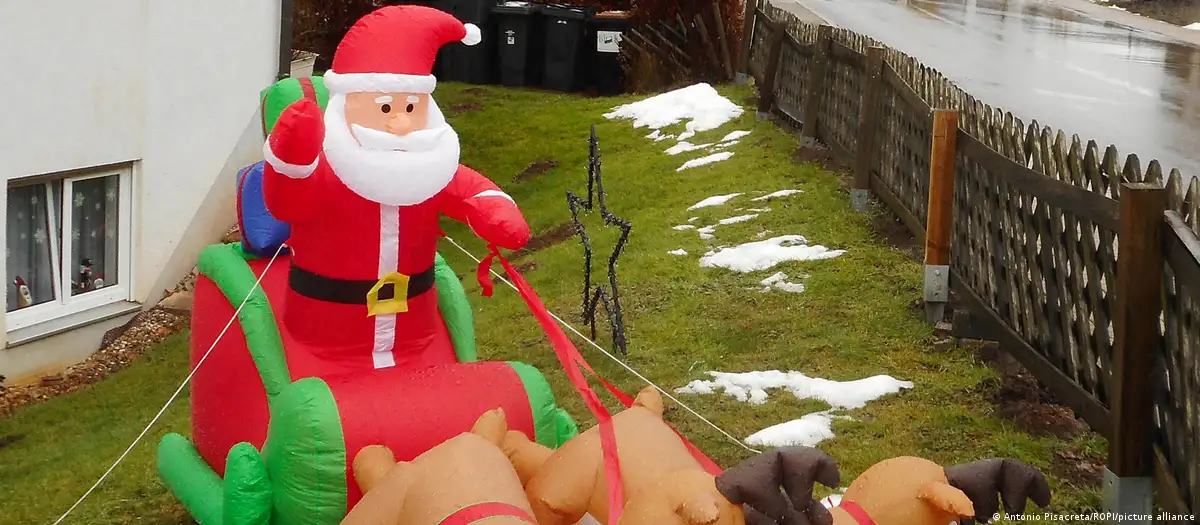
As climate change warms the planet, snowy Christmases are becoming more uncertain in Europe. The tourism sector has already adapted.
Everywhere in the world, Christmas decorations are full of references to ice and snow. Traditionally, the streets in cold countries are dressed in white at this time.
Lights shaped like icicles illuminate pine trees, and white fabrics decorate shop windows. Even the baby Jesus is bundled up for a cold, snowy night in a manger that, incongruously, would be in the Middle East.
And even in Brazil or in countries like Australia and New Zealand, where the date falls in summer and is often celebrated with a barbecue on the beach, the association between Christmas, snow and cold is omnipresent, with the help of colonization, capitalism and plastic decorations.
But now, as climate change warms the planet, snowy Christmases are becoming more uncertain in Europe, and some effects of this are already noticeable.
Missing the snow
In Sweden, the idea of a “real” Nordic winter, with a thick blanket of snow, is seen by many as part of the national identity. But in the south of the country, snowfall has become rarer in recent decades.
Christmas decorations around the world associate the festivity with snow | Robin Utrecht/picture alliance
“Older generations have very detailed stories about what it was like to live with snow, including snow castles, sledding or skiing to school,” explains ethnographer Erika Lundell from Malmö University, who studies the cultural aspects of snow and winter.
But for younger Swedes, according to her, this is not part of everyday life. They are more used to seeing dirty, frozen snow or melting mud.
“There is an extremely strong idea in this part of the world that there needs to be snow for Christmas to be perfect.” Most say they “miss the snow”, that classic winter popularized by centuries of songs, stories and images.
“Huge” cultural loss
Europe, the fastest-warming continent in the world, has seen a decline in the average number of snowy days over the past 40 years. Two of the warmest winters on record have occurred in the last five years.
In North America, traditionally frozen areas, such as the Great Lakes region, on the border between the United States and Canada, are also experiencing a melting process. The relatively mild winter of 2020, for example, saw very little ice over inland seas, which normally have around 40% of their surface frozen.
“Culturally this loss will be a huge shock,” says tourism and sustainability researcher Colin Michael Hall, from Massey Business School, in New Zealand. For him, this absence will be felt particularly intensely in places like Rovaniemi, the self-proclaimed “official hometown of Santa Claus”, in northern Finland.
Visitors to the city expect the complete package: sleigh rides, the good old man and, of course, fun in the snow. But climate change is affecting the “imagined Christmas country.”
“In terms of the number of visitors, Christmas is the peak for Rovaniemi,” he says. “That’s how they positioned themselves for many years, that’s how they stuck in people’s imagination. And it’s very difficult to move away from that.”
Adapted tourism
Travel agencies that organize Christmas and winter tours in northern Europe have already adapted some activities and are forced to be more transparent with customers about what to expect.
“15 years ago, we relied heavily on traditional images of snow-covered landscapes, which reflected what travelers expected at that time,” a spokesperson for a company in Iceland told DW. “Almost all of our tours included winter activities such as dog sledding, reindeer sledding, snowmobiling and glacier experiences.”
Today, given the lack of snow, suppliers have started using huskies sleds with wheels. Santa Claus Village in Rovaniemi remains open all year round, with the good old man welcoming visitors come shine, rain or snow.
“The iconography is there, and this will clearly be with us for a long time,” says Hall. For tour operators, this also means offering tours that value other “local cultural experiences” and celebrating the New Year with bonfires and fireworks.
Lundell predicts that perhaps the emphasis on snow and cold will turn to another important symbol of the season: the interplay between light and dark. “Perhaps in the future winter will be known more as the dark season than the cold season.”
Originally published by DW on 12/20/2025
By Martin Kuebler
Source: https://www.ocafezinho.com/2025/12/21/como-invernos-com-menos-neve-afetam-o-natal-na-europa/