New safeguards to protect European agricultural producers were not enough to obtain the minimum support needed. Possible approval of the agreement was scheduled for January.
Farmers achieved a victory over the European Union (EU) industry and managed this week to postpone the signing of the free trade agreement with Mercosur, which was scheduled to take place on Saturday (20/12) in Foz do Iguaçu.
This week was considered decisive for the signing of the agreement, negotiated almost three decades ago. The president of the European Commission, Ursula von der Leyen, and the president of the EU Council, Antonio Costa, had planned to travel to Foz do Iguaçu, where a Mercosur summit is taking place, to sign the text – if there was the necessary majority in the European bloc.
But this majority was not guaranteed after Italy stated that it would not approve the text, as it understood that a proposal to create extra safeguards for European agricultural producers needed clarification and confirmation. Together with France, Poland and Austria, which are against the agreement, a sufficient quorum was formed to block the text.
President Luiz Inácio Lula da Silva, who on Wednesday had said that Brazil would no longer support the signing of the agreement during his government if it was not closed on Saturday, spoke with Italian Prime Minister Giorgia Meloni this Thursday and said that she had asked for more “at most a month” to try to convince Italian agricultural producers – and the Brazilian agreed.
The Minister of Finance, Fernando Haddad, also supported the postponement. “Some European countries need more time (…) To clarify this [o acordo] for public opinion, for rural producers. I think that maybe, if it’s a short time, it will be possible to wait”, he said.
Agreement balance at risk
To try to convince farmers from countries opposed to the agreement, the EU this week defined a proposal for extra safeguards to protect them, which are not included in the text of the agreement negotiated with Mercosur – which could give rise to retaliation from South American countries in the future.
These safeguards establish that, if imports of some sensitive products from Mercosur countries, such as beef and chicken, grow by more than 8% in EU countries or prices fall by more than 8% below the three-year average, the European Commission can open an investigation and suspend tariff preferences for these products.
This investigation must be completed within three months for sensitive products, and precautionary measures may be announced 21 days after notification.
The creation of these safeguards was not well received by members of the Brazilian government, but the desire to close the agreement and, later, discuss possible retaliations prevailed.
The Minister of Foreign Affairs, Mauro Vieira, stated this Thursday that, if the agreement is signed, Mercosur countries will also be able to define similar safeguards policies – for example, to protect the automotive sector.
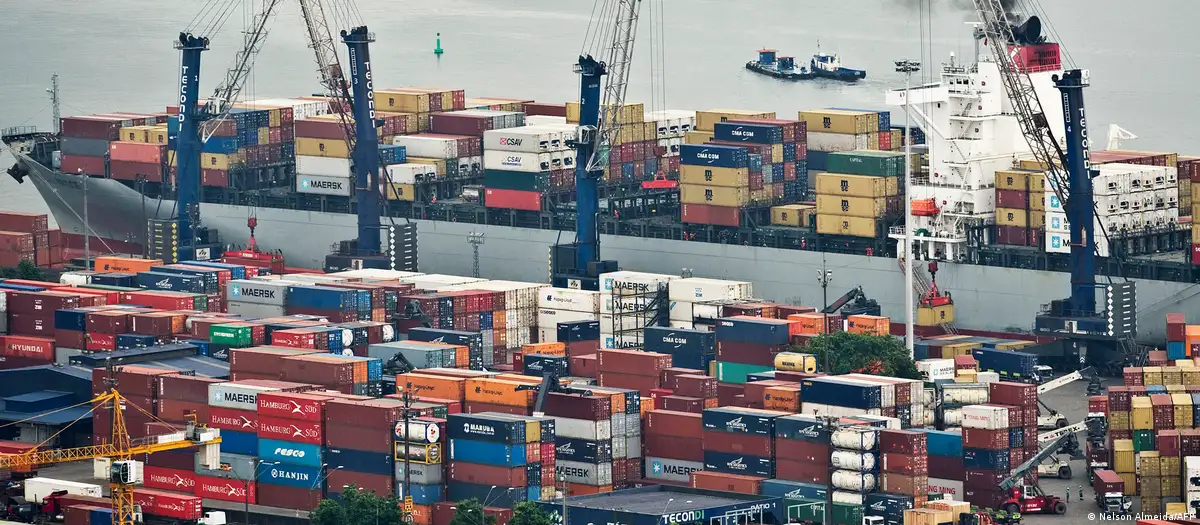
The agreement negotiated between the two blocs already contains significant restrictions on the export of beef and chicken from Mercosur. According to a projection by the European Commission, the text would limit these Mercosur items with reduced tariffs to 1.5% and 1.3% of the European market, respectively.
France is pushing for even more protections for the agricultural sector, such as a reciprocity obligation on agricultural production rules.
Division between EU countries
One of the biggest supporters in the EU of the agreement with Mercosur is Germany, which sees it as an opportunity to expand the export of industrialized goods.
On Wednesday, Sepp Müller, deputy parliamentary leader of the Christian Democratic Union (CDU), the party of Federal Chancellor Friedrich Merz, hinted that, without the agreement with Mercosur, there would be less German money to support the ambitions of the EU itself, which seeks greater autonomy in relation to the US and to strengthen itself militarily. Germany accounts for almost a quarter of EU budget funding.
“Germany is an exporting nation, from which, by the way, all other EU countries also benefit (…). If Germany does not return to being a strong exporting nation, then we will not have the capacity, economically and financially, to bear any additional burdens for an ever-increasing multi-year financial framework,” said Müller.
On the other side is France, mired in a budget crisis. President Emmanuel Macron once again stated this Thursday that the agreement “cannot be signed” and that his country will do everything possible to block it.
Meloni did not rule out supporting the text, but said that the safeguard proposals still need to be approved by the European Parliament and the European Council, and that it would be necessary to wait for this process to be finalized before signing the agreement.
“All these measures, although they have been presented, have not yet been fully completed. Therefore, we believe that signing the agreement in the next few days, as has been suggested, is still premature,” she said.
The EU’s largest industry confederation, BusinessEurope, criticized the decision to postpone the vote on the agreement, which it considers “vital” for the bloc’s economic and political interests. “We urge all parties to quickly agree on a signature date that will finally allow the ratification process to move forward. The EU’s credibility is at stake as a reliable trading partner,” its director general, Markus Beyrer, told the Financial Times newspaper.
Geopolitical aspect
The main objective of the agreement is to expand trade exchanges between the EU and Mercosur, but it has taken on a growing geopolitical aspect in a context of rapid global transformations, including the Donald Trump administration in the USA, which challenges a rules-based world order and increased trade tariffs, and the growth of China, which is already Brazil’s largest trading partner.
This angle was highlighted this week by Lula: “The concrete fact is that we, from Brazil, and we, from Mercosur, worked hard to accept this agreement and pass on an idea at a time when you have a president of the United States wanting to weaken multilateralism and strengthen unilateralism.”
And also by Haddad: “What is at stake is much more than a trade agreement, it is an agreement of a political nature, with a clear signal to the world that we could not return to an environment of tension between two closed blocs”.
Both the EU and Mercosur are made up of democratic countries. Together, they have 721 million inhabitants and a combined Gross Domestic Product (GDP) of around 22 trillion dollars.
Originally published by DW on 12/19/2025
By Bruno Lupion
Source: https://www.ocafezinho.com/2025/12/19/ue-endurece-acordo-com-mercosul-e-nao-garante-assinatura/