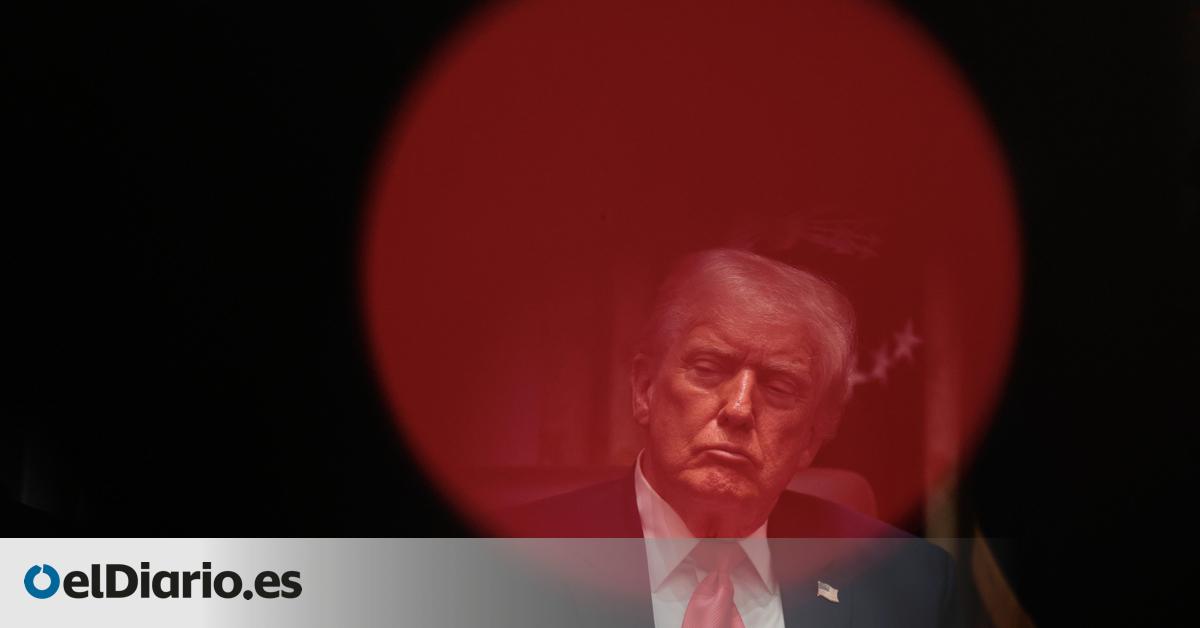
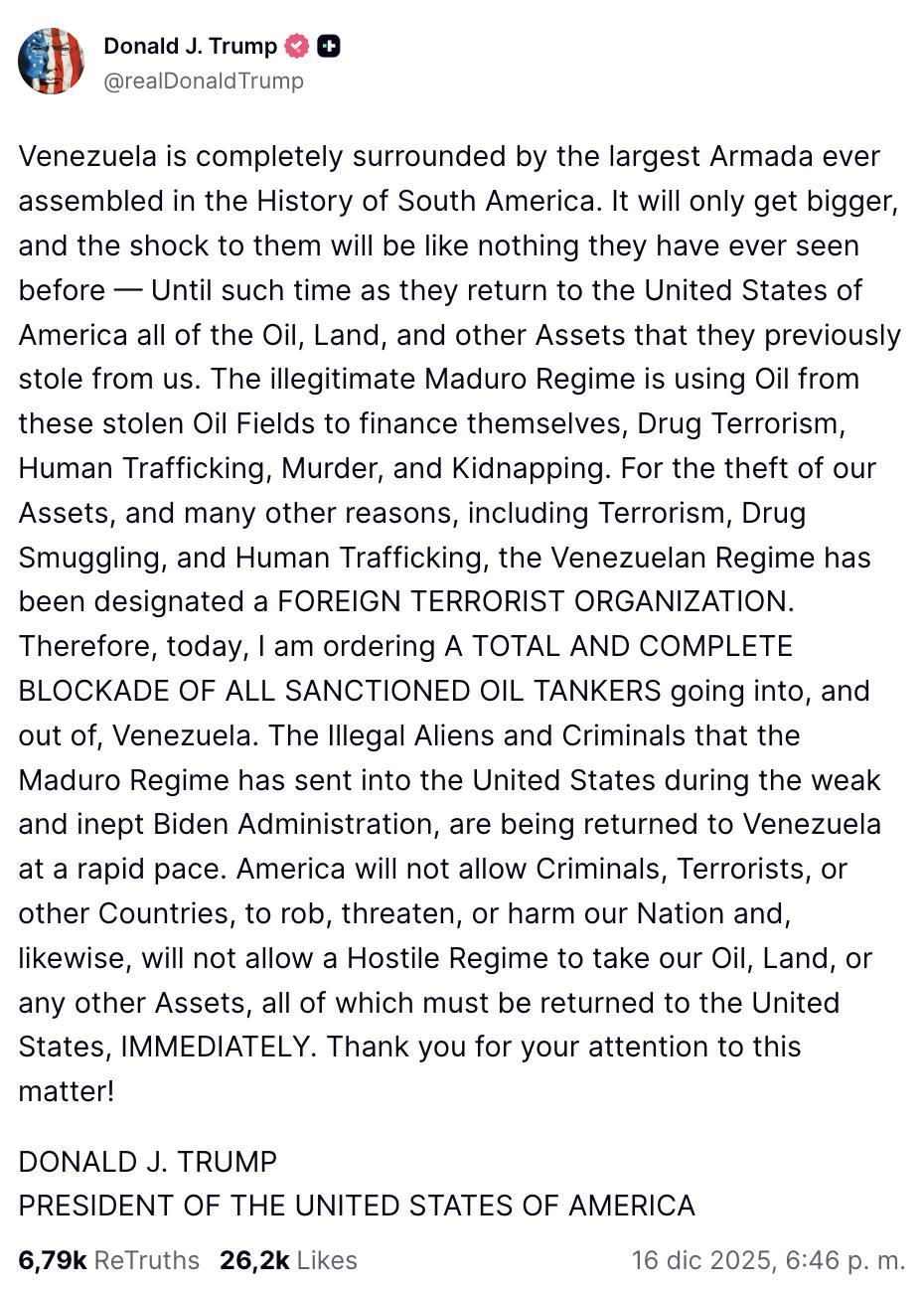
“Venezuela is completely surrounded by the largest Navy ever assembled in the history of South America.” It is the message from the US president published this Tuesday night. Indeed, Donald Trump is redoubling the siege of Venezuela by tightening the blockade of its main industry and means of income and subsistence: oil. An oil that is also essential for the country to continue functioning and for there to be gasoline with which to move people, goods and food.
Oil currently accounts for about 88% of Venezuela’s $24 billion in export revenue, and each tanker seized would erode the revenue needed to import food and medicine, according to The New York Times. Products linked to oil production, such as petrochemicals, account for much of the rest.
Thus, an abrupt drop in oil revenues could trigger a recession and, therefore, food shortages for the population that could translate into famine.
“This Navy,” Trump has said, “will continue to grow, and the impact on them will be like nothing they have seen before.” And he adds: “Until they return to the United States of America all the oil, land and other assets that were stolen from us.”
Of course, Trump does not explain what oil, assets and territories Trump is referring to, nor does he provide evidence of this alleged theft.
“The illegitimate Maduro regime is using the oil from these stolen fields for financing, as well as narcoterrorism, human trafficking, murder and kidnapping,” Trump continued: “For the theft of our assets and for many other reasons, including terrorism, drug trafficking and human trafficking, the Venezuelan regime has been designated a foreign terrorist organization. Therefore, today I order a total and complete blockade of all sanctioned oil tankers [por EEUU] who enter or leave Venezuela.”
What Trump does not explain either is what legal basis the US has to prevent ships sanctioned by Washington from sailing through international or Venezuelan waters.
The Government of Venezuela has responded in a statement to Trump’s announcement: “On his social networks, he assumes that the oil, land and mining wealth of Venezuela are his property. And consequently, Venezuela must hand over all its wealth to him immediately. The president of the United States intends to impose in an absolutely irrational manner a supposed naval military blockade on Venezuela with the aim of stealing the wealth that belongs to our homeland.”
And he adds: “Immediately, our ambassador to the UN will proceed to denounce this serious violation of International Law against Venezuela. […] “This extravagant threat that once again reveals Donald Trump’s true intentions to steal the country’s wealth.”
Maduro rejects US “psychological terrorism”
The Venezuelan leader, Nicolás Maduro, pointed out, for his part, that the country faces a “multidimensional aggression” that ranges from “psychological terrorism” to the “piracy” of the “privateers who assaulted” the Skipper oil tanker on December 10, which was transporting Venezuelan crude oil.
In this context, the president assured that Venezuela is prepared and will defeat the “oligarchy” and imperialism” in “any circumstance.”
“We have shown that we are prepared to continue our march. And what’s more: we are prepared to accelerate the march of a profound revolution that gives power to the people, completely and definitively, without intermediaries,” said Maduro, without offering more details.
According to Trump, “illegal immigrants and criminals that the Maduro regime has sent to the United States during the weak and inept Biden Administration are being returned to Venezuela at an accelerated pace. The United States will not allow criminals, terrorists or other countries to steal, threaten or harm our nation and, likewise, will not allow a hostile regime to seize our oil, land or any other assets, which must be returned to the United States immediately.”
The US Congress reacts to Trump
“A naval blockade is, without a doubt, an act of war,” said Democratic Representative Joaquín Castro (Texas): “A war that Congress never authorized and that the American people do not want. On Thursday, the House of Representatives will vote on the resolution by Representatives Jim McGovern, Thomas Massie and myself, which orders the president to end hostilities with Venezuela. Each member of the House of Representatives will have the opportunity to decide whether they support sending Americans to another war to overthrow a regime. ”
In this context, there are two resolutions on war powers, to prevent Trump from launching a unilateral attack against Venezuela, ready to be voted on this week in the House of Representatives before the Christmas recess –resolution 61 and resolution 64–.
The resolutions to end Trump’s campaign against Venezuela are promoted by the highest-ranking Democrats on the Foreign Affairs and Rules Committees of the US House of Representatives, Gregory Meeks (New York) and Jim McGovern (Massachusetts).
The United Nations High Commissioner for Human Rights, Volker Türk, stated this Tuesday in a statement prior to Trump’s announcement about the US sanctions: “I would like to reiterate the disproportionate impact that widespread sanctions have on the most vulnerable people, as well as their adverse effects on the work of some human rights and humanitarian organizations. I urge that the sanctions be reassessed and lifted.”
Francisco Rodríguez, Venezuelan researcher at the University of Denver, author of The collapse of Venezuela (2025, University of Notre Dame Press) and CEPR analyst, recalls that “this is the first time that the US has seized a Venezuelan oil tanker. If the US begins to do it systematically, this would essentially imply a naval blockade, because it is enough for the US to do this enough times for potential buyers of Venezuelan oil to decide not to take this risk. This is an important deterrent action. US sanctions have made it very difficult for Venezuela to use registered tankers. There is no valid legal prohibition in international law that Venezuela sells oil to other countries that are not the United States. What happens is that since the United States has a lot of economic power to dissuade other actors from interacting with Venezuela, the United States uses it. This is something called the threat of secondary sanctions. That is why it is often difficult for Venezuela to obtain oil tankers that are properly registered to load its oil.
Some experts claim that Trump’s threat to seize more Venezuelan oil tankers may violate international law and point out that UNCLOS (United Nations Convention on the Law of the Sea), which prohibits seizures of foreign ships without prior authorization from the flag State – that is, the State under whose flag the ship is registered and sails – except in exceptional circumstances such as piracy (Article 105, which would not be applicable in this case), the slave trade (Article 99, which neither) or unauthorized broadcasting (article 109, also inapplicable). The ship seized on Friday was without a flag, according to the US.
Last Thursday, the US announced sanctions for the following oil companies: Myra Marine Limited, registered in the Marshall Islands, owns and manages the vessel White Crane; Arctic Voyager Incorporated, registered in the Marshall Islands, is the registered owner of the Panama-flagged vessel Kiara M.; Poweroy Investment Limited, registered in the British Virgin Islands, is the registered owner of the Panama-flagged vessel H. Constance; Ready Great Limited, registered in the Marshall Islands, is the registered owner of the Panama-flagged vessel Lattafa; Sino Marine Services Limited, registered in the United Kingdom, is the manager and operator of the Hong Kong-flagged vessel Tamia; Full Happy Limited, registered in the Marshall Islands, is the registered owner and operator of the Cook Islands-flagged vessel Monique.
Source: www.eldiario.es