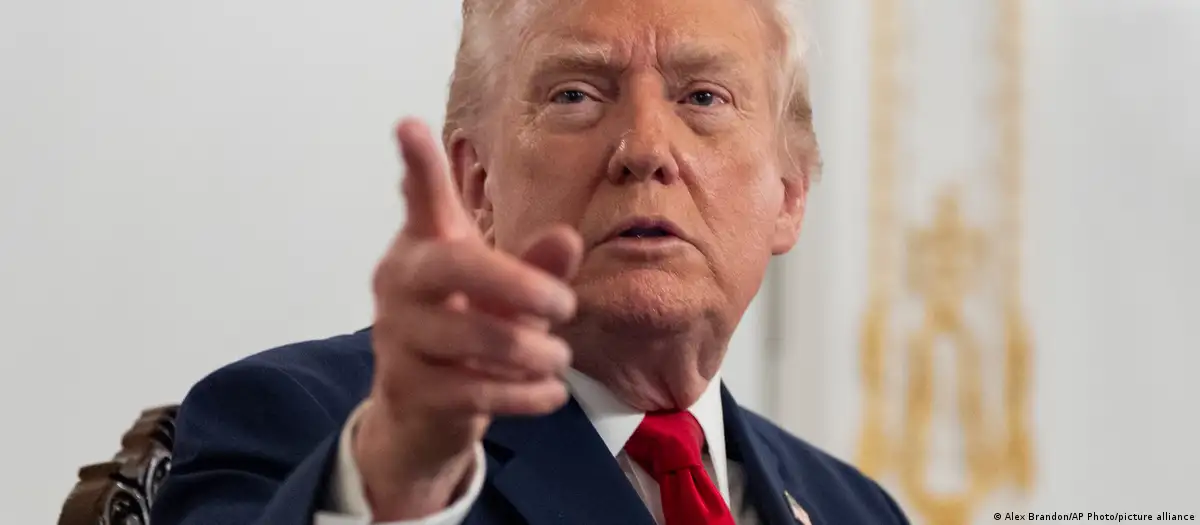
US President has openly supported ideological allies in other nations. While actions are more subtle in allied countries, such as Germany and Israel, the White House’s hand hangs heavier over Latin America.
The United States has a long history of political interventions in other countries, dating back decades.
Between 1947 and 1989 alone, a period that coincides with the Cold War, the White House tried to change the governments of other countries 72 times – six of them openly –, according to an analysis by political scientist Lindsey A. O’Rourke, from Boston College, published in The Washington Post.
Another political scientist, Dov Levin, counted in a book published in 2021 more than 80 interventions since the end of the Second World War – more than any other country, even Russia.
But no president in modern American history has attempted to interfere so brazenly with foreign governments as Donald Trump. The Republican leader has openly supported his ultra-right allies in other countries, and frequently uses posts on his own social network, Truth Social.
In a more recent example of this, Trump threatened “consequences” for Honduras if the candidate he supports, conservative Nasry “Tito” Asfura, of the National Party, does not win.
Nasry Asfura, Honduran presidential candidate supported by Trump | Leonel Estrada/Reuters
The case of Honduras: war on ‘narcocommunism’, pardon for an illustrious drug trafficker?
Trump defines Asfura as “the only true friend of freedom” against “narco-communism”. His victory, he assures, would guarantee “a lot of support” from the White House for the country plagued by poverty and the migration of Hondurans abroad in search of a better life.
The country went to the polls last Sunday (11/30), and the results are being counted slowly. With 57% of the votes counted so far, Asfura appears in a technical tie with Salvador Nasralla, from the Liberal Party, with an advantage of just over 500 votes.
The winner of the election will be the candidate who obtains the highest number of votes, as the Honduran electoral system does not provide for a second round contest.
In a message published on his official Truth Social account, Trump stated that “Honduras is trying to change the results” and warned that “there will be consequences” if that happens. “Democracy must prevail!”, he warned, claiming that the will expressed by voters “in overwhelming numbers” must be respected.
Despite Trump’s warnings against an alleged “narco-communist” threat to Honduras, Washington’s support, just days before the elections, came along with the nod to a possible pardon for an illustrious Honduran drug trafficker convicted by American justice: former president Juan Orlando Hernández (2014-2022), a co-defendant of Asfura who received a 45-year prison sentence for, in the words of The New York Times, having “flooded the US with cocaine.”
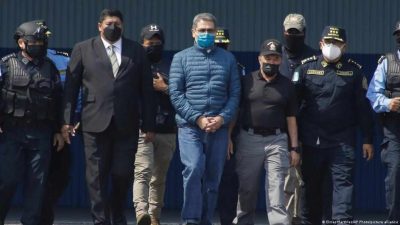 Former Honduran President Juan Orlando Hernández upon being extradited to the US in April 2022 to serve his sentence | Elmer Martinez/AP Photo/picture alliance
This Monday (02/12), Hernández’s wife, Ana García, announced on social media that he was in fact pardoned and released.
“After almost four years of pain, waiting and difficult trials, my husband is once again a free man, thanks to the presidential pardon granted by resident Donald Trump”, celebrated Ana García.
“I can’t think of a time when an American president has been willing to openly declare his preferences in a foreign election in this way, at least in modern history,” said jurist and international relations expert Thomas Carothers, from the American think tank Carnegie Endowment for International Peace, to the AFP news agency.
Other examples from Latin America
Trump appears to feel especially comfortable declaring his policy preferences regarding other countries in Latin America, where the White House’s record of interventions is particularly vast.
Colombia, for example, presided over by the leftist Gustavo Petro – an outspoken Trump antagonist – was punished in October by the White House with a million-dollar cut in funding for the fight against drug trafficking after Petro criticized the US for deadly attacks on vessels in the Caribbean and the Pacific allegedly in the service of drug trafficking.
Petro was called a “lunatic” by the head of American diplomacy, Marco Rubio, and a “drug baron” by Trump.
In Brazil, Washington retaliated against Federal Supreme Court minister Alexandre de Moraes, imposing sanctions on him for having put former president Jair Bolsonaro on trial for an attempted coup d’état, in addition to a 40% surcharge on Brazilian exports. At the time, Trump declared that Bolsonaro was the target of a “witch hunt”.
Eventually, Trump ended up changing his tune and walking back the tariffs. But the pressure put Brazil in a tight spot.
To Argentina, governed by the ultra-rightist Javier Milei, Trump signaled billions of dollars in financial aid before the legislative elections. Of this amount, 20 billion were formalized after a favorable result for Milei in the election. “He [Milei] There was a lot of help from us. He had a lot of help. I gave him a guarantee, a very strong guarantee,” Trump said after the Argentine election.
“[A] unprecedented intervention [de Trump] in Argentine politics and economy was fundamental to sustaining the government’s electoral aspirations [Milei]”, social scientist Nicolás Welschinger summarized at the time in an interview with DW.
Venezuela is currently surrounded by a massive American military contingent in the Caribbean – which includes the largest aircraft carrier in the world –, supposedly intended to combat “narco-terrorists” in the region.
In recent months, the US has increased pressure on Nicolás Maduro’s regime, stating that his government is illegitimate and associating it with drug cartels and terrorism, in what observers see as a justification to legitimize a possible American intervention in the country.
“It is a consistent attempt to influence politically, reinforce what I think they [EUA] see it as a shift to the right that is already gaining strength in the region [América Latina]”, analyzed researcher Will Freeman, from the Council on Foreign Relations think tank, in an interview with AFP.
Interference attempts also in Europe
Trump has also tried to interfere in governments on the Old Continent.
Sometimes, this occurs in a more subtle and indirect way, as in the case of Germany, which elected a new Parliament in February 2025. Visiting the country less than two weeks before the election, American Vice President JD Vance met with the leader of the ultra-right Alternative for Germany (AfD) party, Alice Weidel, and spoke, in front of European leaders, about what he sees as a distortion of the common values that would unite the USA and Europe.
On that occasion, Vance also condemned the existence of “cordons sanitaires” in politics – a clear reference to the reluctance of German politicians to allow the AfD to exercise any influence over Parliament’s decisions – and the annulment of the presidential elections in Romania on suspicion of Russian interference.
The American endorsement of the pro-Russian candidate in Romania did not do much good – Calin Georgescu, who surprised by winning the original first round that was later annulled, was barred from the new presidential race and was unable to transfer his political capital to the eurosceptic George Simion, leader of the ultra-right party Alliance for the Union of Romanians (AUR).
In Poland, however, the White House managed to secure its favorite as President, the conservative Karol Nawrocki, openly supported by the US Secretary of Homeland Security, Kristi Noem, on a visit to the country.
In the UK, Trump and his emissaries censured anti-immigration MP Nigel Farage; in France, they defended ultra-right leader Marine le Pen after she was convicted of embezzling resources from the European Parliament and prevented from running for public office.
Middle East
In Israel, where Prime Minister Benjamin Netanyahu has been balancing his position in recent years amid the war against Hamas in the Gaza Strip, Trump openly campaigned to save his ally from his problems with the justice system: he appealed to President Isaac Herzog to pardon him on corruption charges even before the trials concluded.
In Saudi Arabia, governed by ally Mohammed bin Salman, Trump spoke against foreign interventions, during a visit to the country in May, stating that American efforts in this regard in the past were disastrous. He recently defended the prince from “embarrassing” questions from journalists during his visit to the White House.
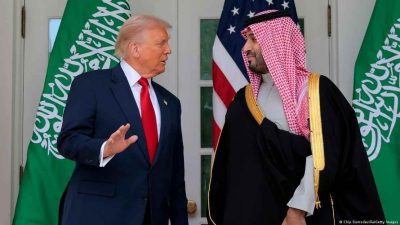 Trump came to the defense of Saudi Prime Minister Mohammed bin Salman after a journalist questioned him about the murder of Jamal Kashoggi, murdered in the Saudi consulate in Istanbul in 2018: “Things happen […]. But he [bin Salman] I didn’t know anything […]. You don’t need to embarrass our guests” | Chip Somodevilla/Getty Images
What distinguishes Trump’s interference attempts
According to international relations expert Carothers, what distinguishes Trump from other American presidents is not only his methods, but also his apparent motivations.
“It’s different from the Cold War, when the US often favored a specific person, but for geostrategic reasons,” he argued. “What we have here is more that Trump thinks he has a group of friends out there that he wants to help.”
Carothers notes that Russia acts similarly in countries that were under its influence in the Soviet era, as was the case in Romania and, more recently, Moldova – where the candidate favored by Moscow also did not prosper.
Hungarian ultra-right Prime Minister Viktor Orbán, who according to Carothers most European leaders would like to see as an outsider in the next elections, should count on Trump’s blessing in 2026. Orbán was received by the American in November at the White House, and heard praise from him.
“He did a fantastic job […]. He administered a really great country, and there is no crime, no problems, like some countries have,” Trump told reporters at the time, adding that European leaders should value their Hungarian counterpart more.
Originally published by DW on 12/02/2025
By Rayanne Azevedo with information from AFP, EFE and Reuters
Source: https://www.ocafezinho.com/2025/12/02/como-trump-vem-interferindo-na-politica-de-outros-paises/