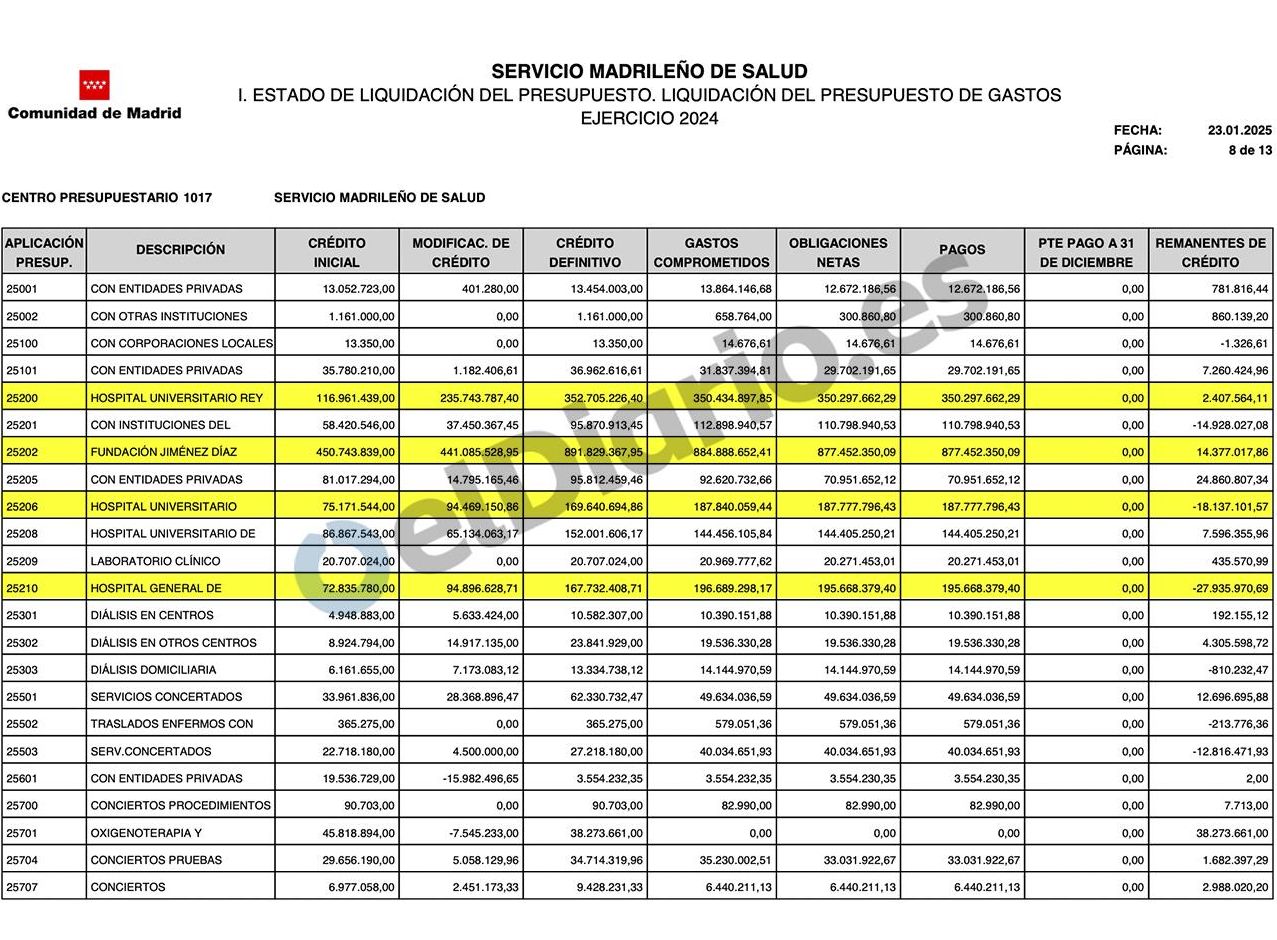
The health giant Quirón, which manages four hospitals in the Madrid public network, has experienced a spectacular increase in income from 2021 from the Government of Isabel Díaz Ayuso. The jump is so high that in the four-year period 2021-2024 the official documents on the settlement of accounts of the Madrid Health Service (SERMAS) confirm that the four Quirón hospitals have charged twice what was originally budgeted: the sum of the initial credit assigned to these centers amounted to 2,543,928,271 euros in that period, but the total of payments accounted for at the close of each of those years skyrocketed to almost the 5,000 million: exactly, 4,803,124,204 euros.
Quirón owns the Fundación Jiménez Díaz hospital in Madrid and manages three other publicly owned hospitals located in the municipalities of Móstoles (El Rey Juan Carlos), Valdemoro (Infanta Elena) and General de Collado Villalba.
The last year whose settlement of accounts is known, 2024, operates as the peak of a phenomenon whose beginning is in 2021 according to official data. So much so that the 715,712,602 euros allocated together to the four hospitals as “initial credit” (see table) was converted to a payment of 1,611,196,188 euros. That is, 125% above budget.
In the four-year period between 2016 and 2019, Quirón was already charging more than budgeted. But the difference between the numbers at the beginning and those at the end was much less relevant: the 1,693 million budgeted in total became 2,126 million, which means an increase of 433 million. Between the two four-year periods (2016-2019 and 2021-2024) there is an exceptional year: 2020, the year of the pandemic.
And precisely that year, the one in which COVID-19 collapsed the hospitals and ended in the Madrid nursing homes with 7,291 lives of infected people who were not referred to any hospital center, Quirón received less from the Madrid health system: for its four hospitals the accounts of the Community of Madrid had reserved 609,405,223 euros, but the payments were reduced to 504,379,292 euros.
By hospitals, the initial budget and the amount paid throughout the four-year period according to the successive documents of “Liquidation of the expenditure budget” of the SERMAS are as follows: Hospital Fundación Jiménez Díaz, 1,566 million budgeted and 2,741 million paid; King Juan Carlos, 460 million assigned and 1,023 paid; Infanta Elena, 240 million initial credit and 519 satisfied; and Villalba General Hospital, 276 million budgeted and 518 paid.
Neither the Madrid Government – whose spokespersons were sent an Excel with the data of each official settlement on Thursday last week – nor Quirón have answered elDiario.es’ questions about what factors explain a disparity of such magnitude. Although the dance of successive credit modifications approved throughout each year makes it materially impossible to know the specific causes of such multi-million dollar extra costs, the continuous message of the regional Executive is summarized in two words: “Free choice.”
And thus, the “free choice” of the more than seven million residents in Madrid to “decide” which hospital to go to would constitute the main cause of the enormous growth of the money transferred to the group. The increase in waiting times due to lack of resources in purely public hospitals continues to increase the list of patients treated by Jiménez Díaz, King Juan Carlos of Móstoles, Infanta Elena de Valdemoro and General de Villalba. In fact, as elDiario.es revealed, Quirón has multiplied by six the patients it attracts from public health in a decade.
The entry of each patient from outside the geographical area assigned to the four Quirón hospitals translates into an increase in profit for the company by virtue of the agreements that govern the relationship of the Community of Madrid with this authentic healthcare giant, a conglomerate originally called Capio and now dominated by the German multinational Fresenius.
The opposition speaks of “free induction”
Socialist sources remember how in the plenary session where the relationship between SERMAS and Quirón was addressed, its vice spokesperson, Fernando Fernández de Lara, alluded to the progressive success of “public-private collaboration” hospitals with a statement: that one thing is free choice and another is “free induction.” Inducing citizens to “choose” hospitals in private hands and, for example, scheduling early morning MRIs, something outside the reach of publicly owned and managed centers.
Both the Más Madrid deputy Marta Carmona and the socialist Sara Bonmatí are waiting for a response to different requests for information about budget modifications and successive agreements of the Government Council that alter the initial budget assigned to the four Quirón hospitals.
Until now, the opacity of the Madrid Government regarding Quirón has allowed, for example, between 2020 and 2023, the largest hospital in the group – the Jiménez Díaz Foundation – to obtain no less than 707 million through “expense validations”, an exceptional figure that involves paying for unforeseen services without prior inspection. In other words, and reproducing the definition provided in 2018 by the current mayor of Madrid and then head of the opposition, José Luis Martínez Almeida, validation is “that award that is made directly, by hand, without any type of public competition as a consequence of prior poor management by the Government team.”
Additionally, eight rulings handed down by the Superior Court of Madrid (TSJM) between February 2023 and March 2024 prove that the Community of Madrid voluntarily agreed in court to the claims for late payments raised by Quirón through judicial resources, claims to which it had initially opposed. The raid, as the voluntary surrender of the defendant to the plaintiff’s claims is legally known, reported to the holding another 85 million.
This week, Más Madrid’s Health spokesperson, Marta Carmona, published an explicit message on her Quirón has a free budget: at the end of the year they are paid as much as they have spent, without saying no to anything. Meanwhile, the public has to beg the Treasury for each substitution, extra material, etc. Opening agendas like this is difficult.
From the PSOE, its Health spokesperson, Carlos Moreno fired a question in said commission to the Minister of Health, Fátima Matute, which was left unanswered: “What the hell do so many consultations, operating rooms, mammograms stop in the afternoons while thousands of Madrid residents suffer waiting for months for their long-awaited test? But many heads of service ask themselves this same thing (…). Why don’t they let me schedule activity in the afternoons if every day I respond to hundreds of complaints about delays in appointments? Why can’t my doctors extend their hours in the afternoon in public? Moreno maintains that it is “an embarrassment” that “public hospitals are not allowed to do the same.” [que los de Quirón]which prevent them from operating in the afternoons due to lack of financing. Why some yes and others no, Madam Counselor? That’s what they never explain to us.” And here he launched the final dart: “You are immersed in a path of complicity with private management.”
The counselor avoided answering the key question – why publicly managed hospitals cannot schedule certain actions in the afternoon – and focused on the star phrase of the Ayuso Government: “free choice.” “In Madrid we believe in freedom and the patient can choose the doctor in whom they trust their health,” Matute emphasized.
Vox has also come to question the disparity between initial budget and actual payment. In June, his deputy Ana Cuartero assured that “what we have is accounting engineering.” “They know perfectly well that they are going to spend more than they budget and also that they can use current spending credits for this. That is why all unfulfilled promises, such as hospital expansions, finance this deviation between what was budgeted and what was spent.”
Source: www.eldiario.es