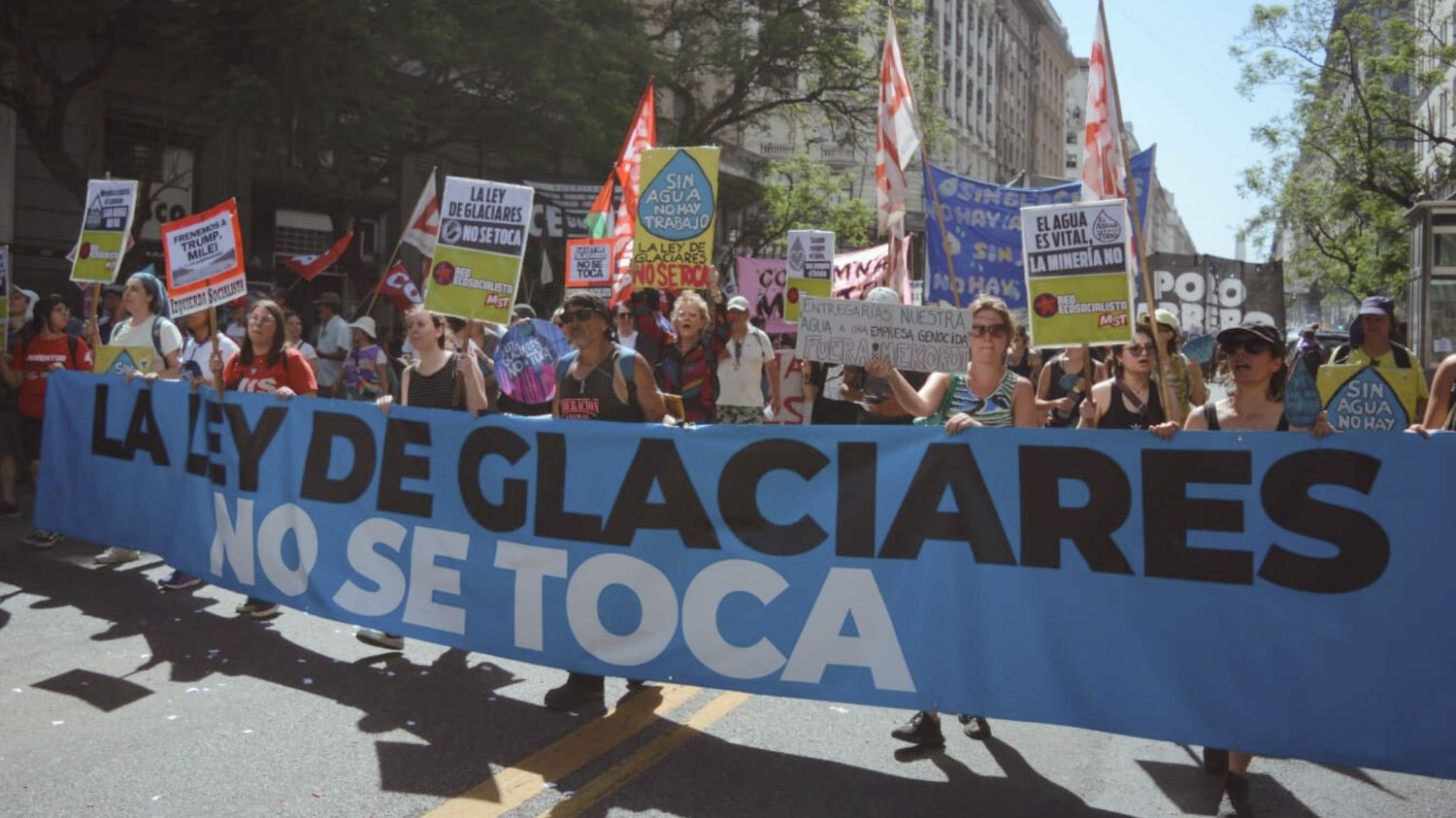
While the Milei government promotes a (counter) labor reform to eliminate the rights of workers who still have them, it also seeks to modify the Glacier Law to enable the advance of mega-mining in areas that are now protected. February 11 is confirmed as the beginning of treatment for the slave labor reform and the date to advance on the glaciers is still pending, but since last year both projects were established as part of the extraordinary measures.
That it is discussed at the same time is no coincidence, it is a comprehensive plan that combines looting of common goods, job insecurity and handing over sovereignty to transnational corporations. These are five keys to understanding why this reform cannot pass and how to confront the government and its accomplices in unity.
1. What the Glacier Law protects today and what they want to change
Law 26,639 protects glaciers and the periglacial environment as strategic water reservesprohibiting activities that could harm them, such as mega-mining, hydrocarbons and large infrastructure works.
The norm was a conquest of the popular strugglepromoted by socio-environmental assemblies, mountain communities, independent scientists and mobilizations against mega-mining.
The reform promoted by the ruling party narrows the scope of what is considered a protected environmentintroduces ambiguous criteria such as “proven water function” and enables exceptions. In fact, this would allow activities that are currently prohibited to advance over glacial and periglacial zones, legalizing what was previously illegal.
Furthermore, it grants the provinces the power to define the scope of the lawwhich contradicts the very nature of a minimum budget law, which exists precisely to guarantee common environmental protection throughout the country.
2. Who requested the modifications: the governors
The text of the project itself recognizes that it responds to requests from provinces linked to lithium, copper and mining tables in general, who want that the law stops being a legal obstacle for strategic projects. Milei has said that the original idea was Alfredo Cornejogovernor of Mendozawhich faces mobilizations against mega-mining in its province.
Governors of any political stripe share the “extractivist consensus” and the general direction of the government. For this reason, the poses are absurd when they meet. environmental catastrophes that promoteas we are seeing these days with the fire season in the south of the country.
A clear example is that of Ignacio Torresgovernor of Chubutwho promoted a press conference calling for the Igneous Emergency after the senators of his province, Edith Terenzi and Andrea Cristinavoted on the 2026 Budget, which involved a cut in the 78.5% in the items destined for the Federal Fire Management System.
Furthermore, the opinion modifying the Glacier Law came from the Senate, and among those who signed it there are representatives of Patagonian provinces that demand funds: once again Edith Terenzi (Chubut, Torres government) and Natalia Gadano (Santa Cruz, Vidal government). They should explain how they are going to put out the fires without glaciers or labor rights.
3. Who benefits: the mining companies
The reform arises from the direct claims of the mining lobby and governors who act as spokespersons for the transnationals. Among the ventures that would be enabled for advance rapidly with flexibility The following are included:
- Pascua Lam y Sailboat (Barrick Gold, one of the largest mining companies in the world, with participation in addition to partners such as Shandong Gold in Veladero).
- El Pachón (Glencore), a huge copper and other minerals project.
- The Blues (McEwen Mining), large copper deposit under development.
- Rich Water (Yamana Gold and associates), and other projects with significant mineral potential that face regulatory uncertainty due to their impacts on glaciers or periglacial environments.
Most are found in Saint Johnwith the exception only of Agua Rica which is located in Catamarca. These transnationals have pushed to weaken the law’s clear prohibitions and open the doors to “case-by-case” evaluations that allow investments to be unlocked and permits to be expedited, even when they imply irreversible environmental damage.
4. What relationship does it have with labor reform?
That the reform of the Glacier Law be voted on the same day as the labor reform is part of the government’s overall plan. Megamining is an activity capital intensivewhich generates few jobs and displaces other types of production in the territories due to the dispute over critical natural assets such as water.
This model generates few productive linkages and deepens the reprimarization of the economy. Added to that is the RIGI and an exchange scheme that encourages imports, accelerating the destruction of local industry. In this framework, the attack on labor rights, presented as “costs” to be reduced to increase a business profitability that fails to compete with the productivity of the central countries. However, this lower productivity is due to the historical investment reluctance of big businessmen – even national ones – who flee profits abroad. More benefits for extractivism and fewer rights for workers are, thus, the two sides of the same project.
5. What would be the consequences
Damage to glaciers and periglacial environment is irreversible. It is not just about environmental impact, but about compromising access to water for millions of people and aggravating the climate crisis. By enabling the advance of the mega mining On areas that are now protected, the main reserves of fresh water in the country are compromised, a common good essential for life, food production and the communities that inhabit the territories.
Glaciers are no longer protected depending on the general interest and not be subordinated to the needs of transnational corporationswhich extract resources, contaminate territories and then leak the profits abroad.
This looting of natural assets deepens to guarantee dollars destined to pay the external debtan illegitimate and illegal debt that continues to be paid with adjustment, environmental destruction and job insecurity. That is why there is never development or improvement in living conditions, because this scheme leads to more dependency, more inequality and sacrificed territories.
Added to this is that, as he himself announced Manuel Adorni When referring to the May Council resolutions, the loss of sovereignty is not limited to glaciers. The government also seeks to advance the Forest Law, Land Law and Fire Management Lawthat is, above all the legal framework that today sets limits—minimum—to the looting of common goods.
defend the Glacier Law and labor rights It is, then, a first battle to stop the entire plan of looting and adjustment. On the 11th and the days in question we have to surround Congress, demand a national strike and unite environmental and labor struggles.
Source: www.laizquierdadiario.com